Economy
Philippine inflation jumps to 7.2%, outpaces several major Asia-Pacific economies

ASM, Philippine Canadian Inquirer
October 14, 2026
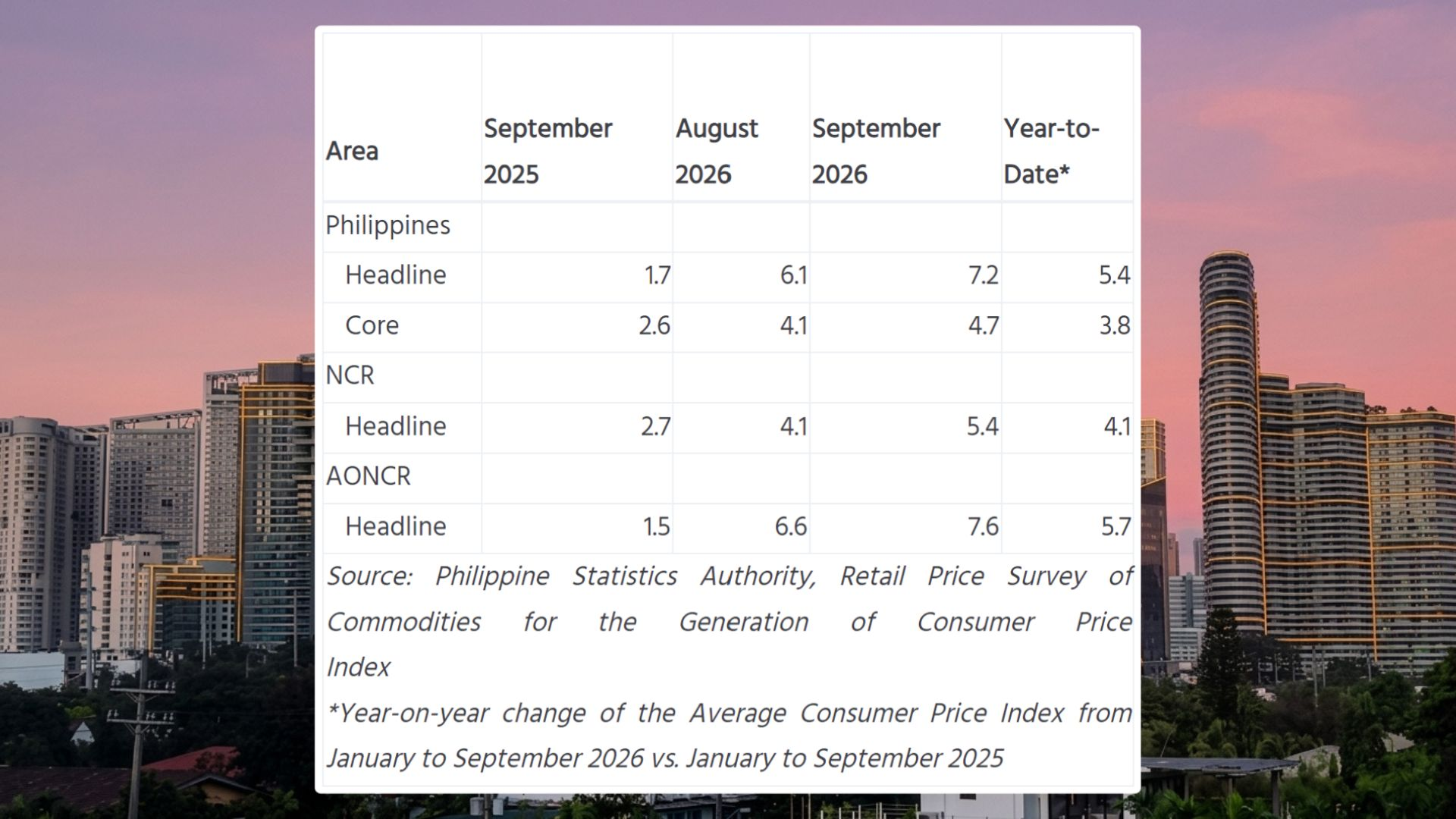
Photo courtesy: Philippine Statistics Authority
MANILA, Philippines — Inflation in the Philippines accelerated sharply to 7.2% in September 2026, putting price growth well above recent readings in several major economies across Asia and the Pacific as Filipino households faced steeper increases in food, transport and utility costs.
The Philippine Statistics Authority said headline inflation rose from 6.1% in August and was more than four times the 1.7% recorded in September 2025. Average inflation from January through September stood at 5.4%.
The September figure was also above the Philippine government’s medium-term 2% to 4% inflation target range. Government economic managers have acknowledged that inflation is expected to remain elevated in the near term, while maintaining a goal of bringing it back within the target band.
How the Philippines compares
Among major regional economies with September figures already available, the Philippines posted markedly faster consumer-price growth.
China reported 0.9% inflation in September, meaning the Philippine rate was about eight times higher – not nine times, as some circulating comparisons have claimed.
Indonesia recorded 3.28%, while South Korea posted 2.9% year-on-year inflation for the same month.
Other economies have not yet released comparable September national figures. Japan’s latest nationwide reading was 1.9% in August, while Australia reported 4.0% for the same month. Their September data are scheduled for release later in October.
In the United States, the latest official figure currently available is 3.4% for August, making the Philippine September rate more than twice as high. The U.S. Bureau of Labor Statistics is scheduled to release its September CPI later on Oct. 14 U.S. time.
Because countries release inflation figures on different schedules and use their own CPI baskets and methodologies, these comparisons should be treated as a snapshot rather than a definitive ranking of the entire Asia-Pacific region.
Food, transport and utilities drive price surge
The PSA attributed the September acceleration primarily to faster price increases in food and non-alcoholic beverages, which rose 6.7% from a year earlier.
Housing, water, electricity, gas and other fuels increased 8.4%, while transport costs surged 14.6%. Together, those three categories accounted for the majority of September’s overall inflation.
Food inflation alone accelerated to 6.8% from 4.6% in August.
Rice prices climbed 20.3% year-on-year, while vegetables, tubers, plantains, cooking bananas and pulses rose 10.7%. Fish and seafood increased 7.4%, and fruits and nuts rose 8.7%.
Core inflation, which strips out selected volatile food and energy items, also increased to 4.7% from 4.1%, indicating that price pressures were not confined to a few commodities.
Inflation was even higher outside Metro Manila. Areas outside the National Capital Region recorded an average 7.6%, compared with 5.4% in NCR. The Bangsamoro Autonomous Region in Muslim Mindanao posted the highest regional rate at 9.7%.
The latest data show that while inflation remains relatively subdued in several neighboring economies, Philippine households are currently confronting substantially faster increases in the cost of essential goods and services.