Headline
Philippines targets bigger global semiconductor share under new industry roadmap

Abi Sarabia M., Philippine Canadian Inquirer
September 04, 2026
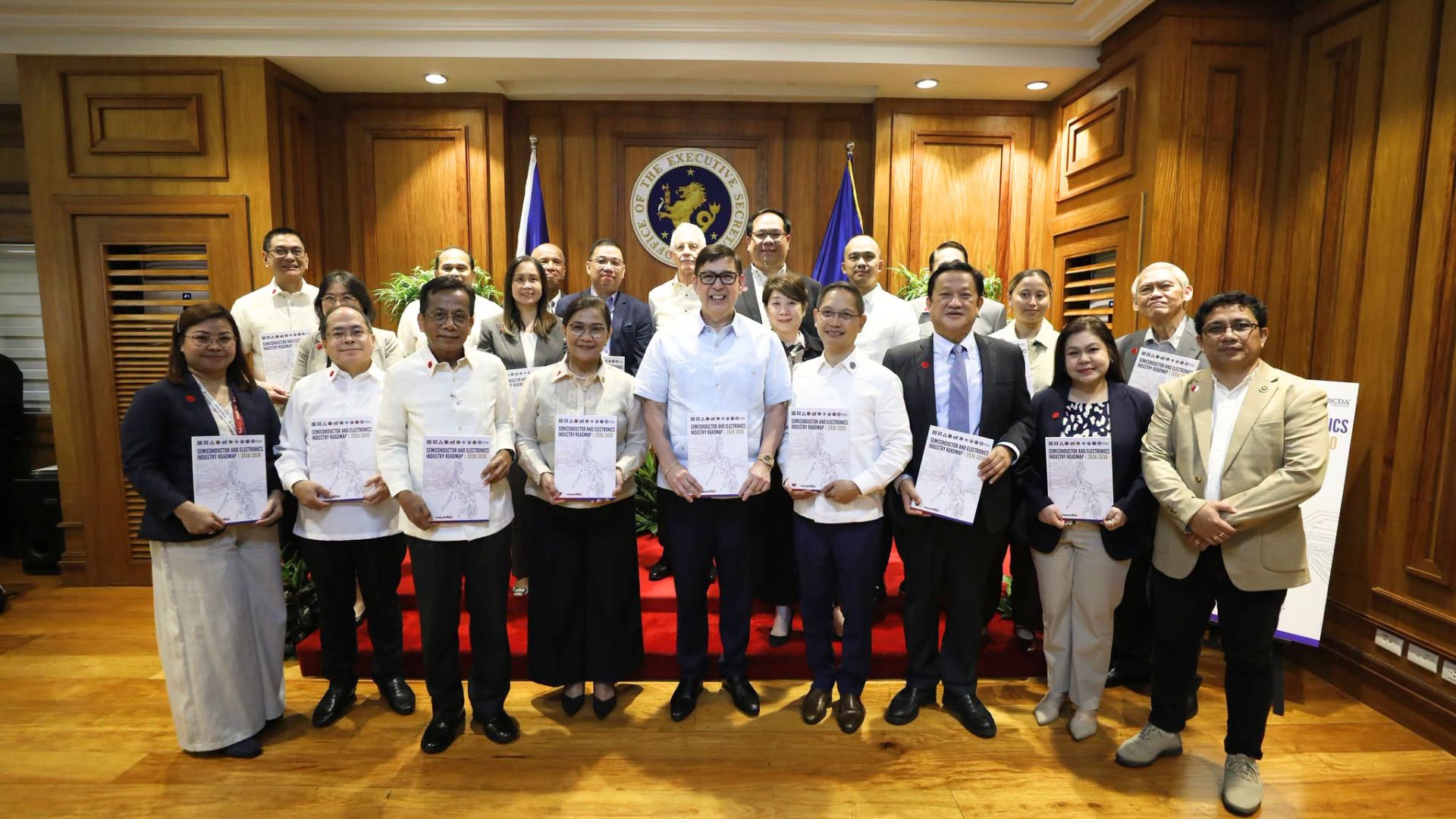
Photo courtesy: Office of the Executive Secretary
MANILA, Philippines — The Philippine government is pushing to move the country beyond semiconductor assembly and manufacturing and into higher-value activities such as chip design, engineering, research and advanced manufacturing under a new industry roadmap.
The Philippine Semiconductor and Electronics Industry Roadmap targets $110 billion in annual semiconductor and electronics exports by 2030, as the government seeks to attract more investments and create higher-paying, highly skilled jobs for Filipinos.
Executive Secretary Ralph Recto said the goal is for the Philippines to become known not only for products made in the country, but also for technology designed, engineered and innovated by Filipinos.
Under the roadmap, the government aims to increase the Philippines’ share of the global semiconductor assembly, test and packaging market from 4 percent to 7 percent.
It also seeks to capture 4 percent of the global electronics manufacturing services market and build an integrated circuit or IC design sector capable of generating $2 billion to $3 billion in annual exports.
The electronics sector is already the Philippines’ biggest export industry. In 2025, electronics exports reached a record $49.64 billion, up 16 percent from $42.75 billion in 2024.
Industry prospects have also strengthened this year. The Semiconductor and Electronics Industries in the Philippines Foundation Inc. or SEIPI recently raised its 2026 electronics export growth forecast to 10 percent, which could bring exports to around $54 billion.
Electronics exports reached $26.10 billion in the first half of 2026, up 20.7 percent from the same period last year, according to data cited by SEIPI. The group said demand related to artificial intelligence, data centers, automotive electronics and telecommunications is helping drive growth.
The roadmap, however, is designed to push the country further up the semiconductor value chain.
Among its priorities are advanced packaging, IC design, research and development and, eventually, front-end semiconductor manufacturing. The government and industry are also working on plans for specialized national laboratories and local wafer fabrication capabilities.
A five-year workforce plan also aims to train and upskill around 128,000 semiconductor professionals to address the industry’s growing need for engineers and highly skilled workers.
Recto said the government must also address barriers that could hold back investment, including shortages of skilled workers, power and water constraints, logistics problems, lengthy permitting processes and regulatory bottlenecks.
The semiconductor sector is also expected to play a major role in the Luzon Economic Corridor, which aims to strengthen infrastructure, manufacturing and logistics connections between Subic, Clark, Manila and Batangas.
Recto said the roadmap should ultimately be measured by actual investments, jobs and industry expansion rather than by plans alone.