Headline
Humanoid robot clocks 8.64-second 100m as China’s ‘Robot Olympics’ showcase rapid advances

Abi Sarabia M., Philippine Canadian Inquirer
September 01, 2026
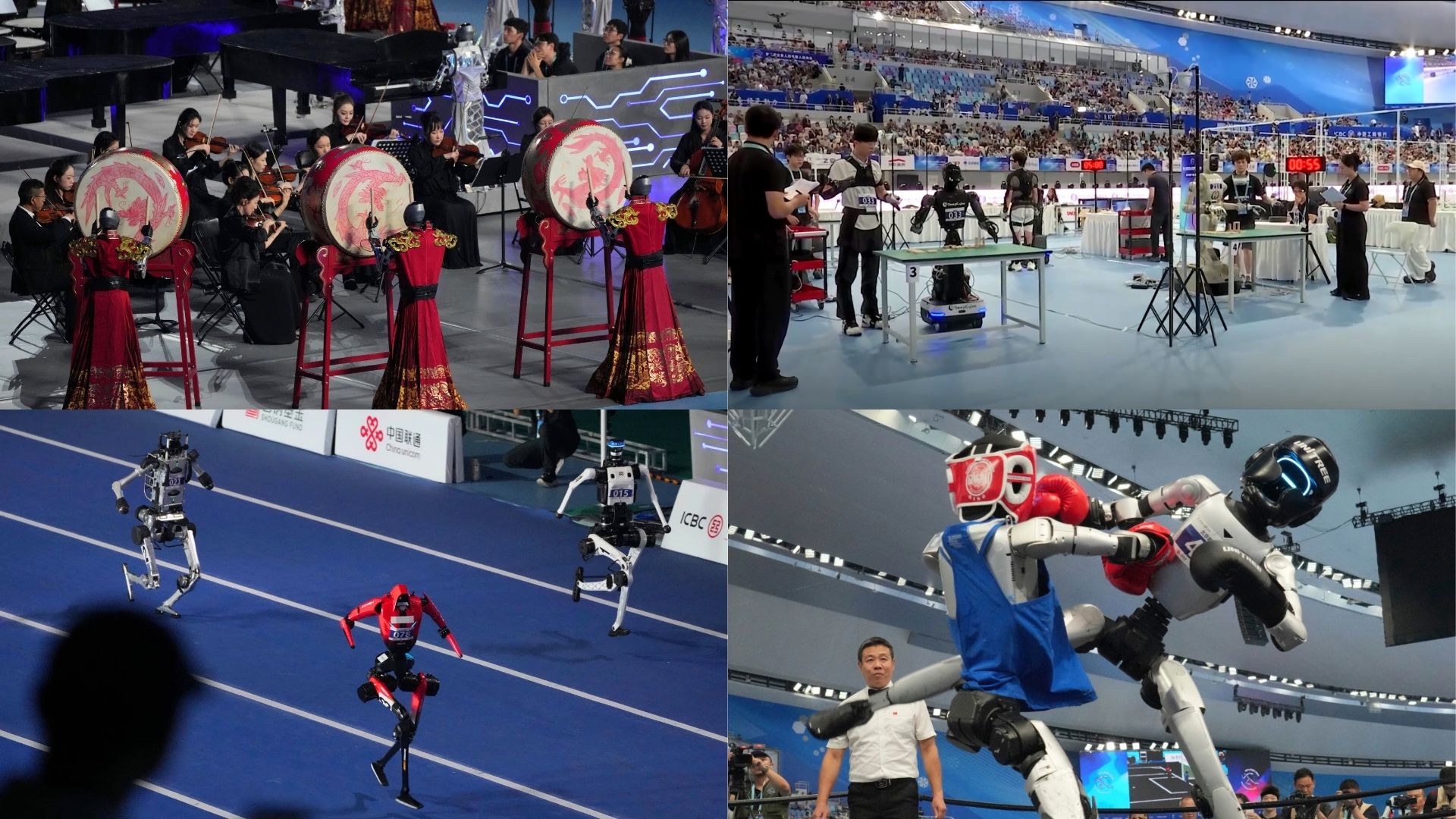
Photo courtesy: Different Sources
BEIJING, China — Humanoid robots ran, jumped, boxed, played football and tackled real-world tasks as China’s second World Humanoid Robot Games wrapped up in Beijing, offering a glimpse at both the rapid progress and remaining limitations of humanoid technology.
The five-day competition, held from August 22 to 26 at Beijing’s National Speed Skating Oval, brought together 666 teams and 2,056 robots from 16 countries. Robots competed across 51 events ranging from athletics and combat sports to emergency response, hotel services and precision tasks.
One of the biggest highlights came in the large-size robot 100-meter final, where Tiangong Ultra, developed by the Beijing Humanoid Robot Innovation Center, crossed the finish line in 8.64 seconds.
The robot had steadily improved during the competition, recording 9.39 seconds earlier in the Games before lowering its time to 8.86 seconds and eventually 8.64 seconds in the final.
For comparison, Jamaican sprint legend Usain Bolt holds the men’s 100-meter world record of 9.58 seconds. While robot races and human athletics are not directly comparable because of differences in mechanics and competition rules, the result demonstrated how quickly humanoid machines are improving in speed, balance and motion control.
Major improvements were also recorded in other events. The Games’ large-size robot 400-meter record fell to 38.15 seconds, while the standing high jump reached 3.40 meters. The 1,500-meter record also improved dramatically, dropping from 6 minutes and 34.40 seconds in the previous Games to 2 minutes and 21.64 seconds this year.
But the Games were not all record-breaking performances.
Videos of robots crashing, falling over, colliding and struggling to stop after races circulated widely online, showing that humanoid robotics still faces significant challenges in stability, reliability and autonomous operation.
Organizers also placed greater emphasis this year on practical applications. Robots were tested in scenarios involving factories, hotels, emergency response and household environments, as well as precision tasks such as tightening screws, opening packages and picking up small objects.
The competitions were designed to test more than raw speed or strength, highlighting the industry’s push to move humanoid robots from controlled demonstrations toward machines capable of performing useful tasks in workplaces and everyday environments.
The spectacle showed just how far humanoid robotics has advanced in a year, but the crashes and difficult real-world challenges also made clear how much work remains before such machines can reliably operate alongside people.