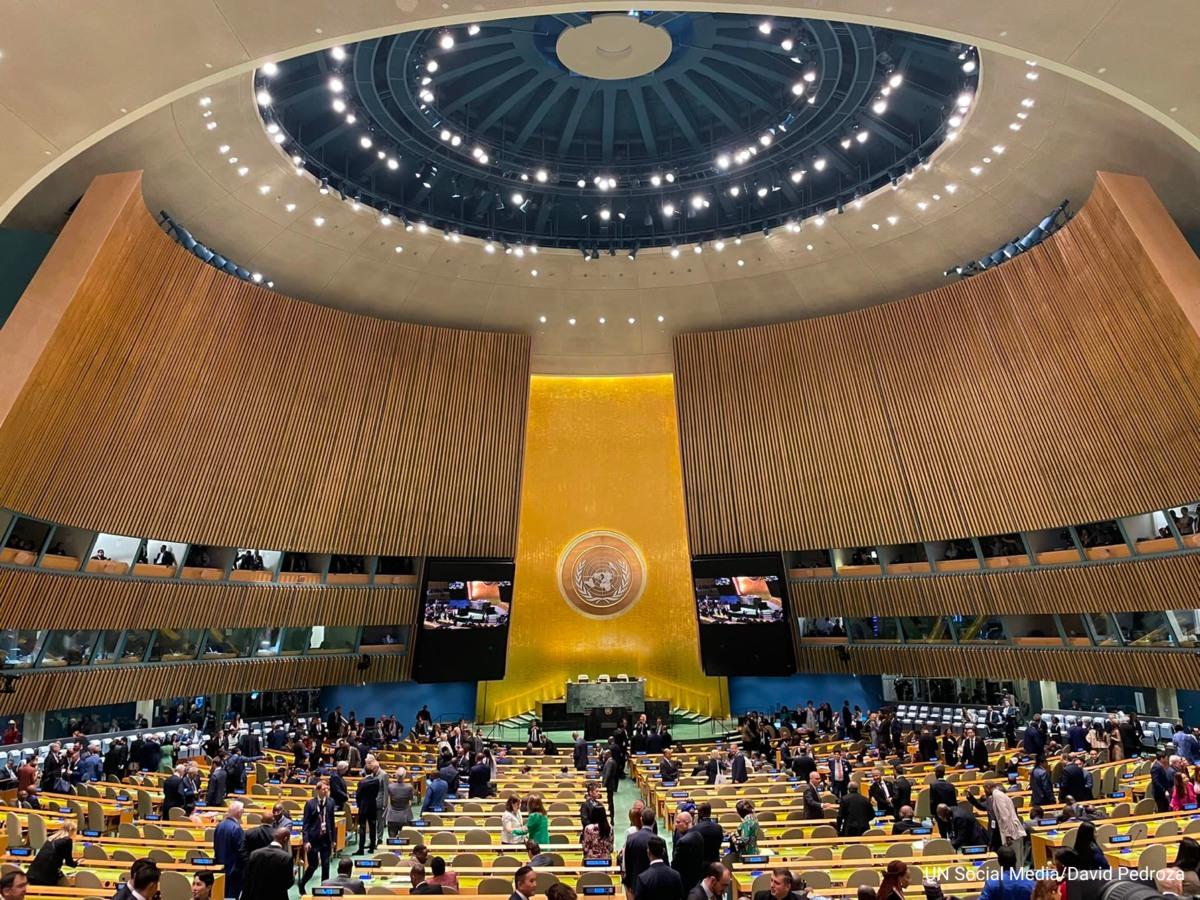
The UN Security Council has passed yet another resolution calling for a ceasefire in Gaza. This is the fourth such resolution adopted by the council since Hamas’ October 7 attack on southern Israel and the launching of Israel’s war in Gaza.
Little has come from the three previous resolutions, all of which have been legally binding since they were passed by the Security Council:
- a resolution on March 25 calling for a ceasefire that was ignored by Israel
- a resolution on December 22 calling for a “sustainable cessation of hostitilies”, which also had no immediate practical effect
- a resolution on November 15 calling for “humanitarian pauses”, which did nothing to alleviate Palestinian suffering or secure the release of hostages.
So, what is new about this latest resolution? And can it bring a halt to the fighting?
What is new
First, this most recent resolution, which was drafted by the United States and supported by a vote of 14-0 (with Russia abstaining), has much more specific terms. For example, it lays out a three-stage approach to achieving a “permanent end to hostilities”.
In this first stage, all fighting will stop and some of the remaining hostages will be returned in exchange for Palestinian prisoners. And if the negotiations take longer than six weeks, the ceasefire will continue.
The document also calls for the return of Palestinians to their homes and neighbourhoods, and for housing units to be delivered by the international community.
This staged approach and inclusion of housing units is new, perhaps with the realisation that over half of Gaza’s buildings have been destroyed and more than 80% of the population has been displaced, often multiple times.
The resolution is also explicitly linked to the ongoing negotiations being carried out by Qatar, with the help of Egypt and the US, to achieve a ceasefire.
This is a positive given Qatar successfully negotiated the only temporary pause in the fighting for seven days in November. This resulted in the release of around 100 hostages, in exchange for 240 Palestinian prisoners.
This current resolution also specifically rejects any territorial or demographic changes to the Gaza Strip, which is a welcome addition given that many fear the re-occupation of Gaza by Israel.
What is not new
Since the beginning of the war, the multiple resolutions passed by the UN Security Council and General Assembly have not led to any real action.
Hamas has previously signalled it is willing to accept the terms of a similar ceasefire negotiated by Qatar. The militant group is also now saying it will abide by the terms of the new UN resolution “that are consistent with the demands of our people and resistance”.
Despite the fact the current resolution specifically mentions Israel has “accepted” its terms, there has been no sign that Israel will, in fact, abide by its obligations under international law.
Israeli Prime Minister Benjamin Netanyahu has reportedly been sceptical about the plan, with his office saying any permanent ceasefire before the “destruction of Hamas military and governing capabilities” is achieved is a “non-starter”.
US Secretary of State Antony Blinken was also apparently still trying to sell the resolution to Israel on Monday. This seems to negate Israel’s presumed acceptance of the ceasefire.
A better chance of success?
Arguably, some of the more specific and detailed terms of this resolution give it a better chance of success than previous UN resolutions.
This is because if parties to a ceasefire have invested time into negotiating and have agreed to specific terms, they know what needs to happen, when and how. There is also greater likelihood the two sides will abide by the terms because this level of specificity ensures some level of accountability from outside observers and the international community.
We saw this in the November temporary truce agreement, which had very specific terms that were followed by both Hamas and Israel.
Another example from a different conflict is the 2002 ceasefire agreement between the government of Sri Lanka and the Liberation Tigers of Tamil Eelam (LTTE) militant group. This ceasefire, which lasted for several years, included references to freedom of troop and civilian movement in specific geographical locations. It also specified landmarks to be used as de-militarised zones.
Problematically, while the current Security Council resolution calls for the effective distribution of humanitarian assistance at scale, including housing units, aid access to Gaza has been stymied by Israel, which now controls all entry points.
Interestingly, the resolution also specifically rejects “any attempt at demographic or territorial change”. However, it omits wording from a previous draft that had included mention of a “buffer zone” Israel is currently building along the border inside Gaza.
And despite the welcome addition of more specific chronological phases in this resolution, the text has some of the same vagueness as previous resolutions, particularly around what exactly will happen in phases two and three.
Phase two seems to link the continuation of the ceasefire with the negotiations being led by Qatar. But, as we have already seen during the war, negotiations can easily be abandoned or dismissed by one or both sides of a conflict.
Likewise, phase three offers the chance for a “multi-year reconstruction plan for Gaza”, but offers no practical detail on how this would be accomplished.
Actions matter more than words
At this stage of this devastating conflict, any halt in fighting that alleviates the suffering of Palestinians is welcome.
However, I remain sceptical this resolution will be any more successful at halting the violence than its predecessors. Success will only come when both parties – but, in particular, Israel as the side with the greater military power – show they are willing to implement a ceasefire through their actions.
Marika Sosnowski, Postdoctoral research fellow, The University of Melbourne
This article is republished from The Conversation under a Creative Commons license. Read the original article.