Canada News
Canada must step up to help millions displaced inside their own countries

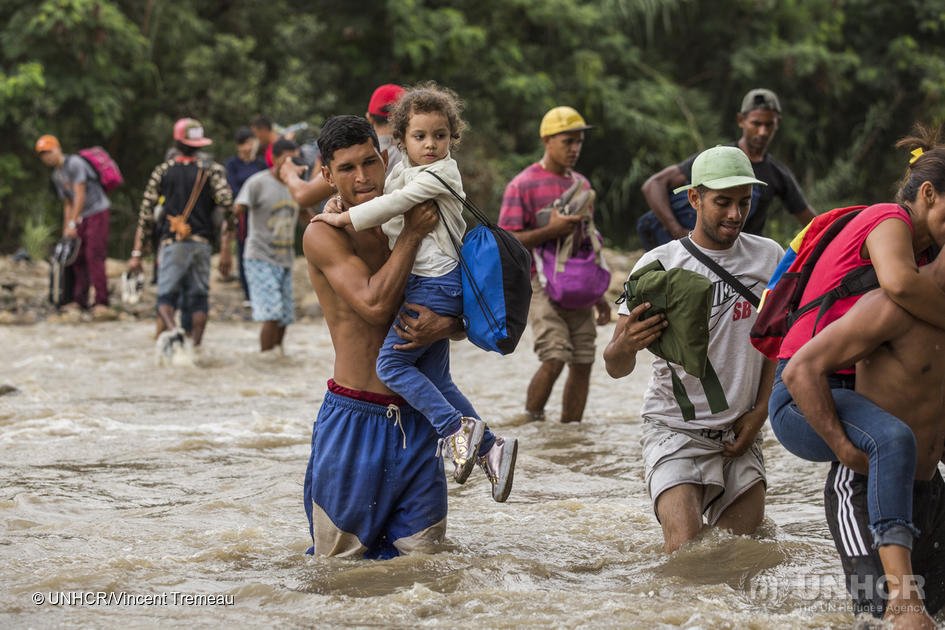
FILE: New Global Trends report on the state of the world’s refugees shows displacement continues to rise (Photo: @Refugees/Twitter)
Record-breaking years for refugee flows have become the norm. UNHCR, the United Nations Refugee Agency, just released its annual tally of displacement worldwide. Once again the numbers rose, with 70.8 million people displaced by conflict and violence — more than at any point since the Second World War.
In media coverage on refugees, we hear the most about the small fraction of refugees who manage to reach Europe or North America, yet well over half of the displaced — some 41.3 million –never make it out of their own countries.
This invisible majority is known by the uninspired acronym of IDPs, or “internally displaced persons.” In countries like Syria, South Sudan, Myanmar and Nigeria, IDPs face targeted violence and extreme poverty, but because they remain within their own borders, they receive little attention or effective international support.
It’s time to change that, and Canada must help.
No coherent strategy
While Canada prides itself for its history of leadership in support of refugees, we lack a coherent, ambitious strategy to strengthen protection and assistance for the majority of displaced people who remain inside their own countries.
Our efforts have focused on comparatively small numbers of refugees by considering the asylum claims of those who arrive at our borders, and resettling refugee families from camps and over-strapped host communities in developing countries.
As UNHCR reported, Canada is now the top resettlement country, resettling 28,100 refugees in 2018 –but that’s only 0.0004 per cent of those displaced worldwide. We reach larger numbers by funding groups such as UNHCR. However, these agencies primarily assist refugees who have crossed international borders, doing little for the majority who are uprooted within their own states.
An improved Canadian response to the challenge of internal displacement could be based on three key pillars: leadership, resources and solutions.
Leadership
Theoretically, leadership in responding to IDPs’ needs and protecting their rights should come from their own governments. In places like Syria and Myanmar, however, IDPs are more hunted than helped by their governments. This means that international officials must step in to address unmet needs.
We need a high-level flagbearer for IDPs, who can work at the international level to advocate for IDPs’ rights, encourage improved government policies and promote effective, co-ordinated responses to IDPs from UN agencies, NGOs and donors.
UNHCR plays this role for refugees who have sought shelter outside the countries, but for IDPs, the UN has only a solitary volunteer expert –an arrangement farcically unsuited to the scale of the challenge. Canada should push for the prompt appointment of a new, prominent, full-time representative of the UN Secretary-General on IDPs, with a fully staffed office dedicated to strengthening responses to internal displacement in cooperation with agencies like the UNHCR.
Systematic & strategic resource distribution
Inequitably distributed resources are also a major barrier to effective responses to IDPs. As a major humanitarian and development donor, Canada should review its aid for IDPs, and prepare a policy to ensure more systematic, strategic support for IDPs, bridging emergency humanitarian relief and longer-term development interventions.
It should also spearhead a broader effort with other donor countries to improve responses to internal displacement.
At a time when aid budgets are already stretched tight, it is hard to hear that more funding is needed. But the reality is that IDP situations are chronically underfunded, with dramatically less spent in support of IDPs compared to refugees facing similar challenges.
This lack of support means that many who would prefer to remain closer to home to tend their crops, safeguard their businesses or care for sick family members have little choice but to make dangerous journeys to seek shelter abroad. It also means that those without the money or physical ability to flee their countries are left high and dry.
To be clear, there is no substitute for refugees’ right to seek asylum. Increased aid for IDPs does not mean that borders can be closed or refugees turned away.
Rather, this is about better responding to the complexity of massive displacement situations in which some people will need shelter outside their countries as refugees, while others may be unable to leave. IDPs should not be sidelined simply because they remain inside their own countries.
Resolving displacement
Finally, we need to refocus on solutions to internal displacement. Canada must co-operate with other donors, governments and UN agencies to promote more comprehensive and systematic support for all those who are struggling to find a solution to their displacement.
From Colombia to the Congo, displacement — internal and cross-border — drags on for longer and longer periods as those forced to flee are unable to safely return or find acceptance elsewhere.
Yet in 2017, over six million IDPs attempted to return to their homes, despite ongoing instability. Many received no support from aid agencies or governments, undermining their ability to return and rebuild. At the same time, thousands of refugees who have repatriated to countries such as Afghanistan have subsequently been internally displaced because they’ve been unable to reclaim their lost homes and re-establish their livelihoods, or have faced violence in their communities.
We must do more to increase the odds that these movements are safe and sustainable.
Forced migration can seem like an insurmountable challenge as displacement rates keep climbing and words of welcome are drowned out by calls to seal up borders and slash aid budgets.
Building on our track record of support for refugee resettlement, we can make progress by standing up for those uprooted within their own countries, creating a broader and stronger response for the millions of refugees and IDPs unable to reach our shores.
——
This article is republished from The Conversation under a Creative Commons license. Disclosure information is available on the original site. Read the original article:
https://theconversation.com/canada-must-step-up-to-help-millions-dis