Art and Culture
The new Smithsonian museum, as seen by a black American

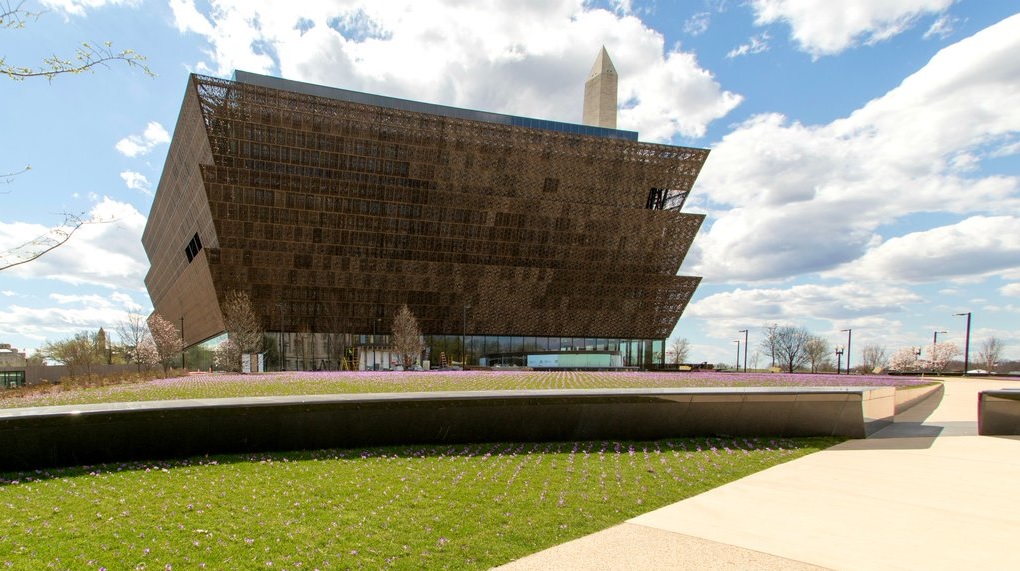
Smithsonian National Museum of African American History and Culture (Photo: Michael Barnes, Smithsonian Institution)
WASHINGTON—I was feeling pretty good until I saw the cowry shells.
There they sat, arranged in neat little stark-white semi-circles on a dark pedestal lit by a spotlight. Disbelief made me lean in and read the display caption twice: “Cowries, manillas, beads, and guns changed hands in exchange for African men, women and children.”
My people were bought with play money? Wow.
I expected the new Smithsonian National Museum of African American History and Culture to hold some surprises. The very thing that this museum is about — the contributions of black people to U.S. society — has been untaught for so long that the truth remains elusive.
Or at least, it remained elusive until now. Walking up to the museum, an ornate bronze structure situated beside the Washington Monument like pieces on a chess board, I wondered if truth would indeed be my friend inside this place.
You see, I was born in the segregated South. Like most Americans, I learned very little in school about my country’s complex racial legacy, including the events that unfolded during my lifetime. I had to gather knowledge through any means I could: The internet. Documentaries. Lectures. Conversations with the elders. Class projects for what was then called Negro History Week. Books borrowed from the library or friends or, in the case of Black Panther activist Eldridge Cleaver’s memoir “Soul on Ice,” found under my sister’s bed.
Hunting down black facts has been a lifelong habit. Being suddenly able to feed this habit via one-stop shopping was a bit of a shock to my system.
At the curators’ suggestion, I started at the bottom floor with the exhibit on slavery. Numbers painted on the walls of the elevator shaft rolled back time from 2008 and came to a stop on the year 1400. It lent a descent-into-hell flavour to the trip.
For sure, the hellish nature of slavery is laid bare. Just six display panels into that exhibit, I’d already seen enough to make my African-American blood boil. Yet I kept walking, kept studying the displays, kept watching the films.
I shed no tears. And that is not because I had confronted the pain of slavery 19 years ago in a visit to a slave transit port off the coast of Senegal.
Truth is I am numb. As this museum opens its doors, the body count of black people slain by police continues to rise. A new one every day, it seems. The killings have drained my emotions to the point where I hardly have any feelings left.
That’s why peeking behind a wall at wreckage from the Portuguese slave ship Sao Jose, and reading the names of other ships that transported captive Africans in the Transatlantic Slave Trade, barely got a rise out of me. I saw that one of them, the Aguila Negra, set sail in 1702 with 500 slaves but arrived with only 107, and all I did was blink in dismay.
Similarly numb people drifted along, exchanging random facts as they drank in new information. There is a word for this, a woman told me quietly as we both eyed artifacts and a tent used by black troops who risked everything to fight for the Union during the Civil War.
“Drapetomania,” she said. “They called it a mental illness, to want to run away from the plantation.”
On this went for the next four hours, from slavery to the American Revolution, the Civil War to World Wars I and II, the Civil Rights Movement to the Black Power movement, the election of the first black president, Barack Obama, and Black Lives Matter.
With each new era, the heaviness seemed to lift. And a thought occurred to me: Black people often say that their ancestors built this nation. To be presented with evidence backing up this statement, a whole building full of evidence, felt overwhelming and inspiring all at once.
In a stroke of consummate timing, up walked Dorothy Gilliam, the first black woman reporter for The Washington Post. Tall and elegant, living, breathing history herself, Gilliam searched for the right words to explain her own awe. “We come from superhuman people,” she concluded.
Together we gazed at chunks of stained glass and cement recovered from the 1963 bombing that killed four little girls in the 16th Street Baptist Church in Birmingham, Alabama. The starkly honest rhetoric of Ella Baker, playing in an endless video loop of famous civil rights oratory, floated in the air around us:
“Until the killing of black men, black mothers’ sons, becomes as important to the rest of the country as the killing of white mothers’ sons, we who believe in freedom cannot rest until this happens.”
At the escalators, I ran into Wendy Frederick, a college classmate of mine. I mentioned being struck by the extent to which items other than silver, or gold, were used as currency to buy and sell human beings.
Wendy nodded. She, too, was amazed by the way the exhibits held nothing back.
“Oh girl!” she exclaimed. “They told it ALL.”