Canada News
In UN speech, PM will present his economic agenda as antidote to angry politics

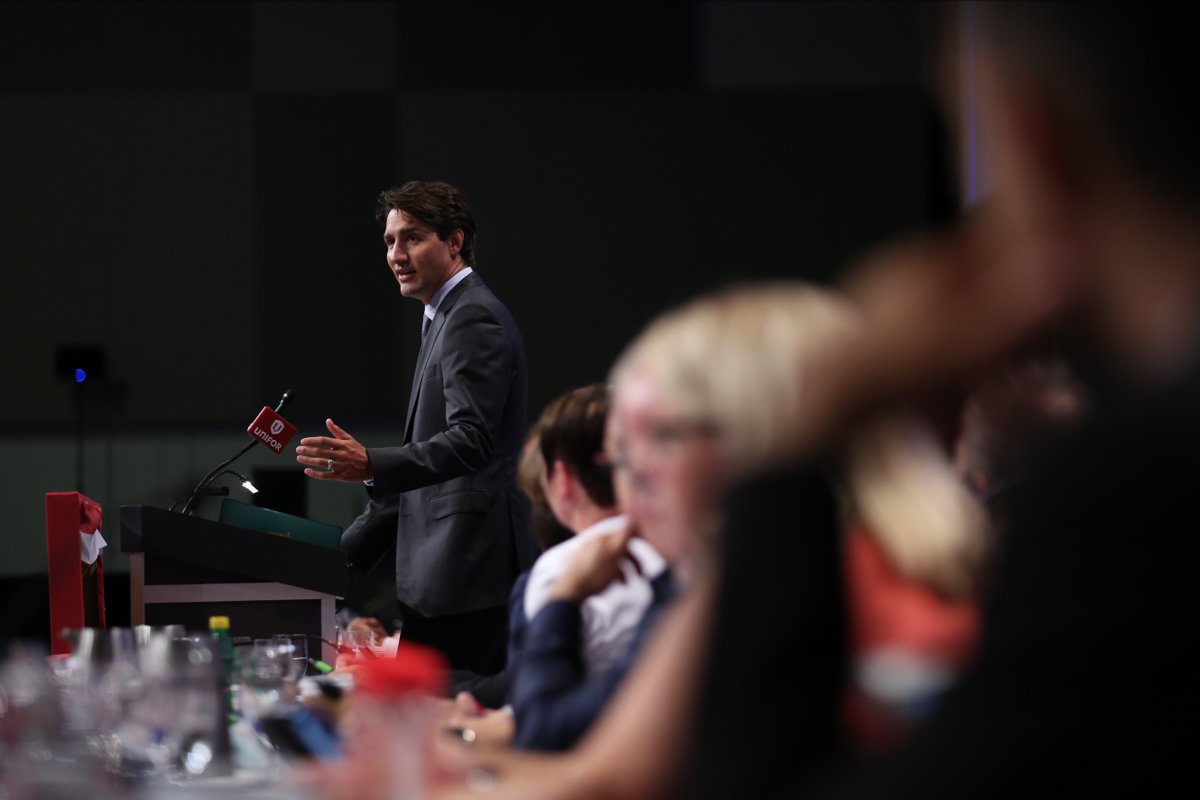
Prime Minister Justin Trudeau (PMO photo)
NEW YORK—Justin Trudeau will use his first speech to the United Nations General Assembly this week to present his brand of economics as an antidote to the angry nationalist politics flaring up on different continents.
The prime minister intends to state his case to the convention hall that government policies geared toward broad-based prosperity make for more hopeful societies — and ultimately for more stable politics.
He’s making that speech in a year where popular resentment has led to Britain leaving the European Union; Donald Trump contending for the U.S. presidency; and once-fringe nationalist parties increasingly competitive in different European elections.
A common theme for these movements is blaming foreign forces for the struggles of domestic workers — while Trump talks about U.S. steel, coal and cars, France’s Marine Le Pen emphasizes farming and agriculture.
The prime minister intends to argue that governments can apply some preventive medicine for that frustration in the form of policies aimed at the working class. A spokesman cited as examples his government’s deficit-financed infrastructure spending and its parental benefit of up to $6,400 per child.
“The prime minister will emphasize his view that a more peaceful and unified world can be achieved through broad-based, shared prosperity,” a spokesman said. “And that governments have a role in implementing policies that have a positive effect on the middle class.”
The prime minister will address the assembly Tuesday on his second day of meetings at the United Nations, following a leaders’ conference on refugees Monday. In that meeting, Trudeau intends to address some of the challenges in successfully integrating newcomers amid a historic refugee crisis spurred by Syria’s civil war.
It’s his first general-assembly speech — although he’s spoken at the UN twice already, once at a climate conference and at a women’s forum where he announced Canada’s campaign for a temporary seat on the UN Security Council.
It comes a few days after his economic policies were applauded by the head of the International Monetary Fund. Trudeau’s domestic opposition grumbled in response that it would be Canadian taxpayers stuck with the bill from a growing national debt.
In her speech to a Canadian audience, Christine Lagarde proposed several policies for stimulating growth:
A social safety net and retraining for workers displaced by new technologies and globalization.
Trade
She said international trade had helped reduce the rate of extreme poverty by half since 1990. She said it had not only benefited developing countries — but also benefited people in wealthy countries who earn 15 per cent more in trade-linked jobs and gain purchasing power thanks to cheaper goods.
She proposed expanding trade deals to include services, not just goods.
Some deregulation
She said barriers to entry in protected industries needed to come down. Lagarde warned against monopolies and market concentration, and urged policies that promote competition.
Creating consumer demand
As examples, Lagarde saluted Canada’s infrastructure spending and its new child benefit geared toward working class parents.
“I hope (Canada’s plan) can actually go viral,” Lagarde said.
A new book by the former chief research economist at the World Bank casts the global challenge in darker terms.
Branko Milanovic writes in, “Global Inequality,” that globalized trade has been good for the vast majority of humans and led to greater equality between societies. However, he describes increased inequality within societies as a dangerous force.
He identifies one group as the biggest loser of globalization: the lower-middle-class of right countries. He writes that it’s happening for a variety of reasons — trade, new technology, and sociological factors like people increasingly intermarrying within their own economic class.
And he draws from economic history to argue that these are perilous times.
Milanovic says we’re living through what he calls the Second Kuznets curve — named after the American economist Simon Kuznets.
The first was the turn of the 20th century, as labour shifted from farming to manufacturing. Now it’s a shift from manufacturing to services.
He warns of a historical cycle: growing inequality, political instability — then war, followed by greater equality. He points to the growth of far-right parties in Greece, Finland and France as an alarming signal.
“Rising inequality indeed sets in motion forces, often of a destructive nature, that ultimately lead to its decrease but in the process destroy much else, including millions of human lives,” says Milanovic, who is referenced on the first page of the book by Canada’s Trade Minister Chrystia Freeland on inequality, “Plutocrats.”
“Very high inequality eventually becomes unsustainable, but it does not go down by itself; rather, it generates processes, like wars, social strife, and revolutions, that lower it…. (Let’s) hope that humanity, facing a very similar situation today as one hundred years ago, will not allow the cataclysm of a world war to be the remedy for the ills of inequality.”