
Headline
Scientists turn red strawberries white by editing a single color-controlling gene

Abi Sarabia M., Philippine Canadian Inquirer
September 03, 2026
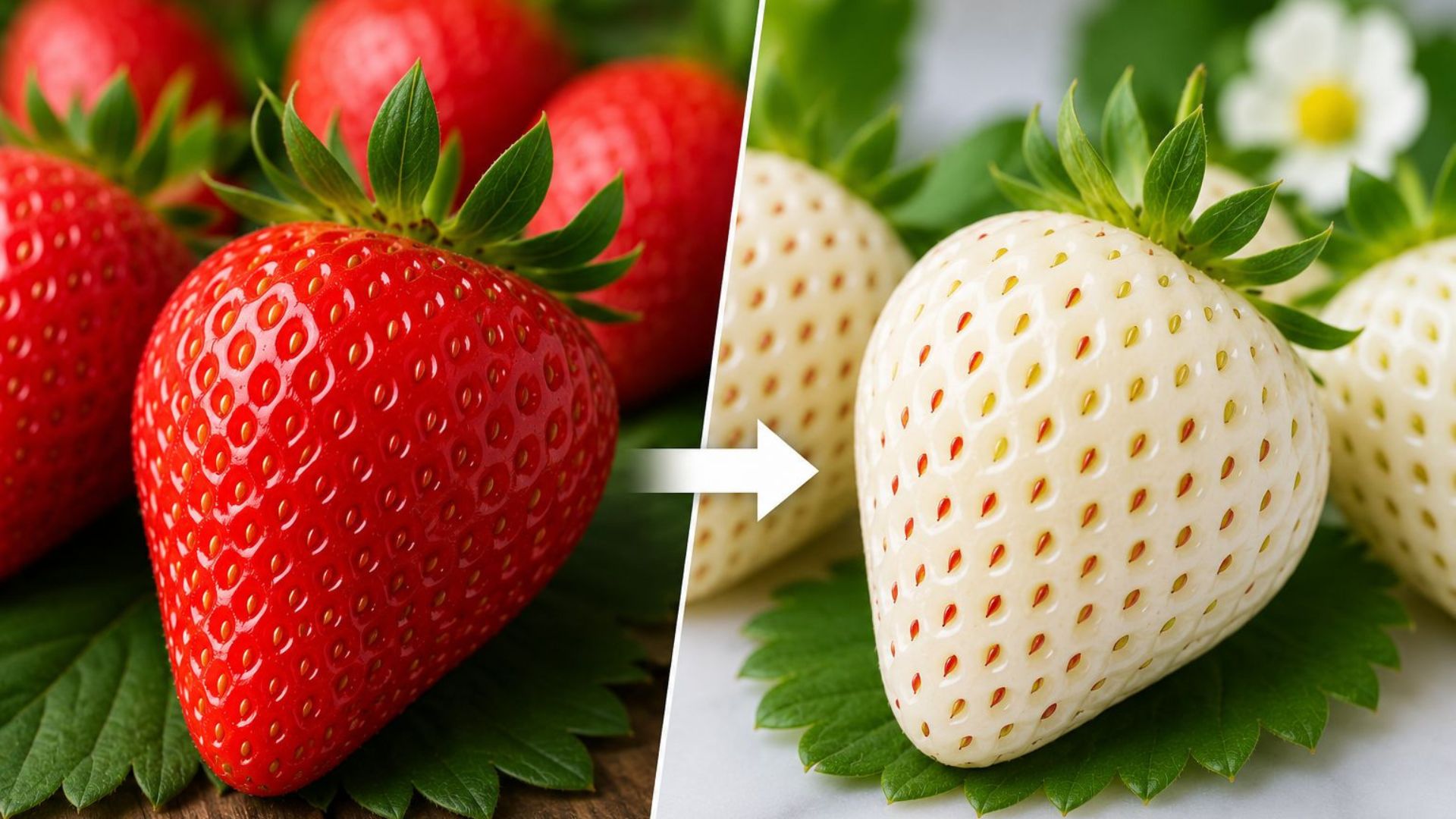
Scientists have turned normally red strawberries white by precisely editing a gene that controls the production of the fruit’s red pigment.
Researchers used CRISPR/Cas9 gene-editing technology on Florida Brilliance, a commercially grown strawberry variety, targeting a specific gene copy known as MYB10-1B. The gene plays a major role in activating the pathway that produces anthocyanins, the natural pigments responsible for strawberries’ familiar red color.
Instead of adding a gene that makes strawberries white, researchers essentially switched off a key genetic control for red pigmentation.
The edited strawberries remained white as they matured instead of progressing from white to red. Their skin and flesh stayed white at full ripeness, although the small seed-like structures on the surface, called achenes, became red.
Researchers examined 13 next-generation plants produced during the experiment. Of eight plants descended from one edited line, three produced white fruit. Another group produced one plant with nearly white, pale-pink fruit.
Further analysis showed that disrupting MYB10-1B also reduced the activity of several genes involved in producing anthocyanins, including CHS, DFR and ANS, providing further evidence that this gene is a major regulator of strawberry coloration.
Why one gene matters
Cultivated strawberries are genetically complicated. Unlike humans, which normally have two copies of each chromosome, the cultivated strawberry used in the experiment is octoploid, meaning its genome contains eight sets of chromosomes.
That gives strawberries multiple related copies, or homoeologs, of many genes. Researchers therefore had to target MYB10-1B specifically, rather than broadly disrupting all related MYB10 copies.
Whole-genome resequencing of selected white-fruited lines showed the intended mutations in MYB10-1B, with few or no mutations detected in the closely related MYB10-1C and MYB10-1D copies examined by the researchers. The study described the overall off-target effects as minimal.
That precision is one of the more important findings of the research: it shows that scientists can potentially modify a specific trait even in genetically complex crops by identifying which copy of a gene has the dominant effect.
White strawberries are not entirely new
White strawberries already exist naturally.
The researchers had previously identified a naturally occurring mutation involving MYB10-1B in the white-fruited variety Florida Pearl. That discovery helped them determine which gene to target in the red Florida Brilliance strawberry.
The new experiment therefore did not discover white strawberries or create the first white strawberry. Instead, researchers reproduced a white-fruit trait in a normally red cultivar through targeted gene editing, helping demonstrate the role of MYB10-1B in controlling fruit color.
The study could have implications beyond appearance. Precise editing of individual gene copies may eventually help plant breeders study or alter other crop characteristics without changing large portions of a plant’s genome.
However, the research was an experimental gene-editing study, not the launch of a new commercial strawberry variety. The study focused primarily on genetics and fruit coloration rather than establishing how the edited strawberries compare with conventional varieties in areas such as taste, nutrition, shelf life or large-scale agricultural performance.
The research was published in the peer-reviewed journal Horticulture Research.




















