Breaking
CHR kicks off Nat’l Children’s Month 2025, vows to ensue fight against OSAEC

By Nash Villena, Philippine Canadian Inquirer
November 5, 2025
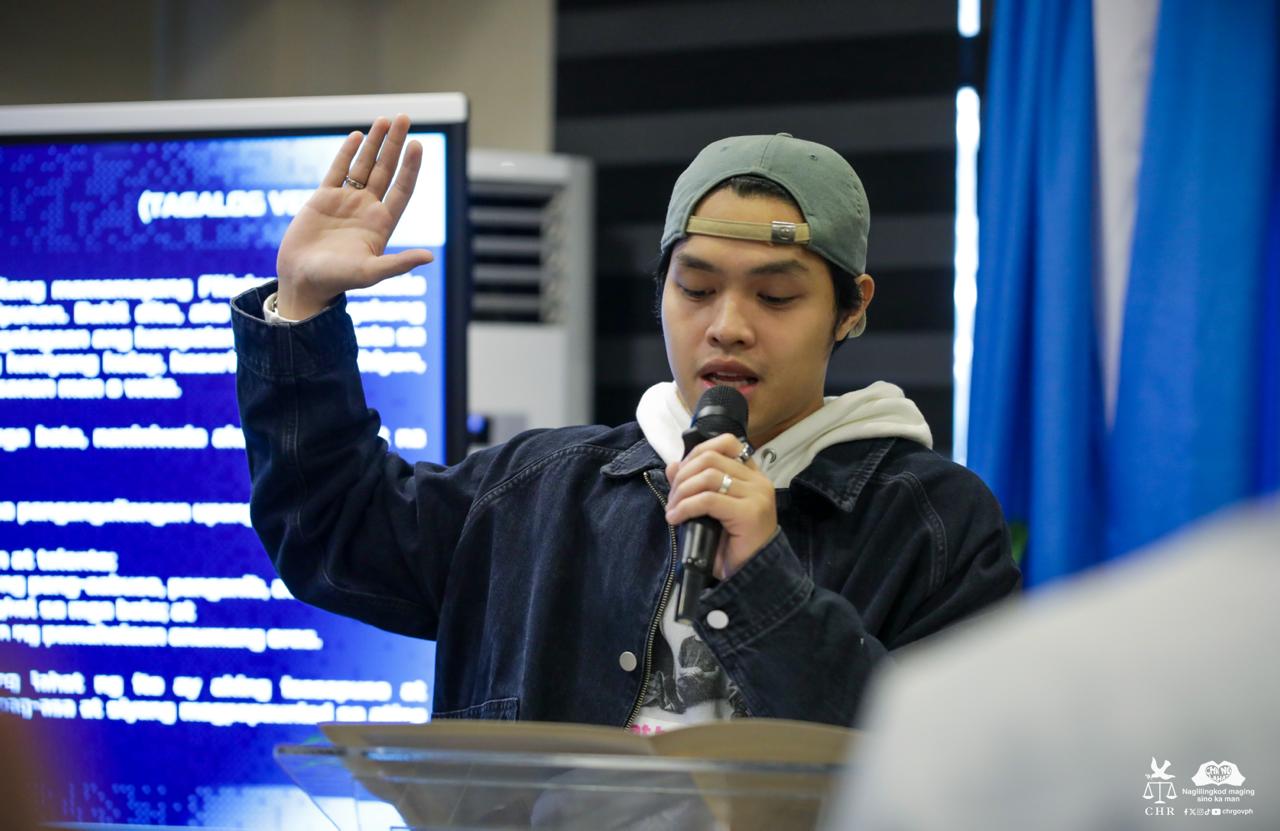
PANATANG MAKABATA. Actor and child rights advocate Elijah Canlas leads the oath-taking of the Commission on Human Rights employees at the onset of this year’s National Children’s Month celebration on Monday (Nov. 3, 2025). (Photo from Commission on Human Rights of the Philippines/Facebook)
QUEZON CITY, Philippines — The Commission on Human Rights (CHR) opened this year’s celebration of National Children’s Month with a refined commitment to combat the country’s alarming cases of Online Sexual Abuse and Exploitation of Children (OSAEC).
Focal Commissioner on Children and Youth, Atty. Beda A. Epres led the opening on Monday at the CHR central office to affirm the commission’s stern mandate in fighting child abuse, toward a safer digital space for Filipino youth.
“No child shall be left behind, no child shall be exploited, discriminated against, or abused. Every child shall grow up safe, valued, and free to thrive with dignity,” he said.
Similarly, National Coordinating Council OSAEC-CSAEM’s Executive Director, Atty. Barbara Mae Flores highlighted the need for a more systemic reform in how Filipinos perceive online child abuse.
“We cannot normalize harm. We cannot outsource courage. Kailangan nating tapusin ang kultura ng tahimik na pagtitiis, at palitan ito ng kultura ng pagre-report nang walang alinlangan,” Flores said.
(We cannot normalize harm. We cannot outsource courage. We need to end the culture of silent suffering and replace it with a culture where reporting OSAEC cases is done without hesitation.)
Actor and child rights advocate Elijah Canlas was also present at the said CHR event to lead the commission’s Panatang Makabata oath-taking.
The Philippines as an OSAEC global hotspot
The Inter Agency Council Against Trafficking (IACAT) defines OSAEC as the use of Information and Communication Technologies to sexually abuse and exploit children; the United Nations generally describes a child as any individual below the age of 18.
The materials produced from OSAEC crimes are called Child Sexual Abuse and Exploitation Materials (CSAEMs), which include videos, photographs, and audio recordings, even explicit AI-generated content based on the likeness of minors.
A 2024 report by Justice and Care affirmed previous findings that OSAEC activities in the Philippines take place in rural and urban areas, making the country among the global hotspots.
According to the same report, the COVID-19 lockdown worsened the problem, with the crimes committed mainly by adults familiar or not to the victims. There was also an observed continual rise in cases in the post-pandemic years.
The report parallels those of local authorities, with a report in the same year from the Philippine National Police’s Women and Children Protection Center (PNP-WCPC) identifying particular hotspots where OSAEC cases are pervasive.
Among the places the PNP-WCPC identified are, namely, Caloocan City, Valenzuela City, and San Jose del Monte, Bulacan.
Uphill battle toward a safer future
In spite of the struggles in detecting and deterring OSAEC crimes, child rights advocates—from civil society and the academe—are working closely with local governments and agencies to bring the anti-OSAEC awareness to vulnerable communities nationwide.
Notable initiatives made by relevant actors include conducting seminars, campaigns, and talks in both schools and barangays, focused on teaching the youth about OSAEC and how they can protect themselves.
In 2022, Republic Act No. 11930, also known as the “OSAEC and CSAEM Act,” was passed as a landmark law addressing digital sexual crimes carried out against children.
The law indicates how respective authorities and agencies must act in handling OSAEC crimes; penalizing perpetrators who will “produce, direct, manufacture, facilitate, or create any form of CSAEM, or participate in [its] production.”
RA 11930 also provides procedures for the rehabilitation and recovery of victims, as well as the protective custody they will be put under.
While laws, innovations, and media serve as effective tools to empower communities against OSAEC, the uphill fight still continues through open conversations, breaking the stigma, and enacting collective actions to safeguard the future of Filipino youth.