News
Why don’t people want more kids? That’s the wrong question, says a new global report

By Natalie Stechyson, CBC News, RCI

And 37 per cent of those polled said they did not believe they could afford to have a child in the next three years. (Pexels photo)
The issue is lack of choice, not desire, says head of the United Nations Population Fund.
Why aren’t people having more kids? What we should actually be asking, according to a new global report, is why so many people feel like they can’t.
It’s often assumed that low fertility rates are due to people simply not wanting to have children, or more than one or two, but a report released Tuesday from the United Nations Population Fund (UNFPA) says that’s not the whole picture.
Vast numbers of people are unable to create the families they want,
said Dr. Natalia Kanem, UNFPA’s executive director, in a news release.
That lack of choice is the real fertility crisis,
she said, and the answer lies in responding to what people say they need: paid family leave, affordable fertility care and supportive partners.
The UNFPA report included polling by YouGov. About one in five of the reproductive-aged adults surveyed in 14 different countries said they won’t be able to have the number of children they would like, with most saying they would likely have fewer than they wanted, or none at all.
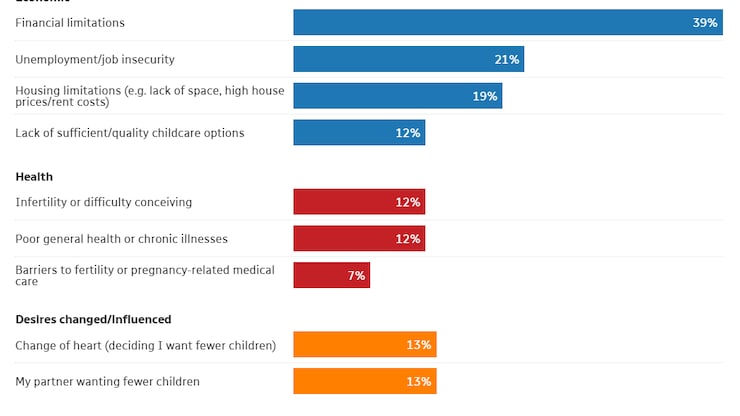
Survey responses to the question: “In your personal situation, what factors have led or are likely to lead you to have fewer children than you initially desired?”
Photo: United Nations Population Fund (CBC)
The most common barriers were economic, with 39 per cent reporting that financial limitations affected or would affect their ability to realize their desired family size.
Other significant barriers included a lack of partner support, low-quality sexual and reproductive health care, a lack of access to services like affordable childcare, and pessimism about the future.
The polling surveyed 14,256 adults aged 18 to 88 from 14 countries including the U.S., South Korea, Italy and India between Nov. 15 and Dec. 5, 2024. It didn’t mention a margin of error but said most data was nationally representative.
While Canada wasn’t surveyed, the authors note the sample of countries represents a third of the global population with a mix of incomes and fertility rates.
Canadians face barriers, too
Previous Statistics Canada data shows a similar trend, with people aged 15 to 49 reporting in 2022 that comparable issues, like affordability, could influence their fertility intentions.
And 37 per cent of those polled said they did not believe they could afford to have a child in the next three years.
Many Canadians face structural constraints that prevent them from realizing their fertility aspirations,
said Rania Tfaily, an associate professor at Carleton University who studies social demography.
The topic recently came up during the federal election campaign when Conservative Leader Pierre Poilievre mentioned that too many young people can’t afford to buy homes before their biological clocks
have run out.
But while his wording struck a nerve, his supporters said he highlighted a real concern. In 2022, 32 per cent of Canadians aged 20 to 29 didn’t believe they would have access to suitable housing to start a family in the next three years, according to Statistics Canada.
WATCH | Why aren’t Canadians having more kids?:
Canada recorded its lowest-ever fertility rate for the second year in a row in 2023, according to Statistics Canada data, at 1.26 children born per woman. It joined the ranks of lowest-low-fertility countries,
including South Korea, Spain and Japan.
Of course, it’s not just a lack of choice driving the rate down — having fewer children is also seen as more desirable today, notes Lisa Strohschein, a sociology professor at the University of Alberta.
Statistics Canada data, for instance, consistently reported between 1990 and 2006 that Canadian women intended to have just over two children, on average, Strohschein said. But the most recent estimates from 2022 now suggest the desired number of children overall is 1.5, and that gets even lower with the younger people surveyed.
At the same time, it is the case that women tend to have fewer children than they actually want — even as they want fewer children overall,
she said.
Reproductive agency goes both ways
The UNFPA report emphasizes that reproductive rights go both ways, and so does the global fertility crisis.
It is a crisis in reproductive agency — in the ability of individuals to make their own free, informed and unfettered choices about everything from having sex to using contraception to starting a family,
says the report.
One in three respondents in the YouGov poll said they or their partner had experienced an unintended pregnancy, for instance, and nearly one in five said they felt pressured to have children when they didn’t want to.
This can have unintended consequences on the fertility rate, the report noted, especially when policymakers attempt to control reproductive autonomy. For instance, bans on abortion can lead to individuals voluntarily or involuntarily forgoing reproduction,
the report explained.
WATCH | This is what an abortion ban looks like in Texas:
A recent study looking at U.S. medical claims found that tubal sterilization and vasectomies increased in the U.S. after among participants ages 19 to 26 after the U.S. Supreme Court overturned Roe v. Wade.
If we want people to achieve their desired family size, we need to move away from treating fertility as a means of controlling women’s bodies, Strohschein said.
Incentives don’t work, but what does?
Meanwhile, U.S. President Donald Trump says he wants a baby boom, and has mulled incentives to try to convince more people to have children, including so-called baby bonuses.
This week, he announced his plan to create tax-deferred investment accounts for babies born in the U.S. over the next four years, starting them each with $1,000, reported The Associated Press.
Yet, as the UNFPA report notes, most incentives like this don’t work, and can sometimes have the opposite effect. That’s because they are not creating the full range of enabling conditions that people say they need to have families,
it states.
So what would help people have more children — assuming that’s what they want?
Guaranteed affordable and high-quality childcare for all,
said Carleton University’s Tfaily, as well as economic policies that could reduce people’s financial stress, like better worker benefits and more stable jobs.
Strohschein had similar suggestions, like making it easier for mothers to return to work after having a baby, as well as affordable childcare.
However, we still have not been all that successful in Canada with either of these two policy levers,
she said.
It will be interesting to see whether our national childcare program can change this in the years to come.
This article is republished from RCI.