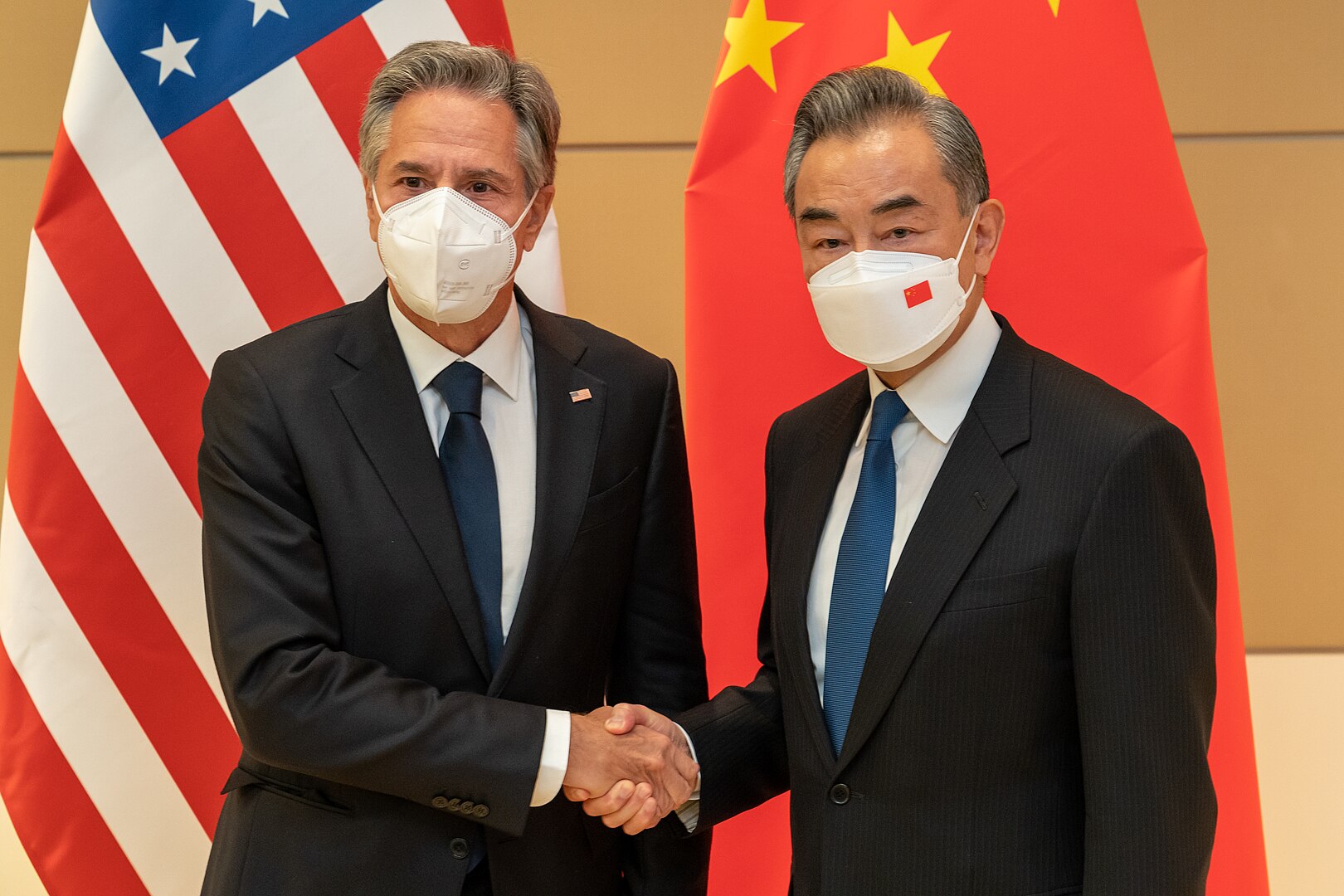
US secretary of state Antony Blinken fired a warning salvo towards China during a G7 foreign ministers’ meeting on the Italian island of Capri on April 20. The US’s top diplomat said that China is a “prime contributor” of weapons-related technology to Russia, and was fuelling what is the “biggest threat to European security since the end of the Cold War”.
As Blinken detailed further when he landed in Beijing this week, while China has complied with US’s requests not to sell arms to Russia during the Ukraine war, the list of items they are selling, which could have military use, is extensive. They include semiconductors, drones, helmets, vests, machine tools and radios.
Apparently, the Chinese resupply of the Russian industrial complex also undermines Ukrainian security. And unfortunately for China, Chinese support of the Kremlin’s war effort is likely to earn Chinese firms sanctions from the US government.
Why then is Beijing aiding Moscow so ardently even when imminent US sanctions are going to aggravate its already weak economy? One word: survival.
China’s need for allies
China realises that if it wishes to break the US monopoly on power, it can’t go about it alone. Aside from requiring a strong Russia to help reform the US-dominated international system, China needs Russia for its long-term survival.
There is a famous Chinese idiom: “Once the lips are gone, the teeth will feel the cold.” (Meaning that when two things are interdependent, the fall of one will affect the other.) Right now, the west is dealing with the Russian rogue state. But if Russia falls, Beijing realises that the west could consolidate its resources to deal with the “Chinese threat”. Therefore, Beijing must aid Moscow.
At present, presidents Xi Jinping and Vladimir Putin enjoy a close friendship. The closeness of both regimes became more apparent through a joint statement released on February 4 2022, which declared that there were “no limits” to Sino-Russo friendship and no “forbidden” areas of cooperation.
But let’s get one fact straight: China-Russia relations have not always been rosy. Both the Soviet Union and China had experienced massive bouts of tension over the communist doctrine and had disputes over border issues.
Relations became so tense that both communist regimes broke off their formal alliance in 1961, and Chinese and Russian soldiers later clashed in northeast China and the Xinjiang region.
Not surprisingly, there’s lingering distrust on both the Chinese and Russian sides, and Chinese experts fear that Russia may prioritise its own interest over bilateral ties.
For instance, if a renewed Trump presidency does occur, the US may express less support for Ukraine and improve ties with Russia. In such a scenario, the Kremlin may prioritise better ties with the west and may withhold support for China’s struggle against the US.
Incidentally, China’s distrust of Russia and existential concerns may have fuelled a recent high-level visit from Beijing to Pyongyang, North Korea. On April 13 2024, China’s top legislator and third most senior Chinese communist leader, Zhao Leji, paid an official visit to Pyongyang.
During the meeting with North Korean strongman Kim Jung Un, Zhao claimed that the meeting was meant to reaffirm good relations and deepen bilateral cooperation between the two nations.
So, was Zhao simply making a courtesy call?
The timing of the meeting cannot be more curious as it occurred amid surging North Korea-Russia relations. Reports indicate that Russia is purchasing large quantities of munitions from North Korea to fuel the Kremlin’s war effort against Ukraine. This would have brought Moscow and Pyongyang closer together.
The reality is that Pyongyang has traditionally exploited Russian and Chinese rivalry to achieve its goals. So, the strategy of pitting the Chinese against the Russians comes right off a chapter in the realpolitik playbook.
But the truth is Beijing cannot afford to lose its influence on North Korea to anyone else, be it American or Russian. This is because China’s security risk hinges on North Korea’s dependence on China.
North Korean threats
This fear is not unfounded. North Korea has a tradition of defying China. This came in form of the execution of Kim Jung Un’s pro-Chinese uncle, the assassination of Kim Jong Nam in Malaysia, or North Korea’s high-profile weapons tests.
More importantly, Beijing fears that if North Korea becomes a fully-fledged nuclear power, it might even detonate nuclear weapons on Chinese soil.
This all sounds strange, since both regimes signed a treaty of mutual defence and cooperation in 1961 that was renewed in 2021. But beneath the veneer of friendship lies deep rooted resentment that has been festering for centuries.
Korea used to be a tributary state to imperial China and has played second fiddle to the Chinese for centuries. So when the Chinese interfered with the course of the Korean War, and even normalised ties with North’s primary foe, such actions not only angered North Korea, but also opened up historical wounds of being China’s vassal.
If Beijing wishes to maintain a major foothold in North Korea it needs to contain non-Chinese influence surrounding Pyongyang at all costs. It does so with a two-pronged approach.
First, China sends Zhao to cajole Kim Jung Un and assure the North Korean strongman that Beijing has his back. Second, China sends weapons and technology to Russia so that the Kremlin’s arms dependence on Pyongyang diminishes.
At first glance, Beijing’s supply of arms and technology to the Kremlin seem unrelated to Zhao’s visit to Pyongyang. But that simply isn’t true.
Chee Meng Tan, Assistant Professor of Business Economics, University of Nottingham
This article is republished from The Conversation under a Creative Commons license. Read the original article.