Canada News
Unprecedented challenges for Canada’s mountains are driven by human activity

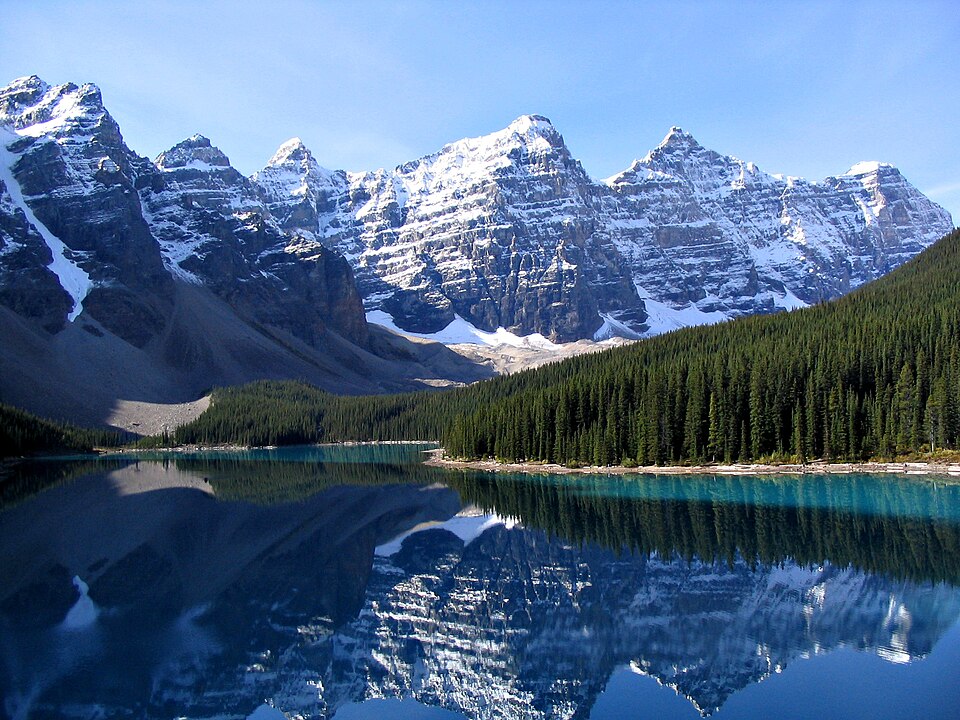
FILE: Valley of the Ten Peaks and Moraine Lake, Banff National Park, Canada. Mountains from left to right: Tonsa (3057 m), Mount Perren (3051 m), Mount Allen (3310 m), Mount Tuzo (3246 m), Deltaform Mountain (3424 m), Neptuak Mountain (3233 m) (Photo By Gorg/Wikimedia Commons, Public Domain)
Canada is a nation deeply connected to its mountains. Across the country, millions of people live within, or adjacent to, interconnected or geologically related ranges known as mountain systems.
But our mountains are facing unprecedented challenges due to climate change, land conversion, human development, resource extraction, recreation and tourism. The Canadian Mountain Assessment, published last fall, warns the cumulative impacts of these threats “are rapidly transforming mountain systems across Canada.”
People and their activities are at the centre of this change and must be part of shaping policies if we are to protect mountain systems now and into the future. More detailed and inclusive research is also needed to ensure sound strategies.
Mountains are home to crucial ecosystems for air and water filtration and for carbon storage. They are key places for wildlife habitat, economic development, outdoor recreation and tourism.
They are also important cultural and spiritual landscapes that have been stewarded by Indigenous Peoples for millennia. Collaborative and Indigenous-led conservation and restoration of mountain systems offer important pathways toward cultural regeneration and reconciliation in Canada and beyond.
However, a recent review says a limited “understanding of the human dimensions of life in the mountains” is constraining management and policy decisions to balance development and conservation efforts.
Filling that void is important because the Canadian government has set ambitious conservation targets – with help from the provinces and territories – to protect 30 per cent of Canada’s land and water by 2030, largely by supporting Indigenous-led conservation. Canada also has a goal to halt and reverse the loss of nature by 2050.
These are crucial targets. Protecting Canada’s mountain regions, while supporting the communities in or near them, will be necessary to achieve Ottawa’s goals. Research that improves our understanding of how people live in, play in and benefit from mountains can help inform the policies needed.
As a post-doctoral researcher at the University of Northern British Columbia, I have been working with colleagues and the Yellowstone to Yukon Conservation Initiative (Y2Y) to assess these research gaps within and near the Rocky Mountains.
Recently we published a new social-science research agenda for Y2Y, a group that strives to protect and connect habitat from the greater Yellowstone ecosystem in the United States to the Yukon territory in Northern Canada.
Like mountain systems more broadly, this 3,400-kilometre region stretching along the spine of the Rocky Mountains faces significant threats.
Y2Y is a non-governmental, science-based organization. It works collaboratively with more than 700 partners to support large landscape conservation. Over the last number of years, it has focused more on the human side of its mission.
In helping to identify and fill knowledge gaps, our goal is to help Y2Y and its partners across the region, including all levels of government, make conservation decisions informed by the most up-to-date information, including from the social sciences.
Existing research lays bare the many barriers to conservation decision-making in Canada. Answering important questions about how best to overcome these barriers – as well as where, why and how people decide to act to protect nature – will improve the likelihood of Canada meeting its global commitments.
The value of natural assets must be measured for truly sustainable development
Canada needs to close the “logging loophole” in its boreal forest
A better understanding of how ready, willing and able that key stakeholders and rights holders, such as Indigenous Peoples, are to adapt to environmental and climate change can enhance follow-through on existing policies and shape new climate and biodiversity strategies.
Filling knowledge gaps about the booming outdoor recreation sector in Canada would also go a long way in helping governments and land managers craft effective strategies and tweak existing ones.
It would also help inform governments, communities and the business sector about how to support outdoor recreation in ways that improve human health and well-being as well as protect the environment.
Our work is not simply about research. Our goal is to improve how knowledge is shared between researchers, conservationists and decision-makers. We also are striving to build a stronger and more interdisciplinary conservation science community across the Yellowstone to Yukon region.
We aim to do this by supporting innovative research and by sharing research and knowledge – including the benefits of Indigenous-led conservation – with Y2Y’s network of partners and the public. Any success from this approach could be reproduced in other mountain regions.
Plant trees, but remember: nature is more than a carbon sink
It will be important to listen to the people of these regions and beyond if we are to overcome threats facing the mountains and meet Canada’s ambitious conservation and restoration targets. People must be part of shaping decisions that need to be made to confront these difficult challenges.
Improving our understanding of human dimensions of life in the mountains through rigorous and collaborative research, sharing of knowledge and enhancing how science informs policy is crucial if Canada is to live in harmony with nature.
This article first appeared on Policy Options and is republished here under a Creative Commons license.