Canada News
Niagara pre-emptively declares a state of emergency in anticipation of massive solar eclipse crowds

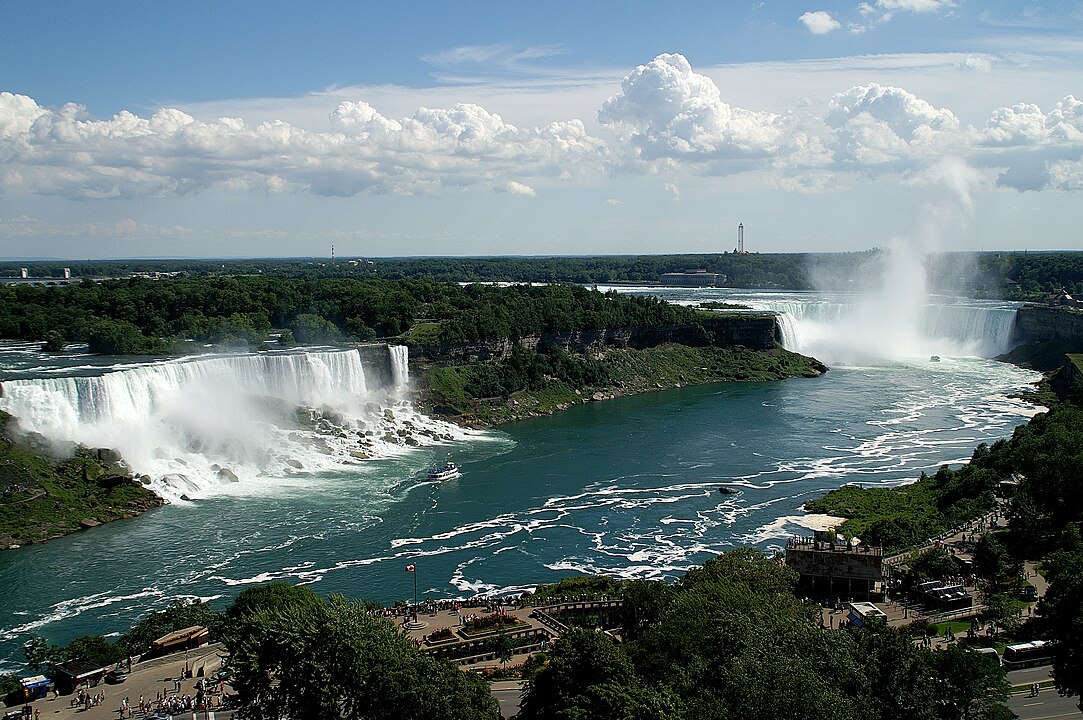
FILE: A view of the American, Bridal Veil and Horseshoe Falls from the Presidential Suite of the Sheraton Fallsview Hotel, Niagara Falls, Ontario, Canada. (Photo By Saffron Blaze/Wikimedia Commons, CC BY-SA 3.0)
Officials estimate that the total solar eclipse on April 8 could prompt up to one million people to visit Canada’s Niagara Falls. In preparation, a pre-emptive state of emergency has been declared for Ontario’s Niagara Region.
Unlike other sudden-onset disasters, there is specific information available in advance about the potential dangerous impacts of the eclipse. It is known when and where large crowds of spectators will converge — the location of any impacts will be at the prime vantage points in proximity to Niagara Falls. The timing of any potential impacts will be immediately before, during and after the eclipse.
We face an odd juxtaposition of emergency management techniques as applied to the viewing of a rare celestial event. Understanding how a declaration of a state of emergency relates to the eclipse helps understand the human aspects of the upcoming celestial event.
Advance preparation
At the basic level, the management of the massive temporary population influx has some similarities to the management of large planned special events.
Special event characteristics include non-routine mass gatherings that place an extraordinary strain on community resources. Temporary large crowds of people require additional advance planning and preparation.
Unlike fixed-location special events, such as sports championships, an eclipse can bring wildcards. The location of the influx of spectators can change rapidly. For example, changes in cloud cover can cause eager spectators to rush in a way a little like storm chasing, from overcast viewing areas to clear ones, causing a hurried chaos of distracted movement.
Declaring a state of emergency
A provincial act, the Ontario Emergency Management and Civil Protection Act (EMCPA), enables a regional municipality like Niagara to declare their own localized state of emergency.
Sec. 6.62 of the Ontario Provincial Emergency Response Plan specifies that, under the provisions of the EMCPA, municipalities can decide what their own emergencies are. The head of the municipality — in Ontario, the mayor or the reeve — can then issue the orders they feel are necessary to protect the health, safety and welfare of inhabitants.
The Niagara Region’s Emergency Plan specifies that the powers to declare a state of emergency rest with the mayors of any one of the 12 Niagara-area local municipalities, and also with the regional chair.
Effective March 28, Niagara Regional Chair Jim Bradley declared a state of emergency in the entire region due to the upcoming eclipse.
Generally, a state of emergency provides government with the authority to do whatever is necessary for the safety of people and the protection of property. Typical actions can include restriction of movements, suspension of regulations to expedite response and creation of new emergency legal sanctions.
Emergency declarations are issued for a wide range of situations beyond routine natural disasters like floods or forest fires. For example, in March 2023, the Niagara Regional Council declared a state of emergency over mental health, homelessness and opioid addiction.
Pre-emptive declarations
While a declaration of a state of emergency is typically made after a disaster occurs, pre-emptive declarations are by no means unique. Emergency planners in the Niagara Region have long anticipated potential emergencies associated with the temporary population influx of eclipse spectators.
If, for any reason, a disaster response is needed during the eclipse, time will be of the essence. Reasons for issuing a pre-emptive emergency declaration involve laying the bureaucratic foundations for quickly ramping up management procedures, rapidly deploying resources and co-ordinating multi-jurisdictional support.
While pre-emptive states of emergency are rare in Canada, there have been other situations elsewhere, like hurricanes leading to states of emergency being declared in advance.
In September 2023, one day before the landfall of Hurricane Lee, the governor of Maine declared an anticipatory state of emergency.
Prudent planning
It would be foolhardy to not use all tools available to prepare for dealing with emergencies during the eclipse, including pre-emptive emergency declarations.
At best, throngs of cautious and well-behaved eclipse spectators will enjoy witnessing the rare natural phenomenon, and no major problems will occur.
At worst, many emergencies may occur: infrastructure can fail, a terrorist attack may be carried out, vehicle accidents can cause major congestion. Additionally, during mass gathering events, there is a noticeable rise in the workload for emergency medical service personnel.
A pre-emptive declaration of a state of emergency is an example of prudent planning. It allows for the necessary tools to be in place to respond quickly to any unintended consequences of the temporary population influx of eclipse spectators.
Jack L. Rozdilsky, Associate Professor of Disaster and Emergency Management, York University, Canada
This article is republished from The Conversation under a Creative Commons license. Read the original article.