Headline
Gaza update: no end to the killing in sight as extremists on both sides make a peace deal hard to imagine

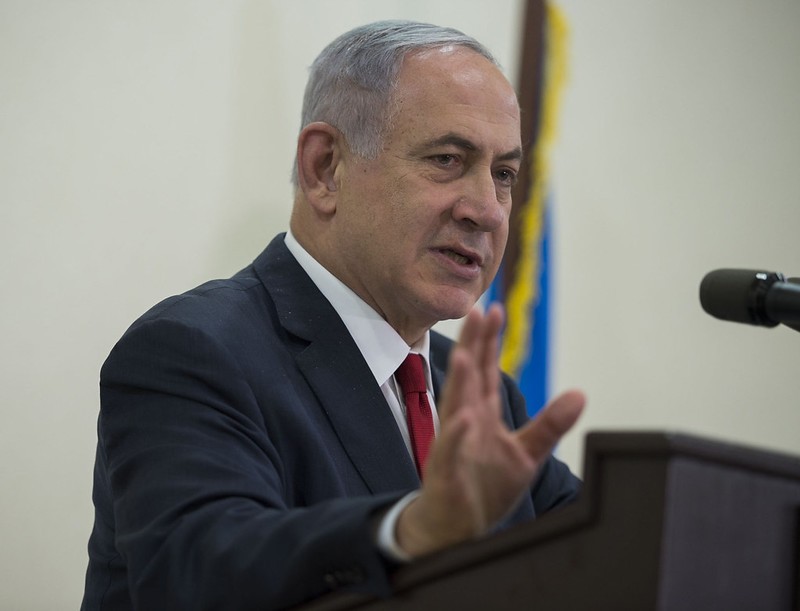
Hamas has always refused to recognise the state of Israel, while Israel’s Netanyahu government is being kept in power with the cooperation of the extreme right Religious Zionism party. (File photo: Paul Kagame/Flickr, CC BY-NC-ND 2.0)
As the death toll from Israel’s assault on Gaza climbed past 23,000 – including nearly 10,000 children – according to the latest figures from the Hamas-controlled health ministry, the Palestinian militant group released a series of videos showing operations in the northern Gaza Strip. Analysts commented that Hamas was keen to emphasise, contrary to claims by the Israel Defence Forces (IDF), it still has operational capabilities in the north of the enclave.
Meanwhile attacks by Hezbollah and other Iran-backed militant groups continue in northern Israel and southern Lebanon, as well as against US bases in Iraq and Syria as part of an ongoing campaign to harass and expel US troops.
Antony Blinken returned to the region for another round of shuttle diplomacy, putting on a determinedly optimistic face as he insisted after a meeting with Saudi crown prince Mohammed bin Salman that Israel could still normalise relations with Saudi Arabia. Visiting the West Bank this week, Blinken also restated Washington’s commitment to the creation of a Palestinian state.
Of course, a major hurdle to the “two-state solution” is the inconvenient fact that two of the biggest players in any peace agreement along those lines would be Israel and Hamas. Hamas has always refused to recognise the state of Israel, while Israel’s Netanyahu government is being kept in power with the cooperation of the extreme right Religious Zionism party.
Amnon Aran, an expert in Israeli politics at City, University of London, says that the party’s leaders – national security minister Itamar Ben Gvir and finance minister Bezalel Smotrich – flatly reject any cooperation with the Palestinians. But, significantly, Aran also believes that they will also prevent any real progress at other regional peace initiatives. This includes a joint US-French gambit that aims to reduce tensions between Israel and Lebanon by finally realising a deal originally mooted as a way of ending the 2006 conflict between Israel and Hezbollah.
That would involve a new land demarcation agreement specifying where and how the two sides could deploy forces across the Israel-Lebanon border. It is already backed by UN security council resolution 1701 from 2006, which would replace any Hezbollah troops close to the Israel border with the Lebanese army.
As Aran notes, Netanyahu faces a string of corruption charges and has been marking strenuous efforts to delay his trial. The collapse of his coalition could give his main rival, former defence minister Benny Gantz, a chance to form a government. Gantz is itching to pass legislation to prevent anyone facing criminal charges from being able to lead a government.
Gaza Update is available as a fortnightly email newsletter. Click here to get our updates directly in your inbox.
In peril on the sea
Meanwhile, Iran-backed Houthi rebels continue to cause chaos in the Red Sea, mounting such regular attacks on shipping there that many ships are opting to take the longer way round the Cape instead of risking access to the Suez Canal.
A US-led taskforce involving Royal Navy ships this week fought off what has been described as the biggest attack by Houthi rebels yet, involving a mix of rockets, drones and cruise missiles. UK defence secretary Grant Shapps did the rounds of the media making appropriately belligerent noises.
But in truth the Houthis are mounting what appears to be a classic example of “assymetrical warfare”, leveraging their limited means to cause major disruption to global supply chains and sending insurance premiums skywards. This will inevitably feed into higher commodity prices.
Noting that the Red Sea accounts of 15% of global trade, Basil Germond, an expert in maritime affairs at Lancaster University, believes that the west has few options for dealing with this. As of the time of writing, the UK is talking up the likelihood of airstrikes against the Houthis on the ground in Yemen. But, as Germond writes here, this is an entirely different proposition from shooting down the odd drone at sea.

Institute for the Study of War
Major escalation unlikely
As well as pursuing its war aims in Gaza, Israel continues to make good on its promise to find and kill all those involved in planning and carrying out the October attacks. While Israel and its spy agencies rarely claim responsibility for assassinations, it appears to be generally accepted that the decisions to target high-ranking Iranian general Sayyed Razi Mousavi in Damascus on Christmas Day and senior Hamas leader Saleh al-Arouri in Beirut on January 2 were taken in Israel.
Scott Lucas, a Middle East security expert at University College Dublin, says that while the killings were greeted with predictably bloodcurdling threats from Hezbollah and Iran, a close reading of their statements suggests a major regional escalation remains unlikely for now.
As Lucas points out, both Iran and Lebanon, where Hezbollah comprises a state within a state, face severe economic problems. They are more likely to harass Israel, or in Iran’s case, use its proxies including the Houthis to do it for them.
A post-Palestinian Gaza?
Another of the factors making a durable peace deal more difficult to imagine is the vision that many high-ranking Israeli politicians have for a post-conflict Gaza – without any Palestinians living there. Both Smotrich and Ben Gvir have talked up the idea of Gaza’s population being farmed out as refugees around the world, while Gaza is reoccupied by Israeli settlers.
But it isn’t just the extreme right in Netanyahu’s government that have proposed moving Palestinians out of Gaza. As Leonie Fleischmann, a Middle East expert at City, University of London, writes, more moderate voices have criticised the international community for a moral failure to help Palestinian civilians. For example, former Israeli ambassador to the UN Danny Danon and the centre-left politician and former deputy director of Mossad Ram Ben-Barak have proposed that countries around the world should accept some of Gaza’s population who “have expressed a desire to relocate”.
On the other side is the settler movement, which is already making ever larger and more aggressive inroads into the West Bank. One of the movement’s leading lights, Daniella Weiss, appeared recently on mainstream Israeli television to describe her longing for a Gaza where “there will be no homes, there will be no Arabs”, adding that Gaza City had always been “one of the cities of Israel. We’re just going back. There was a historical mistake and now we are fixing it.”
Peace polling
One of the great tragedies in all this is the way that ideas and opportunities which might have provided a pathway to peace have been squandered over the years. Colin Irwin, now a research fellow at the University of Liverpool, has been involved in peace negotiations in various conflicts over several decades. Perhaps the most conspicuous success was his involvement in the negotiations which led to the signing of the Good Friday agreement in 1998. Irwin was working with Bill Clinton’s peace envoy, Senator George Mitchell, conducting peace polls.
As Irwin explains, the principle of polling as a part of peace negotiations is absolute inclusivity and public buy in. He developed relations with eight political parties across the spectrum of Northern Irish politics, including those that represented the Irish Republican Army, Ulster Volunteer Force and Ulster Freedom Fighters. His team commissioned polls on the many different political positions held by the parties, who then used this information to negotiate a peace deal they knew would receive support.
Irwin writes that he was all set to repeat this process with Mitchell in 2009, who Barack Obama had appointed as his Middle East envoy. But several things got in the way – including, most significantly, the election of Netanyahu as prime minister in the spring of 2009. Unlike his predecessor Ehud Olmert, Netanyahu did not want to include Hamas in any talks. The process collapsed. And so the killing has continued to this day.
Gaza Update is available as a fortnightly email newsletter. Click here to get our updates directly in your inbox.
Jonathan Este, Senior International Affairs Editor, Associate Editor, The Conversation
This article is republished from The Conversation under a Creative Commons license. Read the original article.