Canada News
Methane emissions from oil and gas exploration are under reported

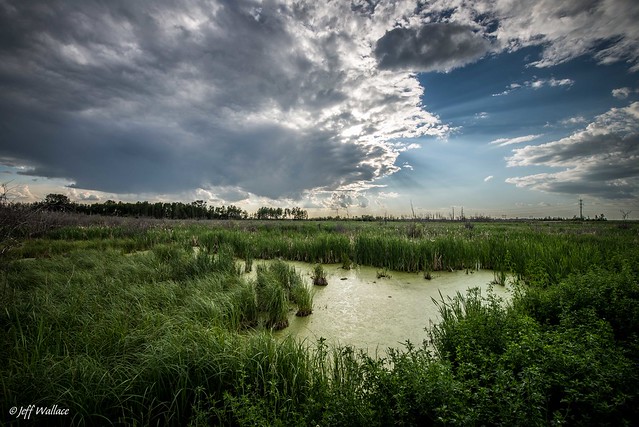
FILE: Poole Wetlands near Big Lake (Photo: Jeff Wallace/Flickr, CC BY-NC 2.0)
Wetlands in Canada’s boreal forest contain deep deposits of carbon-rich soils, made up of decomposed vegetation (peat) that has accumulated over thousands of years. Globally, peatlands store twice as much carbon as all of the world’s forests combined. Protecting this carbon store is critical in the fight against climate change.
But the amazing capacity of boreal peatlands to store carbon is being curbed by oil and gas exploration.
Our recent study in the journal Nature Communications shows how vast networks of seismic lines — long clearings constructed for petroleum exploration — increase greenhouse gas emissions from boreal peatlands. In Alberta alone, these undocumented emissions would boost Canada’s national reporting of methane in the category of land use, land-use change and forestry by about eight per cent.
And, regrettably, that’s probably an underestimate.
Petroleum and peatlands
Alberta has immense petroleum deposits, including the third-largest proven oil reserves in the world. The bulk of these deposits are found in the northern part of the province: a landscape that also contains an abundance of peatlands.
When most people think of northern Alberta’s petroleum industry, they envision the large surface mines located near Fort McMurray. Yet most of the province’s oil and gas, including 97 per cent of the oil-sands area, is found in reservoirs that are too deep for surface mining.
Across much of Alberta, petroleum companies use deep wells to access oil and gas. The surface footprint of this “in-situ” extraction is less intensive than mining, but — as we explain below — the operations create a dense network of disturbances that cover a much larger area.
Seismic lines
In the hunt for subsurface petroleum deposits, oil and gas companies construct seismic lines. Seismic lines are linear features, two metres to 10 metres wide, cut through the forest using bulldozers or other types of machinery.
Once cut, seismic lines provide access for field crews to place geophones and other types of survey equipment to search underground for petroleum reservoirs. This form of exploration has been taking place in Alberta since the 1940s.
More than 1.8 million kilometres of seismic lines have been cut in Alberta alone, enough to circle the planet 45 times. This little-known feature is by far the most common type of industrial disturbance in Alberta’s boreal forest.
A thousand cuts
The ecological impacts of seismic lines on boreal ecosystems are substantial. Though seismic lines are most closely associated with the decline of woodland caribou, researchers have shown that they influence everything from butterflies to grizzly bears. In the Lower Athabasca region of Alberta, in-situ development has shifted the composition of entire mammalian communities, creating both winners (wolf, coyote and white-tailed deer) and losers (caribou, black bear and fox).
Compared to wildlife, the effect of seismic lines on soil and carbon dynamics has received little public attention.
In general, boreal peatlands are net sinks of carbon — that is, they take up more carbon from the atmosphere than they release. However, industrial disturbances can shift the balance. Rather than accumulating organic matter, disturbed peatlands can release ancient carbon that has been building up in the soil since the last ice age, more than 11,000 years ago.
Undocumented emissions
We used data from the Alberta Biodiversity Monitoring Institute to identify over 345,000 km of seismic lines crossing peatlands in Alberta. This translates to more than 1,900 sq. km of disturbance: an area almost three times the size of all the active oil-sands surface mines in Canada.
The equipment that cuts seismic lines through peatlands removes vegetation and compresses the soil, creating wet conditions close to the surface. This leads to increased emissions of methane: a potent greenhouse gas with 25 times the warming potential of CO2.
We estimate that seismic lines increase methane emissions in Alberta by 4,400 to 5,100 metric tons annually. That’s equivalent to the CO2 emitted by about 27,000 passenger vehicles driven for one year.
This amount is relatively small compared to the 251,000 tonnes of methane generated naturally by Alberta peatlands each year. However, these induced emissions are not part of Canada’s national carbon accounting, mandated under the Paris Agreement. If included, these emissions would increase the amount of methane reported for land use, land-use change, and forestry for all of Canada by seven to eight per cent.
A conservative estimate
We’re being conservative in our estimates here, since we account only for the effect of seismic lines making peatlands wetter. Soils on seismic lines also get warmer, which may further increase methane emissions.
In addition, we suspect that the true length of seismic lines in Alberta is much greater than the 1.8 million km documented in public records.
To investigate this latter point, we looked at a 10,000 sq.
km portion of boreal forest near Conklin, Alta. We found that more than 70 per cent of the narrow seismic lines cut since the mid-1990s were missing from the public dataset.
This is because these narrow lines are difficult to detect in the satellite imagery used to record disturbances.
Our estimates also exclude emissions from seismic lines crossing peatlands in other parts of Canada.
Restoration targets
There is currently no legislation for restoring seismic lines in Alberta, despite plenty of evidence suggesting that seismic lines often fail to regenerate on their own.
Leading petroleum companies in Alberta are pioneering new methods for erasing seismic lines from the landscape, including site preparation and tree planting. Their efforts are motivated primarily by the recovery strategy for boreal caribou mandated by the federal Species at Risk Act. Whether these treatments also restore peatlands’ natural carbon dynamics is largely unknown.
Our work comes out weeks after researchers revealed higher-than-reported CO2 levels over the oil-sands surface mines.
Undocumented greenhouse gas emissions like these and the ones we report are silently contributing to climate change. Through better measurement of all emissions, we can develop strategies that result in real climate action.
——
This article is republished from The Conversation under a Creative Commons license. Disclosure information is available on the original site. Read the original article:
https://theconversation.com/methane-emissions-from-oil-and-gas-explo