Business and Economy
Dairy farmers say denting supply management in NAFTA deal would be ‘devastating’

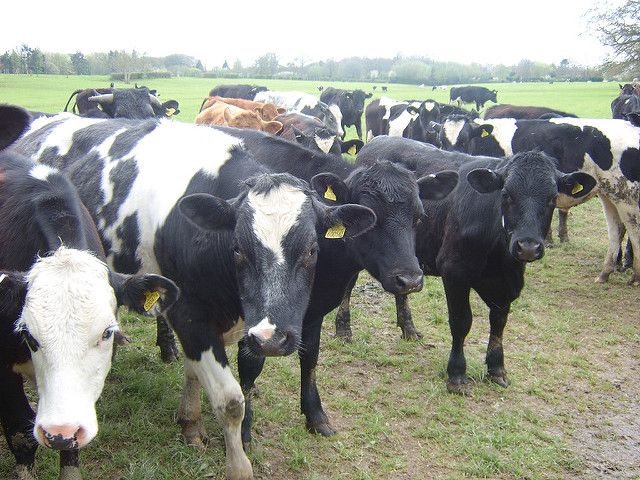
“There would be lots of bankruptcies … It would be devastating,” he said from his farm south of Montreal. (File Photo: Sam & Emer/Flickr, CC BY 2.0)
MONTREAL — Nearly 1,000 kilometres from Washington, where a team of top Canadian negotiators sit in 11th-hour NAFTA discussions, Peter Strebel works under a cloud of concern at the rural Quebec dairy farm his father founded in 1976.
The Quebec milk producer is worried that rumblings that Canada may sacrifice part of the sacred cow of supply management as a concession in trade negotiations with the United States would “punish” the dairy industry, open the floodgates to American milk products and prompt thousands of farm closures north of the border.
“There would be lots of bankruptcies … It would be devastating,” he said from his farm south of Montreal.
“We’ll probably have to cut back on investment, maybe lay off a couple workers. I don’t know how it would be done.”
Canadian dairy operates under a supply management system, in which farmers are protected from competition because the government blocks out foreign production with high tariffs and sets quotas to limit production and prevent market saturation. With traditional market forces removed, the government decides how much farmers are paid for their production, helping to keep farmers’ incomes stable.
The protectionist policy, a staple of Canadian agriculture for more than 40 years, has come under periodic attack from U.S. President Donald Trump.
And as trade talks hit a fever pitch ahead of a pending Friday deadline, Strebel and others fear that the Canadian government is ready to make concessions on dairy.
More than 15 per cent of the Canadian dairy market is already opening up to imports under terms of the Trans-Pacific Partnership signed in March. Any further dents to supply-side protection would imperil the business, said Strebel, who represents his region on the board of the Milk Producers of Quebec.
Strebel’s 150 cows churn out 5,000 litres of milk per day, which is trucked off to 115 processing facilities — waypoints on the path to products ranging from Yoplait yogurt to local cheese.
Several potential concessions are of particular concern to him and Canada’s 11,000 dairy producers, the vast majority of whom are located in Quebec and Ontario.
One is Canada’s domestic milk ingredient pricing system. The Class 7 pricing agreement struck in 2016 has effectively restricted U.S. exports of ultra-filtered milk used to make dairy products, industry experts say.
The policy allows Canadian dairy processors to buy domestic milk at world market prices instead of higher prices controlled by the national supply management system. U.S. dairy groups argue the policy provides processors with an incentive to cut milk imports and intentionally blocks American products.
But the head of the Dairy Farmers of Ontario believes scrapping Class 7 would be detrimental to the Canadian industry.
“Either we’d try to get less capital cost per unit of milk shipped and try and live that way, or go broke — or just try to ride it out for a few more years and then quit,” said Ralph Dietrich, who chairs the advocacy group and co-owns a dairy farm in southwestern Ontario.
Should supply management suffer a blow at the trade table, Strebel wondered if Canada would compensate with hundreds of millions of dollars in subsidies, or rethink its ban on bovine growth hormone for dairy cows, which the U.S. allows as a means to boost milk production.
Robert Wolfe, a professor emeritus at Queen’s University who specializes in agriculture trade policy, pointed to the possibility of devalued quotas. Much like the medallion system that regulates the number of taxi drivers, quotas mean a farmer has the right to produce a certain amount of the product.
Any new farmer has to buy in, and the rights don’t come cheap — anywhere from $20,000 to $43,000.
“That quota is the right to sell a certain amount of milk. But if anybody can sell milk, then that quota that you’ve spent a lot of money on is worthless,” he said. “For the typical dairy farmer, we’re talking millions.”
Slashing supply management or lowering tariff rates would have a ripple effect, particularly for farmers with recent capital investments and bigger debt loads, said Al Mussell, research lead for Agri-Food Economic Systems in Guelph, Ont.
“There are some farmers that have reinvested in facilities and expanded in more efficient facilities, but are relatively new and financially leveraged who could have a great deal of difficulty in that environment because they’ve lost some of their ability to generate revenue,” Mussell said.
However, supply management is also one of the few cards the Trudeau government has left to play at the bargaining table after the U.S. and Mexico reached their own side deal on Monday.
Defending dairy farmers, who enjoy artificially high prices and exorbitant incomes, threatens to hurt the steel, aluminum and automotive industries during trade negotiations unless concessions are made, said Martha Hall Findlay, president and chief executive of the Canada West Foundation.
“Why are we sacrificing those sectors, those jobs, those Canadians, for a small number of now wealthy producers?” she wrote in a paper released Wednesday.
Findlay called on Ottawa to dismantle supply management, “not because Trump says so, but because it’s in Canada’s best interests.”