
Canada News
Oil rich provinces not just Canada’s best economic performers, world beaters as well

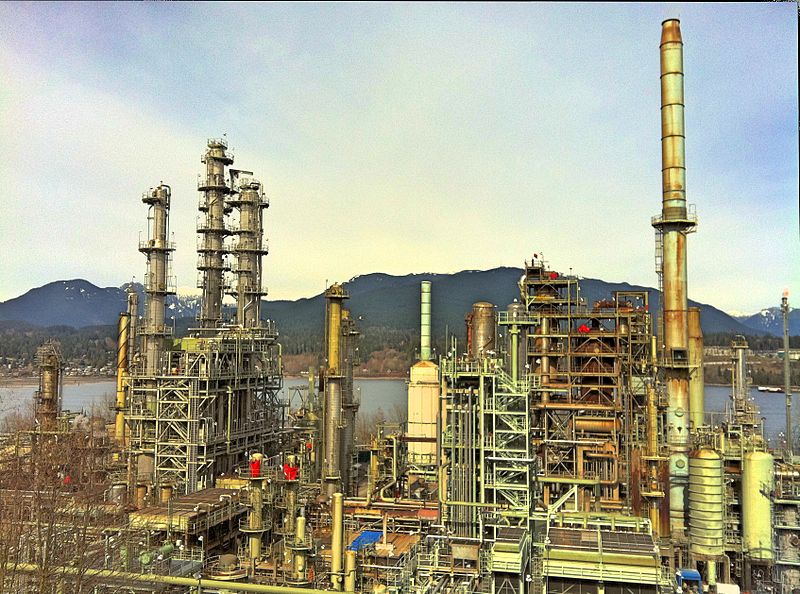
The Chevron oil refinery in Burnaby, B.C., Canada. Photo by
Kyle Pearce / Flickr.
OTTAWA—A new report from the Conference Board puts Canada’s three oil rich provinces on top of the world in terms of economic performance.
For the rest of the country the news is not so stellar.
The think-tank’s annual economic report card comparing 16 of the world’s richest countries puts Canada in fifth place overall, a one spot better than last year and behind Australia, Ireland, the United States and Norway.
That’s partly a function of Canada’s relatively stable growth rate, but also due to difficult recoveries in the eurozone and Japan.
Canada scores highly on economic growth and employment growth, although “poor grades on labour productivity as well as inward and outward foreign direct investment raise concerns about long-term prosperity,” the report cautions.
In in a new twist for the Conference Board’s annual report card, the latest grades treats the 10 provinces as if they were countries to create a picture of not only the internal disparities but also how the provinces compare globally.
The report places Alberta, Saskatchewan and Newfoundland—the three oil producing provinces—in that order as the top performers with A-plus scores across indicators such as per capita income, economic growth, unemployment and productivity. They are the only jurisdictions rated to have A-plus economies.
Alberta is “class leader,” says the report with 2013 per capita income that was $10,000 higher than Norway, the top-ranked country in that indicator.
At the bottom of the class are Nova Scotia and New Brunswick with D grades, along with countries such as France and Belgium.
Ontario, Prince Edward Island and British Columbia score B grades, putting them alongside Switzerland, Germany and the United Kingdom. Manitoba and Quebec were given C grades.
“What this tells us is we have provinces outperforming the rest of the world, and we have provinces that are struggling along with the laggards in the eurozone,” said Brenda Lafleur, the project director for the think-tank.
The common denominator for economic performance, in Canada at least, is oil and to a lesser degree other natural resources, which Alberta, Saskatchewan and Newfoundland all have in abundance.
Lafleur said Canadians might be surprised by Newfoundland’s high marks, but noted that the province had a 7.9 per cent growth rate in 2013 and that per capita income now is higher than the Canadian average. Where the province scores poorly is in employment growth with a jobless rate still hovering above 11 per cent.
In another related study issued Tuesday morning, the Centre for the Study of Living Standards concludes that while there has been a flattening in economic disparities in Canada in the past half century, income variables have risen dramatically since the 1990s due to the high growth rates in the three oil-producing provinces.
The centre notes that the two-speed economy in Canada can create tensions with oil-producers that want to retain as much of the benefits as possible and the federal government hoping to see resource wealth spread widely.
“But since the growing income disparities reflect the growing economic pie,” the report added, “this development represents an opportunity. More resources are available at the national level for both private and public uses.”
Last month, Bank of Canada governor Stephen Poloz called the country’s oil riches a “gift” that all Canadians can share. He estimated that gross domestic income has been enriched by about seven per cent by the sector since 2002.
“Yes, when we break this down by region, big benefits are accruing to the three oil-producing provinces.
But those who suspect GDI (gross domestic income) is falling elsewhere will have to think again,” he said.
There is little doubt the that oil gift will continue to be a bigger benefit in producing provinces, however.
The Conference Board report predicts Alberta and Saskatchewan will continue to “dominate” its economic performance report card in the coming years, continuing to “record lower unemployment rates than the rest of Canada and stronger growth than the peer countries as the eurozone continues its long and painful recovery.”
But that doesn’t necessarily doom non-oil provinces, the think-tank adds. It recommends that they work hard on initiatives that boost labour productivity in order to keep up.




















