
Canada News
Diesel spill from CN Rail derailment threatens Skeena River as First Nations demand accountability

Floyd Brenz, Philippine Canadian Inquirer
November 28, 2026
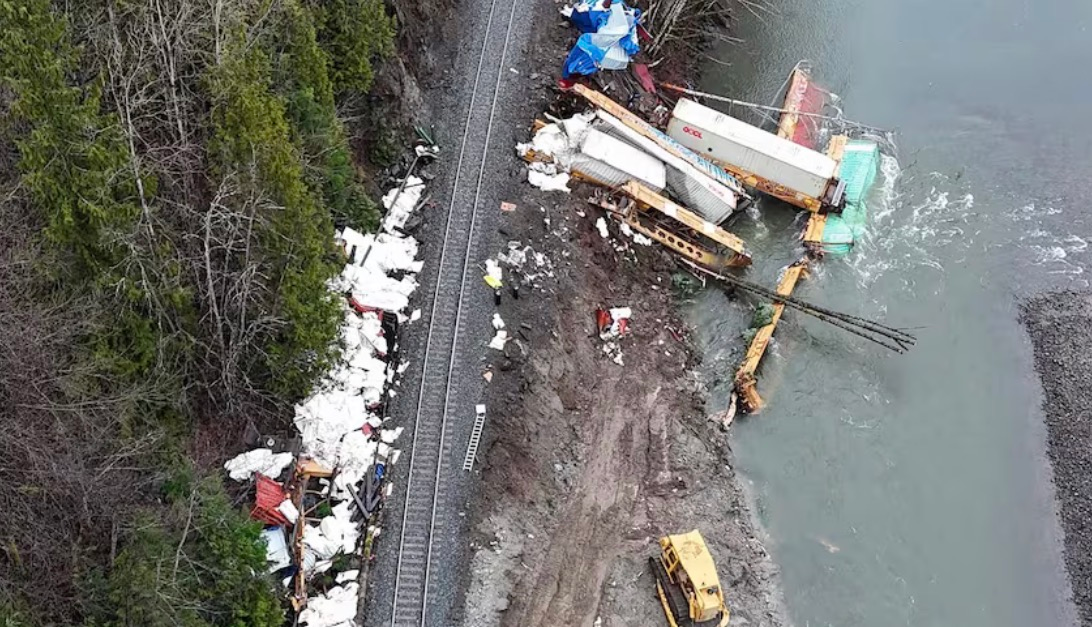
Photo Courtesy: CBC News
Environmental concerns are mounting in British Columbia after a Canadian National Railway (CN) train derailed beside the Skeena River, releasing diesel fuel into a major waterway that supports Indigenous communities, fisheries and wildlife.
The November 17 incident happened about 16 kilometres west of Terrace when a rockslide sent two locomotives and five railcars carrying forestry products off the tracks. Several containers plunged into the river, while two railway employees were taken to hospital with non-life-threatening injuries.
More than a week after the accident, the full extent of the contamination remains uncertain. CN reported that the locomotive may have contained as much as 11,600 litres of diesel, but only around 1,400 litres had been recovered as of November 24.
The Lax Kw’alaams Band reported detecting diesel traces as far as 50 kilometres downstream during its initial monitoring activities. Laboratory testing also confirmed diesel in a water sample collected about 10 kilometres from the derailment site.
By November 23, the community’s monitoring team continued to observe traces of diesel approximately 27 kilometres downstream, raising concerns about the potential effects on fish and other aquatic wildlife.
The spill has placed renewed pressure on CN and government agencies to strengthen environmental safeguards, particularly as the Skeena River serves as an important habitat for migrating salmon and a traditional food source for Indigenous communities.
Gitxsan hereditary chiefs have called for an immediate suspension of cargo train operations between Burns Lake and Prince Rupert until the railway line undergoes a comprehensive safety inspection. They pointed to the age of the tracks and the fact that another derailment occurred in the same region earlier this year.
The March incident also involved a landslide that sent railcars into the Skeena River, releasing approximately 7,949 litres of diesel, according to provincial records.
Meanwhile, Lax Kw’alaams, Kitselas and Kitsumkalum First Nations have expressed concern over the environmental consequences and called for stronger coordination with railway officials and government agencies.
CN has deployed cleanup crews and specialized equipment, while containment booms and absorbent materials have been installed to limit the spread of the fuel. The company also confirmed that the locomotive was removed from the river on November 24, although damaged railcars remained at the site.
The Lax Kw’alaams Fisheries Department said it would continue monitoring the lower Skeena through the winter and upcoming salmon migration periods. Water and sediment samples are also undergoing laboratory testing.
For communities that depend on the river for food, livelihood and cultural traditions, the incident raises serious questions about the long-term protection of the waterway and the safety of transporting goods along the aging railway corridor.
The cause of the derailment remains under investigation, while the full environmental impact of the diesel spill has yet to be determined.