Headline
What Lee Kuan Yew and Seretse Khama teach about choosing results over politics

ASM, Philippine Canadian Inquirer
September 14, 2026
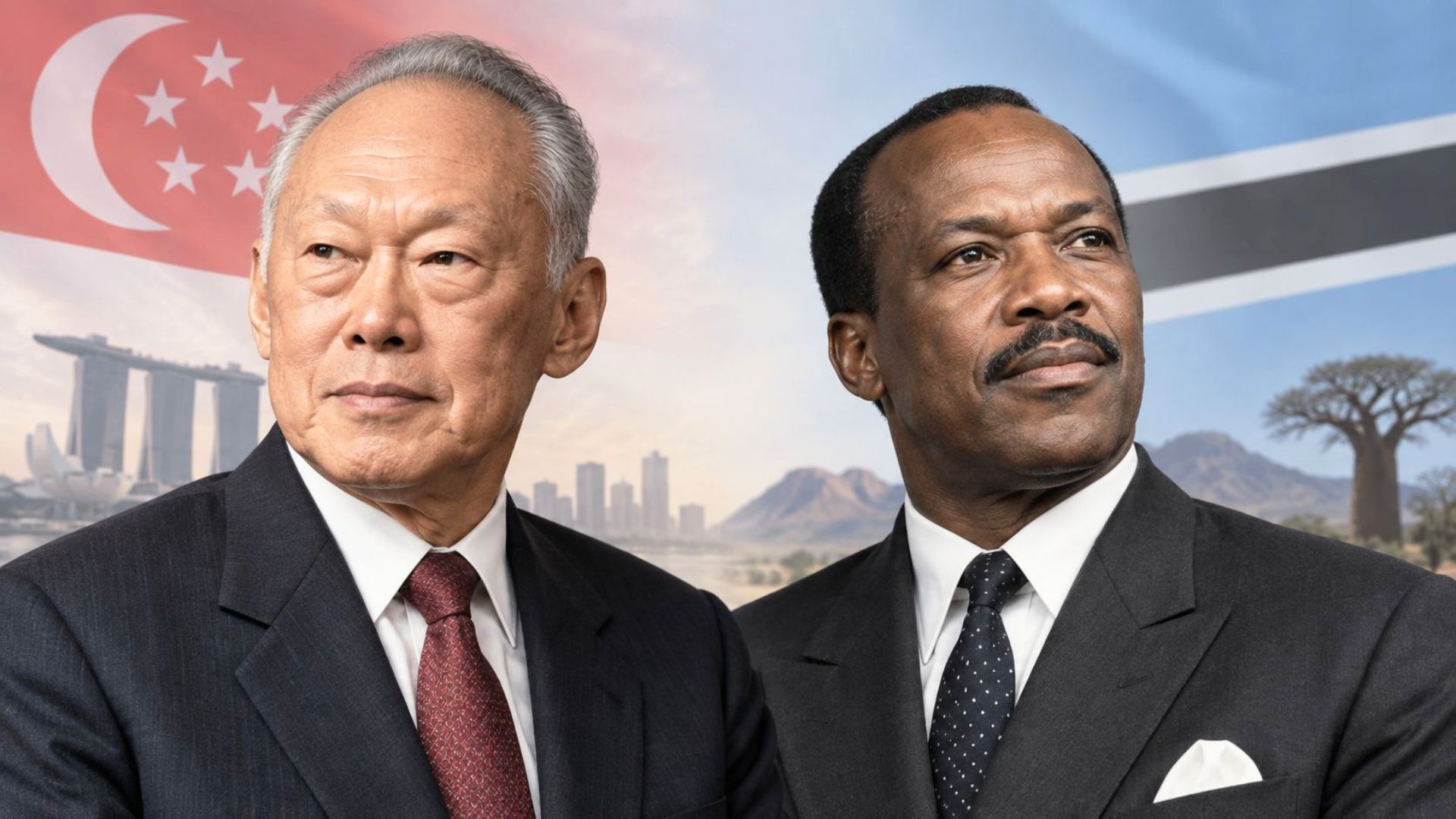
Two countries. Two difficult beginnings. One shared lesson: nation-building often requires practical decisions rather than politically satisfying ones.
Singapore’s Lee Kuan Yew and Botswana’s Seretse Khama governed in very different political and regional environments, but both faced a similar problem after independence: how to build functioning states with limited resources, vulnerable economies and institutions that were still developing.
Their approaches were not identical, and their political legacies should not be treated as interchangeable.
But one feature stands out in both stories – a willingness to retain useful institutions, expertise and partnerships when immediate rejection might have carried greater political appeal.
Singapore: Preparing for life after the British
When Singapore became independent in 1965, British military forces remained a major part of its economy and security environment.
The British bases supported thousands of jobs, while military spending accounted for roughly 14 to 20 percent of Singapore’s economy, depending on the measure and period cited. Britain later accelerated plans to withdraw its forces by 1971, confronting the young country with the prospect of major job losses and lost spending.
It would therefore be inaccurate to describe Lee simply as choosing to let British forces stay indefinitely or striking a straightforward “stay and pay” arrangement. The decision on withdrawal was ultimately Britain’s.
Singapore instead focused on managing the transition.
Lee’s government accelerated industrialization, sought foreign investment, expanded manufacturing and prepared Singapore to replace the economic activity that would disappear with the military bases. The government also built up its own defense capability as British forces departed.
The calculation was practical: Singapore could not afford to treat economic independence as a matter of symbolism alone. It needed jobs, investment, security and time to build institutions capable of supporting the new state.
Botswana: Independence without throwing expertise away
Botswana faced an equally daunting starting point when it gained independence in 1966.
The country was among the world’s poorest, with little infrastructure and a severe shortage of trained professionals. A World Bank assessment notes that Botswana had only six kilometers of paved roads at independence and very limited educational and health infrastructure.
Its civil service also remained heavily dependent on expatriate personnel.
Rather than rapidly replacing foreign officials regardless of experience, Seretse Khama’s government pursued gradual localization. Botswana continued using expatriate staff where necessary while emphasizing training so qualified Batswana could progressively take over government positions.
The approach reflected a recognition that political independence did not instantly create the technical expertise required to run ministries, manage public finances or build a professional bureaucracy.
That did not mean leaving colonial structures untouched. Botswana developed its own institutions and steadily expanded local control. But it avoided replacing experienced personnel faster than qualified citizens could fill their roles.
Khama had personal reasons to resent British policy. His marriage to Ruth Williams, a white Englishwoman, triggered political controversy, and British authorities exiled him from Bechuanaland before allowing him to return in 1956 after he renounced his claim to the chieftainship.
Yet as president, his government emphasized institution-building, racial inclusion and economic development rather than allowing that history to dictate every policy choice.
Different leaders, similar calculation
The development stories of Singapore and Botswana cannot be explained by pragmatism alone.
Singapore benefited from its strategic position and pursued aggressive industrialization and international trade. Botswana later benefited enormously from diamond discoveries, while its government earned recognition for relatively strong institutions and the management of mineral revenues.
Their political systems and leadership styles also differed significantly.
But both countries demonstrate a useful principle: independence does not require rejecting everything inherited from the past.
Sometimes governments must keep expertise they still need, work with partners they may disagree with, or delay politically popular decisions until stronger institutions are ready.
The bigger question is whether those compromises serve a clear national goal.
Lee’s Singapore used the years surrounding British withdrawal to build defense capability, attract investment and restructure its economy.
Khama’s Botswana used expatriate expertise while gradually developing a professional local civil service.
Neither approach was about preserving colonial rule.
It was about managing the difficult period after it.
For modern governments, the lesson is less dramatic but more useful: symbols matter, but functioning institutions matter more. Political slogans cannot replace trained people, sound policy or long-term planning.
Strong leadership is not simply about appearing decisive.
Sometimes it is knowing what must be changed immediately, and what must be kept long enough to build something better.