
News
PH set to resume e-Visa for China in November – embassy

By Joyce Ann L. Rocamora, Philippine News Agency
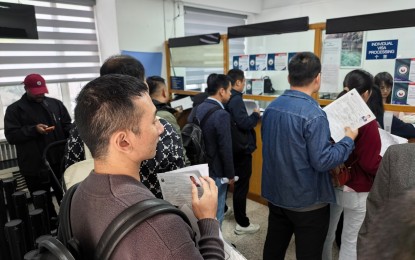
E-VISA. Visa applicants line up at the Philippine Embassy in Beijing’s Consular Section in this undated photo. The Philippine Embassy in Beijing announced on Wednesday (Oct. 15, 2025) that the Philippine government is set to resume its e-Visa program for Chinese nationals in China in November 2025. (Photo: PNA)
MANILA – The Philippine government is set to resume its e-Visa program for Chinese nationals in China next month, the Philippine Embassy in Beijing announced on Wednesday.
The e-Visa system allows visa applications to be made online, making the process more convenient for those visiting the Philippines for a non-extendible period of 14 days.
Once the system is rolled out, Chinese applicants who will visit the Philippines for tourism or business purposes can apply for the e-Visa, provided they are entering through the Ninoy Aquino International Airport (NAIA) in Metro Manila or the Mactan-Cebu International Airport.
The embassy said it will soon provide more details about the system, including the relevant websites and procedures for the submission of requirements.
Philippine Ambassador Jaime FlorCruz said the embassy, as well as the Philippine Consulates in Chongqing, Guangzhou, Hong Kong, Macau, Shanghai, and Xiamen, will all serve as issuing posts of e-Visa for qualified applicants residing in mainland China and its Special Administrative Regions.
The embassy said this upcoming launch forms part of its “continuing efforts to strengthen people-to-people exchange and facilitate trade and tourism” with China.
“The implementation of the e-Visa comes at an opportune time,” FlorCruz said.
“Under the leadership of Secretary Ma. Theresa Lazaro, the Department of Foreign Affairs met with the Chinese Ministry of Foreign Affairs in July 2025 for the Joint Consular Consultations. The meeting discussed the importance of people-to-people exchange–incidentally also our thrust as the Philippine Embassy commemorates the 50th anniversary of bilateral relations this year,” he added.
The e-Visa program will tap the services of VFS Global in China, but will use the same system designed by the Department of Information and Communications Technology (DICT) in 2023.
First launched and tested in Manila in 2023, the embassy said the e-Visa is expected “not only to enhance the efficiency of daily consular operations but also significantly improve the delivery of services to the public.”
Meanwhile, it said Chinese travelers who wish to stay in the Philippines for more than 14 days, as well as other eligible nationals living in China, may still apply for the conventional visa through the nearest Visa Application Centers that will open in Beijing, Chongqing, Fuzhou, Guangzhou, Hong Kong, and Shanghai.
Earlier, Foreign Affairs Spokesperson Angelica Escalona said the Philippines is ready to meet the demand should there be an increase in tourist visa applications in China.
Before the pandemic, China was the country’s second top source market with 1.7 million visitors in 2019, lagging only behind South Korea with 1.9 million.




















