

By H. Christopher Frey, North Carolina State University; The Conversation
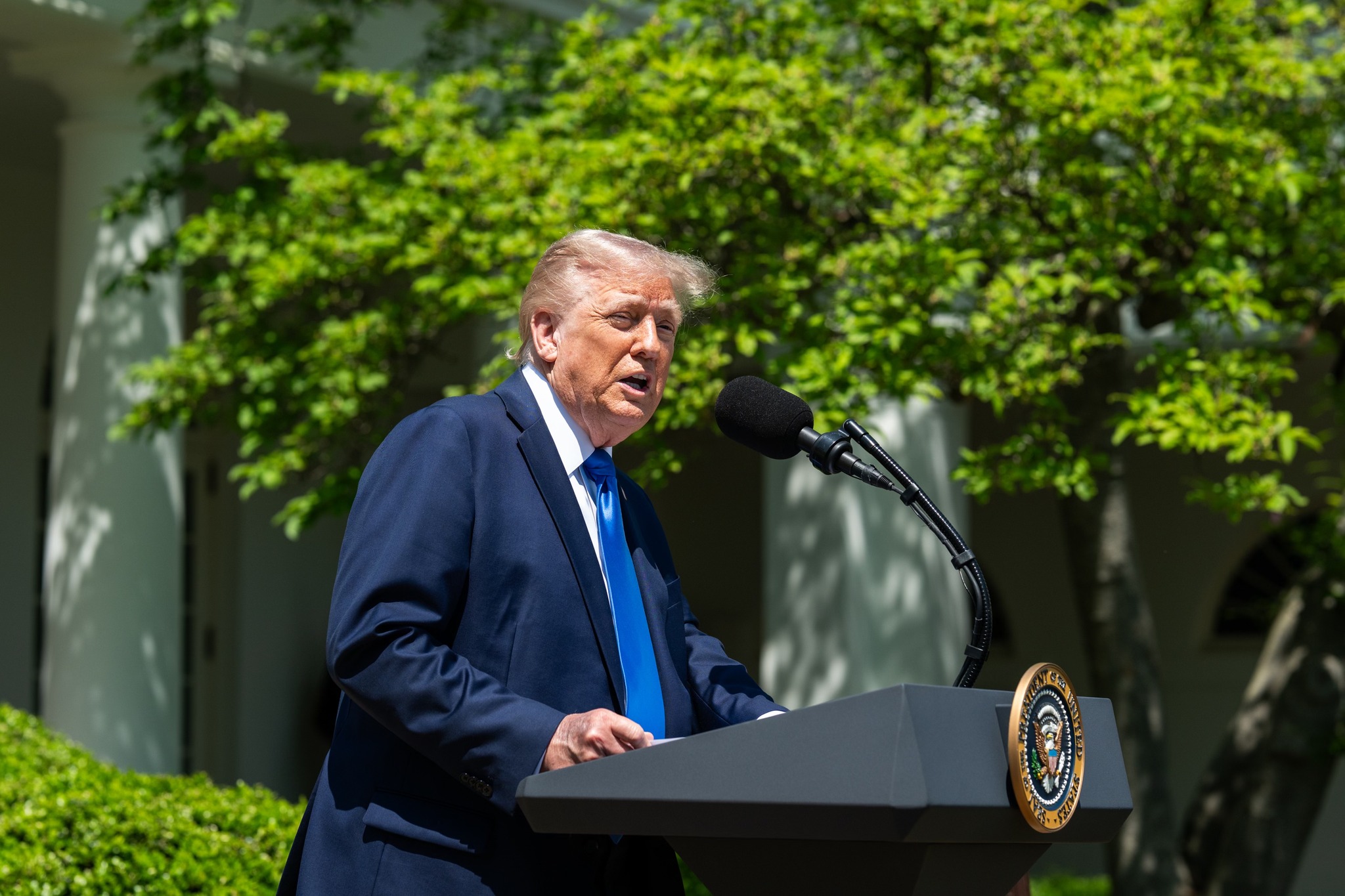
Trump’s executive order focuses on reproducibility. (Official White House File Photo by Joyce N. Boghosian; The White House/Facebook)
The first time Donald Trump was president, the head of the U.S. Environmental Protection Agency developed a regulation known as the “science transparency” rule. The administration liked to call it the “secret science” rule.
“Transparency” sounds positive, but this rule instead prevented the EPA from using some of the best available science to protect human health.
For example, it required the EPA to ignore or downplay studies that established links between exposure to chemicals and health damage if those studies were based on confidential patient information that could not be released to the public. The problem: Many health studies, including those underpinning many U.S. pollution rules, rely on confidential patient information.
A U.S. District Court struck down the rule on procedural grounds a few weeks after it was issued. But now, the idea is back.
Trump’s so-called Restoring Gold Standard Science executive order of May 23, 2025, resurrects many features of the EPA’s vacated rule, but it applies them to all federal agencies.
To many readers, the executive order might sound reasonable. It mentions “transparency,” “reproducibility” and “uncertainty.” However, the devil is in the details.
What’s wrong with transparency and reproducibility?
“Transparency” implies that scientists should adequately explain all elements of their work, including hypotheses, methods, results and conclusions in a way that helps others see how those conclusions were reached.
“Data transparency” is an expectation that scientists should share all data used in the study so other scientists can recalculate the results. This is also known as “reproducibility.”
Trump’s executive order focuses on reproducibility. However, if there are errors in the data or methods of the original study, being able to reproduce its results may only ensure consistency but not scientific rigor.
More important to scientific rigor is “replicability.” Replicability means different scientists, working with different data and different methods, can arrive at consistent findings. For example, studies of human exposure to a set of pollutants at different locations, and with different populations, that consistently find relationships to health effects, such as illness and premature death, can increase confidence in the findings.
Replicability doesn’t require releasing confidential health data, as reproducibility would. Instead, it looks for the same results broadly from other sources.
The science transparency rule in the first Trump administration was intended to limit the EPA’s ability to consider epidemiologic studies like those that established the health harms from exposure to secondhand smoke and to PM2.5, fine particles often from pollution.
Many large-scale studies that assess how exposure to pollution can harm human health are based on personal data collected according to strict protocols to ensure privacy. Preventing policymakers from considering those findings means they are left to make important decisions about pollution and chemicals without crucial evidence about the health risks.
These attempts to create barriers to using valid science echoed tactics used by the tobacco industry from the 1960s well into the 1990s to deny that tobacco use harmed human health.
Uncertainty: A matter of balance
Trump’s new executive order also emphasizes “uncertainty.”
In the first Trump administration, the EPA administrator and his hand-picked science advisers, none of whom were epidemiologists, focused on “uncertainty” in epidemiological studies used to inform decisions on air quality standards.
The EPA’s scientific integrity policy requires that policymakers “shall not knowingly misrepresent, exaggerate, or downplay areas of scientific uncertainty associated with policy decisions.”
That might sound reasonable. However, in the final 2020 rule for the nation’s PM2.5 air quality standard, EPA Administrator Andrew Wheeler stated that “limitations in the science lead to considerable uncertainty” to justify not lowering the standard, the level considered unhealthy. PM2.5 comes largely from fossil fuel combustion in cars, power plants and factories.
In contrast, an independent external group of scientific experts, which I was part of as an environmental engineer and former EPA adviser, reviewed the same evidence and came to a very different conclusion. We found clear scientific evidence supporting a more stringent standard for PM2.5.
Skepticism versus denial
The executive order also requires that science be conducted in a manner that is “skeptical of its findings and assumptions.”
A true skeptic can be swayed to change an inference based on evidence, whereas a denialist holds a fixed view irrespective of evidence. Denialists tend to cherry-pick evidence, set impossible levels of evidence and engage in logical fallacies.
The first Trump administration stacked the EPA Clean Air Scientific Advisory Committee, which advises EPA on setting health-protective air quality standards, with opponents of environmental regulation, including people connected to industries the EPA regulates. The committee then amplified uncertainties. It also shifted the burden of proof in ways inconsistent with the statutory requirement to protect public health with an adequate margin of safety.
The current administration has been dismantling science advisory committees in various agencies again and purging key EPA committees of independent experts.
Who decides when politics trumps science
According to Trump, “violations” of his executive order will be determined by a “senior appointee designated by the agency head.” This means a political appointee accountable to the White House. Thus, science in each federal agency will be politicized.
The political appointee is required to “correct scientific information.”
Anyone can file a “request for correction” regarding a published agency report. During the first Trump administration, chemical companies or their representatives repeatedly filed requests for changes to final EPA toxicity assessments on ethylene oxide and chloroprene. The administration delayed health-protective actions, which were finally addressed during the Biden administration for both chemicals.
The request for correction process is intended to correct errors, not to bias assessments to be more favorable to industry and to delay protective actions.
The bottom line on Trump’s ‘gold standard’
While the language of the executive order may seem innocuous based on a casual reading, it risks undermining unbiased science in all federal agencies, subject to political whims.
Setting impossible bars for “transparency” can mean regulators ignore relevant and valid scientific studies. Overemphasizing uncertainties can be used to raise doubt and unduly undermine confidence in robust findings.
A politicized process also has the potential to punish federal employees and to ignore external peer reviewers who have the temerity to advance evidence-based findings contrary to White House ideology.
Thus, this executive order could be used to deprive the American public of accurate and unbiased information regarding chemicals in the environment. That would prevent the development of effective evidence-based policies necessary for the protection of human health, rather than advancing the best available science.
H. Christopher Frey, Glenn E. Futrell Distinguished University Professor of Environmental Engineering, North Carolina State University
This article is republished from The Conversation under a Creative Commons license. Read the original article.




















