
Canada News
Wildfire-monitoring satellite system will be ‘game changer’ in North, officials say


Vehicles make their way through wildfire smoke on Yukon’s North Klondike Highway in July 2022. The new WildFireSat constellation will provide daily measurements of fire intensity which will also help with smoke and air quality forecasting, according to the Canadian Space Agency. (Jackie Hong/CBC)
By RCI, CBC News
Canadian Space Agency announced $72M WildFireSat constellation this month
A new satellite system for monitoring wildfires in Canada will be a boon to firefighting efforts in the North, officials say.
“I think it will be a game-changer, in terms of not only us internally seeing this, but also public and media being able to see some more accurate real-time information,” said Mike Smith, the chief meteorologist with Yukon Wildland Fire Management.
The Canadian Space Agency announced plans for the new $72-million WildFireSat constellation earlier this month. The contract to design it went to Ontario-based exactEarth Ltd., a subsidiary of Spire Global Canada, and the plan is for it to be functional by 2029.
In the meantime, NASA’s VIIRS and MODIS satellites will still be providing useful data for Canadian firefighters — though they’re near the end of their lifespan, Smith said. The new WildFireSat constellation is meant to effectively replace those once they’re gone.
Smith says WildFireSat will “both add to what we have now, and improve what we have now.”
The constellation will consist of seven microsatellites equipped with infrared sensors that measure daily how much heat is being given off by wildfires. That can help track the intensity of fires and how quickly they’re spreading.

Smith says the detail is “surprisingly good.”
“It’s certainly not something that is the only thing we look at, but it can pick out quite a bit of detail in terms of where the fire is, if it’s approaching or if it’s crossed a river or lake,” he said.
“It does give us quite a bit of information.”
He also said that it will orbit from pole to pole, and will pass over Canada each day during “peak burns.”
“So late afternoon, early evening, when the fires are generally at their most active. And that’s something that we’ve never had before in Canada,” he said.
WildFireSat data will also help with smoke and air quality forecasting, according to the Canadian Space Agency.
Smith also says a big selling point for the government-owned WildFireSat is that the data will be accessible to the public.
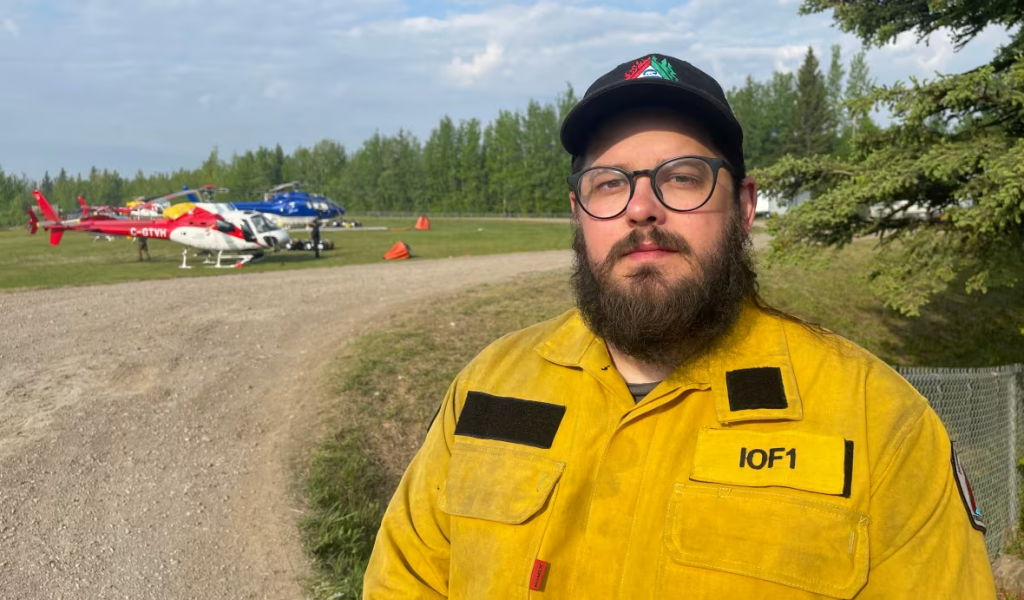
“We get quite a few calls every summer from tourism operators, paddlers looking for information from some of these remote fires, how it might affect their trips and safety,” he said.
“We want the public to be able to see this. And with the data being open and lots of smart people out there, have no doubt that somebody will build something neat that we haven’t thought of.”
Mike Westwick, manager of wildfire prevention and mitigation for the N.W.T. government, shares Smith’s enthusiasm for the new system. He said a “really cool tidbit” is that it will be polar-orbiting.
“Meaning that the N.W.T. is actually going to get better coverage than a lot of the rest of the country, with more frequent overpasses because of our northern latitudes. So that’s pretty cool. It’s a significant improvement over what we have available,” Westwick said.
“More intelligence ultimately means a better fire response and better protection for things that people care about out there, like communities and infrastructure, homes, cabins, you name it.”




















