Canada News
Canada’s response to Trump tariff threats risks unintended consequences

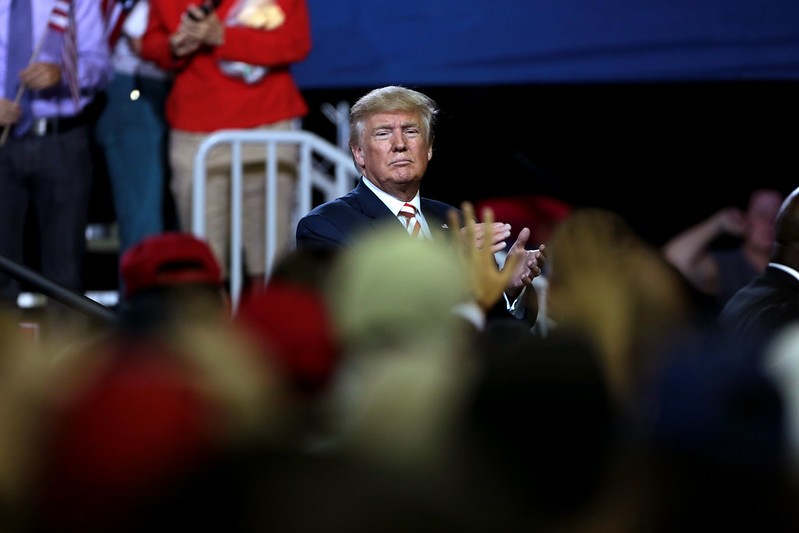
Because the proposed tariffs would bring about a deep economic recession, Canadian policymakers have scrambled to respond to the threat by proposing actions designed to appease Trump. (File Photo by Gage Skidmore/Flickr, CC BY-SA 2.0)
Fentanyl and migrant trafficking have taken centre stage following U.S. president-elect Donald Trump’s announcement of plans to impose 25-per-cent tariffs on all Canadian and Mexican imports when he takes office Jan. 20.
While Canada’s contribution to these problems is small relative to Mexico’s, drug trafficking across the northern border is a growing problem. In 2024, fentanyl seizures along the U.S.-Canada border were nearly four times higher than the average from the previous two years, according to U.S. Customs and Border Protection data.
Because the proposed tariffs would bring about a deep economic recession, Canadian policymakers have scrambled to respond to the threat by proposing actions designed to appease Trump.
However, research indicates those approaches will not work and could lead to even greater harm. A better approach would be to wait out the storm that will hit U.S. consumers hard, too, and to seek free trade agreements with a broader range of countries.
Canada scrambling to act
The federal government has already committed $1.3 billion to strengthen border security in the wake of Trump’s threats.
The Canadian Border Services Agency will be tasked with increasing surveillance at ports of entry, while the RCMP will be given more resources to disrupt criminal networks at their source.
However, Canadian policymakers should be wary of this approach because its limited efficacy is unlikely to justify its exorbitant cost. Furthermore, it risks increasing criminal violence in Canada.
Some of the funding will be used for initiatives that aim to intercept drugs or migrants before they cross into the United States. However, research shows that drug traffickers respond to such efforts by shifting their previous routes to avoid crackdowns.
Because Canada and the United States share a nearly 9,000-kilometre border, giving traffickers access to many alternate routes, increasing surveillance at ports of entry will go only so far.
Similar results have been found with border walls, which have cost American taxpayers billions but had limited effect in deterring migrant trafficking.
Research shows some approaches backfire
The planned spending also aims to disrupt criminal networks that facilitate the trafficking of drugs and migrants.
This often involves arresting the top leaders of criminal enterprises because they are more likely to be central to the organization’s success. At face value, the policy appears to make sense.
Trump appears to believe this is a viable approach and is currently floating the possibility of sending U.S. troops to Mexico to take out the heads of criminal enterprises.
Arresting the leaders of organizations that traffic drugs and migrants could hypothetically cause them to collapse and cease operations.
However, my research shows that this policy falls short of achieving its goals. Instead, it produces unintended consequences for public safety, empowering the organization’s rivals to compete violently with the targeted group to expand their market share.
My work used Mexico, where President Felipe Calderón aggressively implemented the policy following his election in 2006. Specifically, I studied whether the policy led the targeted criminal groups to leave the market and how it affected the decisions of other criminal actors.
To do this, I needed data on when and where specific criminal enterprises operated. This was complicated by the fact that Mexican drug markets have become increasingly competitive, making these groups difficult to track.
To overcome this challenge, I trained three machine-learning algorithms to extract this information from a database containing more than 21 million newspaper articles.
I found that in areas where leaders were captured or killed by law enforcement, the number of existing criminal groups did not decline.
Instead, the policy incentivized other criminal enterprises to enter the territory. In line with this, homicide rates increased, with a significant portion likely involving civilian victims.
Canada should not give in
This research offers a cautionary tale for Canadian policymakers seeking to appease Trump by doubling down on the “war on drugs.”
While Canada’s criminal landscape differs from Mexico’s, anecdotal evidence suggests that targeting the leaders of criminal enterprises may also increase conflict between Canadian gangs.
The Quebec biker war, in which motorcycle gangs violently competed for the province’s narcotics trade, began following a major arrest of one gang leader.
The conflict, which lasted for nearly two decades, resulted in more than 80 bombings, approximately 130 acts of arson, and 20 cases of disappearances. More than 160 lives were lost, and more than 200 individuals were injured, many of them innocent bystanders.
Some may argue that these costly measures are justified if they convince Trump that Canada is taking action and thus eliminate or mitigate his tariff threat.
However, this assumes a bargaining partner who engages in good faith — an assumption undermined by his recent statements about using economic force to make Canada the “51st state.”
Even if he were negotiating in good faith, he is unlikely to be swayed by policies with limited efficacy. Furthermore, even if Trump were convinced, enacting this plan would only set a precedent for similar demands in the future.
Instead, Canada’s best option is to weather the storm. Trump’s proposed broad-based tariffs would be catastrophic for American consumers because the cost would be passed on to them, fuelling inflation and making them politically unsustainable.
Given the growing support for protectionism globally, Canada should also mitigate its exposure to this type of geopolitical risk by pursuing free trade agreements with a broader range of partners.
This article first appeared on Policy Options and is republished here under a Creative Commons license.