
Canada News
Tree planting may not be effective climate change solution for the North, study finds

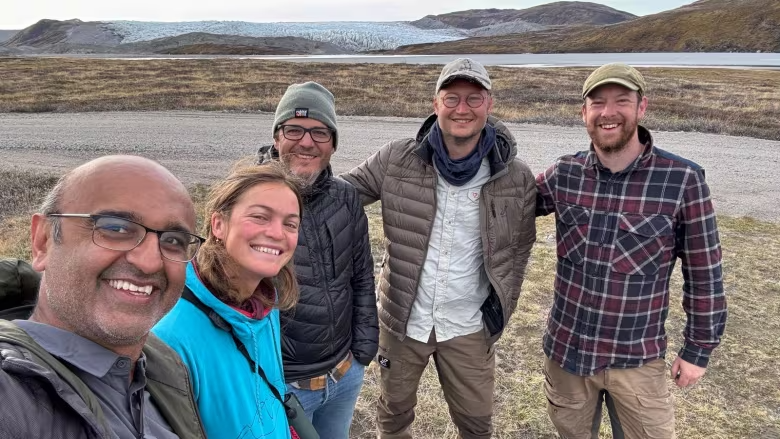
Members of the research team in the field in Greenland in the summer of 2024. From left to right: Yadvinder Malhi, Mathilde le Moullec, Marc Macias-Fauria, Jeppe Kristensen and Jeff Kerby. The researchers were looking at the effectiveness of tree planting at high latitudes as a climate solution. (Submitted by Jeppe Kristensen)
Researcher says tree planting at high latitudes may not prevent warming
Planting trees is a popular way to mitigate climate change, but in northern and Arctic regions, it may not be an effective solution.
A recent study published in the journal Nature Geoscience, found that tree planting in northern boreal and Arctic regions is not only ineffective at mitigating climate change, but may actually cause net warming.
“Tree planting, in the many areas of the tropics and lower latitudes is of course something that can help be part of the solution to mitigate climate change,” said Jeppe Kristensen, lead author of the paper from Aarhus University in Denmark. “However, you can’t necessarily place that in a different context and expect it to have the same effect.”
Climate change mitigation solutions are particularly important for the Arctic, where climate change has been happening three to four times faster than the global average. In recent years, numerous tree planting projects in high-latitude regions have started. However, Kristensen worries that these projects are not an effective solution for these regions.
Kristensen and his colleagues found that in northern boreal and Arctic regions, where the ground is snow-covered for much of the year, planting trees creates shade and prevents snow from reflecting sunlight. The resulting warming will counteract any carbon storage that trees provide.
“Into the early summer you still have snow on the ground in large portions of this area and that means that when you also then have 20 to 24 hours of sunlight, a lot of that sunlight is reflected on a snow-covered surface,” Kristensen said. “If you have a tree surface, then only 10 per cent will be reflected as opposed to 75 per cent from a snow-covered surface.”
The study also suggests that planting trees could disturb carbon stored in the soil and release greenhouse gases into the atmosphere. This is particularly significant in high-latitude regions, where large amounts of carbon are stored in permafrost.
“Soils in the Arctic store more carbon than the atmosphere and biosphere combined,” Kristensen said. “It’s actually a very vulnerable type of carbon, it’s really vulnerable to disturbances. Something like cultivating for planting releases a lot of carbon from these soils.”
Local biologist cautions against ruling out tree planting
Donald Reid, a Whitehorse-based wildlife biologist, is cautious about the conclusions made in the study. He worries that ruling out tree planting in all northern and Arctic regions is not the right approach.
“They’ve essentially said we shouldn’t be tree planting and I disagree with that,” said Reid. “There may be some reasonable opportunities for tree planting in some areas.”
In northern boreal regions, many previously-treed areas have lost tree cover, due to human-caused disturbances or wildfires. Reestablishing tree cover in these areas may have an overall positive effect, according to Reid.
“There are areas, including parts of Eagle Plains in north Yukon, where repeated burns have resulted in lack of tree cover,” said Reid. “Replanting trees at the right density in those places may well help lichen regrowth and bolster the winter range for the Porcupine caribou.”
Kristensen agrees that reforesting areas that have lost tree cover should not be avoided. However, he does suggest that no new trees should be added to ecosystems that did not already have tree cover.
Reid, on the other hand, wonders if there is opportunity in certain areas of the Arctic tundra for experimental tree planting.
“We know from how the climate is changing that trees could well be growing a lot further north than the current tree line,” Reid said. “There’s lots of areas in the Arctic, where there isn’t a whole lot of carbon in the soils. Those could be suitable places to plant trees.”
Kristensen argues that tree planting in the Arctic is too consequential, and in areas like southern Greenland, where trees have been planted at high latitudes, tree growth occurs so slowly that significant reductions in greenhouse gases may not happen for 70 to 100 years after trees are planted.
No matter the regional solutions, both Kristensen and Reid agree that the Arctic is particularly vulnerable to climate change and that a global reduction in greenhouse gas emissions is the most effective way to protect the region.




















