

By Dorje C. Brody, University of Surrey, The Conversation
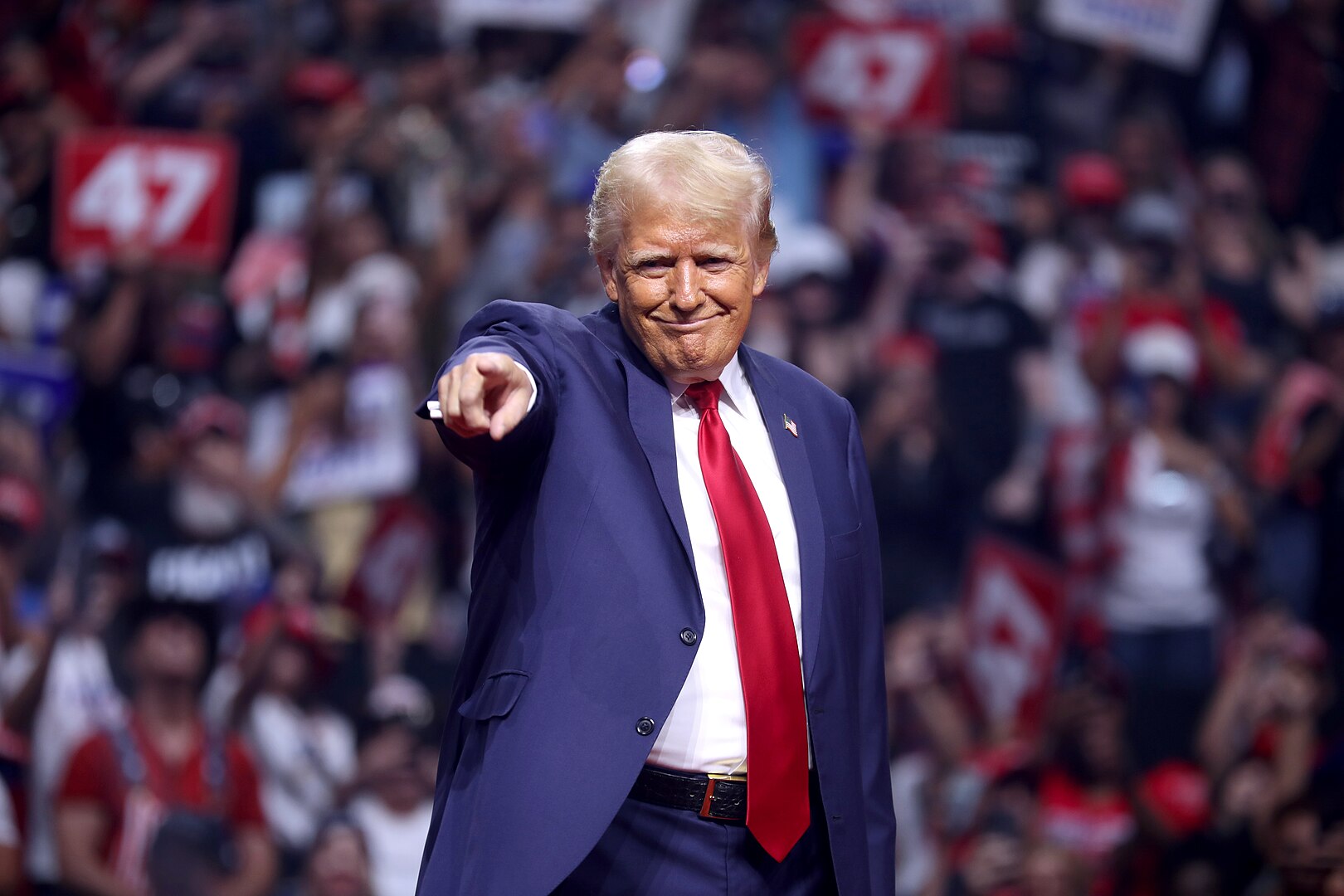
The spectacular comeback of US president-elect Donald Trump has taken the world by surprise. No doubt people can point to various explanations for his election victory, but in my view, the science of information will pave the way towards deeper insights. Unless the Democrats – and their counterparts around the world – can develop a better understanding of how people receive and reject information, they will never fully understand what happened or successfully fight elections in the future.
There is a fundamental law of nature, known in physical science as the second law. This says that, over time, noise will overwhelm information and uncertainties will dominate. Order will be swamped by confusion and chaos. From a single particle to the whole universe, every system known to science obeys this law. That includes political systems, or societies.
Whenever there is progress in communication technology, people circulate more and more inessential or inaccurate information. In a political system, this is what leads to the noise domination described by the second law.
Want more politics coverage from academic experts? Every week, we bring you informed analysis of developments in government and fact check the claims being made.
Sign up for our weekly politics newsletter, delivered every Friday.
In science, the quantity that measures the degree of uncertainty is known as entropy. The second law therefore says that entropy can only increase, at least on average.
While entropy does not reduce spontaneously, it is possible to reduce it by spending energy – that is, at a cost. This is exactly what life is about – we create internal order, thus reducing entropy, by consuming energy in the form of food.
For a biological system to survive, it has to reduce uncertainties about the state of its environment. So there are two opposing trends: we don’t like uncertainties and try to reduce them. But we live in a world dominated by growing uncertainties. Understanding the balance of these two forces holds the key to appreciating some of the most perplexing social phenomena – such as why people would vote for a man who has been convicted of multiple crimes and strongly signalled his autocratic tendencies.
The world is filled with uncertainties and information technology is enhancing the level of that uncertainty at an incredible pace. The development of AI is only propelling the increase of uncertainty and will continue to do so at an unimaginable scale.
In the unregulated wild west of the internet, tech giants have created a monster that feeds us with noise and uncertainty. The result is rapidly-growing entropy – there is a sense of disorder at every turn.
Each of us, as a biological system, has the desire to reduce this entropy. That is why, for example, we instinctively avoid information sources that are not aligned with our views. They will create uncertainties. If you are a liberal or leftwing voter and have found yourself avoiding the news after Trump’s re-election, it’s probably linked to your desire to minimise entropy.
The need for certainty
People are often puzzled about why societies are becoming more polarised and information is becoming more segmented. The answer is simple – the internet, social media, AI and smartphones are pumping out entropy at a rate unseen in the history of Earth. No biological system has ever encountered such a challenge – even if it is a self-imposed one. Drastic actions are required to regain certainties, even if they are false certainties.
Trump has grasped the fact that people need certainty. He repeatedly offered words of reassurances – “I will fix it”. Whether he will is a more complex question but thinking about that will only generate uncertainties – so it’s better avoided. The Democrats, in contrast, merely offered the assurance of a status quo of prolonged uncertainties.
Whereas Trump declared he would end the war in Gaza, Kamala Harris remarked that she would do everything in her power to bring an end to the war. But the Biden-Harris administration has been doing exactly that for some time with little progress being made.
Whereas Trump declared he would end the war in Ukraine, Harris remarked that she would stand up against Putin. But the Biden-Harris administration has been merely sending weapons to Ukraine to prolong the war. If that is what “standing up against Putin” means, then most Americans would prefer to see a fall in their grocery prices from an end to the war.
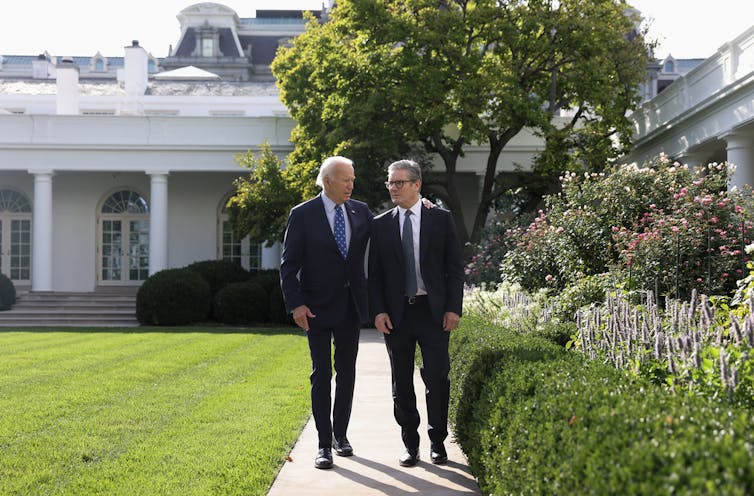
Flicker/Number 10, CC BY
Harris argued that Trump is a fascist. This may prove to be true, but what that means exactly is unclear to most Americans.
While Harris’s campaign message of hope was a good initiative, the Democrats failed in delivering certainty and assurance. By the same token they failed to control the information space. Above all, they failed the Americans because, while Trump may well bring an end to the war in Ukraine and Gaza in some form, his climate policy will be detrimental to all Americans, with lasting impacts.
Without understanding the science of information, the blame game currently underway will not bring Democrats anywhere. And there are lessons to be learned for other centre-left governments, like the UK Labour government.
It is not entirely inconceivable that the former prime minister Boris Johnson, encouraged by the events in the US, hopes for a dramatic return to the throne at the next general election. If so, prime minister Keir Starmer must find a way to avoid following the footsteps of Biden and Harris. He must provide people with certainty and assurance.
Dorje C. Brody, Professor of Mathematics, University of Surrey
This article is republished from The Conversation under a Creative Commons license. Read the original article.




















