
Canada News
A creek near the Eagle Gold mine in Yukon sees mercury levels spike

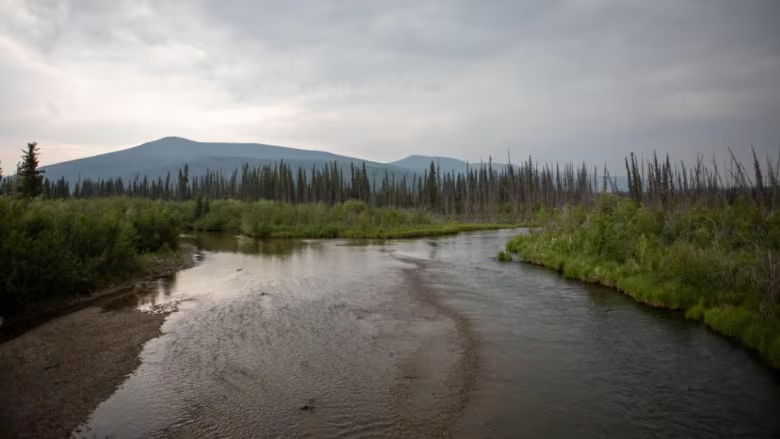
Mercury levels in Haggart Creek are higher than they should be — in some cases, much higher. (Camille Vernet/Radio-Canada)
By Julien Greene, RCI, CBC News
Territory says it’s studying the issue; scientists say risks are severe
The Yukon government has for weeks been reporting spikes in mercury levels in a free flowing creek near the Eagle Gold mine — and at least one environmental toxicologist says water needs to be treated immediately.
Since late September, mercury levels have exceeded what’s considered safe for aquatic life at several sites along Haggart Creek, which is near the mine’s heap leach pad.
In June, that facility, where gold is chemically extracted from rock using a cyanide solution, failed, with a massive rockslide severely damaging the system. Walls containing chemical compounds breached, spilling some 300 million litres of cyanide solution.
That solution, the levels of which sharply increased during the summer, is still showing up in the creek, though at lower concentrations. What’s in the red now, though, is mercury, a known neurotoxin.
Water quality guidelines for mercury are 0.02 micrograms per litre of water. Several results show that levels at four areas are far above that threshold, some registering three kilometres downstream from the site.
During the second week of October, one value close to the mine was more than seven times the acceptable level.
Cameron Sinclair, a senior fisheries biologist with the Yukon government, told CBC News mercury can affect how fish breathe; quicksilver can also impact their brains. Over time, he said, there’s a risk of mercury bioaccumulation.
“They’re really putting their energy toward respiration and essentially just trying to breathe better and not putting toward reproduction or growth,” Sinclair said. “We can detect those changes over a long period of time.”
With the help of the First Nation of Na-Cho Nyäk Dun, biologists with the territory are indeed studying the problem, said Sinclair, adding teams, aided by drones, are mapping where fish like Arctic overwinter to get a sense of whether they could be coming into contact with heavy metals and other contaminants.
In the wake of the spill, governments installed a series of fish barriers. Those, Sinclair said, have been removed so as to avoid disrupting grayling’s natural migratory patterns.
Clarifying whether the fish are grappling with what Sinclair calls chronic effect will take years of data collection, he said.
“There’s been no indication of any fish kill. No one has seen that. No one has reported that. That’s good. But this is why we have to sort of get an understanding of where fish are at risk in the winter time.”
‘Prevention is better than cure’
Juan José Alava, an environmental toxicologist, told CBC News mercury is challenging to clean up. That’s because over time, it has the propensity to biomagnify, entering the food web.
“Once it’s in the environment, once it’s in the food web, it’s already in the species,” he said.
Alava said the fix looks like a water treatment plant capable of filtering out heavy metals like mercury.
“I think prevention is better than cure.”
An Oct. 1 first report produced by receiver PricewaterhouseCoopers states the legacy water treatment plant at the mine was not designed to remove cyanide and heavy metals. Instead, the facility worked as a closed loop system, recirculating various solutions. The report states it’s contracted a company to upgrade the system, installing reverse osmosis technology. While the report states progress has been made, it adds “the results of the treatment process to-date have not produced water that is compliant with all regulatory requirements.”
CBC News has repeatedly requested comment from the receiver. It has declined interviews each time, instead deferring to the report.
Alava said bottom line, this is a problem that raises several red flags.
“The issue is that the mercury is already there. This is just in the water. We’re not even talking about mercury that might already be accumulating in the fish.”




















