Canada News
Public transit funding is broken. Montreal may have some ideas to fix it

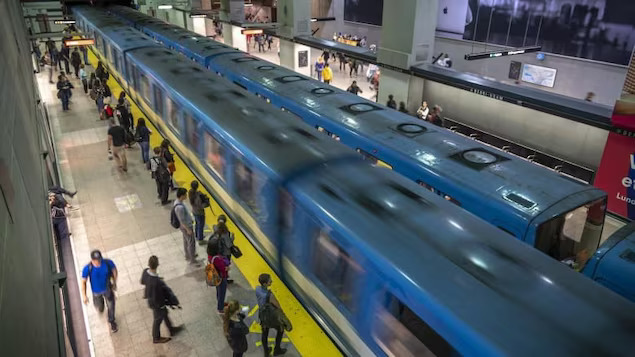
This photo shows people waiting at the Berri-UQAM Metro Station. In recent years, there have been concerns about potential cuts to bus and Metro services due to deficits with the Société de transport de Montréal. (Simon-Marc Charron/Radio-Canada) PHOTO: (SIMON-MARC CHARRON/RADIO-CANADA)
Greater Montreal transit agencies expect growing deficits in coming years
Public transit may be essential, but funding that service has become more and more difficult. Elected officials in Montreal are trying to find solutions to that problem.
With ridership for transit agencies in the greater Montreal region still not back to pre-pandemic levels, their total deficit for 2025 is an estimated $560 million, according to documents from the city of Montreal. In 2028, that number is expected to be just under $700 million.
In recent months, concerns about potential service cuts have led to very public negotiations (new window) between mayors and Quebec’s transport minister, with both sides saying the other should be doing more to address the financial shortfalls.
This past spring, the government offered $200 million to cities, who took the money while adding that it wasn’t enough.
Last Friday, the city of Montreal’s finance and administration commission presented a list of ideas for how to make public transit funding more sustainable and keep bus and Metro services afloat.
WATCH | Explaining why you can’t tap to pay on Montreal buses:
WHY CAN’T YOU TAP TO PAY ON MONTREAL PUBLIC TRANSIT? BECAUSE BUREAUCRACY.
Montreal is behind most major cities when it comes to paying for public transit. For years, the Société de transport de Montréal (STM) has looked into implementing easier payment options, but a series of bureaucratic setbacks has halted the process. The latest development is that you can now buy your tickets for the 747 airport bus line on your phone.
The commission is made up of 12 Montreal-area elected officials, including Pierre Lessard-Blais, the commission’s president and the borough mayor for Mercier–Hochelaga-Maisonneuve.
Here’s a rundown of some its ideas.
Getting more money from taxes
In its report, the commission highlighted several areas where it believes Quebec could be collecting more taxes to help fund public transit.
In 2022, the Legault government decided to reduce the share of the province’s carbon market revenues that goes to funding public transit from 66 per cent to 25 per cent.
As for fuel taxes, three per cent goes to the Autorité régionale de transport métropolitain (ARTM), which is in charge of planning public transit in the greater Montreal area. That three per cent share hasn’t gone up since 2010.
The city’s finance and administration commission recommends bumping the share of carbon market revenues for transit back to 66 per cent.
It also wants have fuel tax and vehicle registration fees indexed annually to the cost of living and be adjustable depending on the type of vehicle.
Taxing more parking lots
Montreal has a tax for parking lots on some non-residential property.
Right now, that tax applies to all downtown parking lots — indoors and outdoors — and outdoor parking lots elsewhere in the city that are larger than 10,000 square metres.
The commission recommends applying that tax to a greater number of outdoor properties in the city.
Find more users, delay rollout of electric buses
As part of its green economy plan, the Quebec government wants 55 per cent of urban buses to be electric by 2030. The commission recommends delaying that timeline. The money set aside to electrify the bus fleet could then be used to help maintain current services.
The commission also believes transit agencies like the STM should come up with marketing campaigns to encourage people to get back on buses, Metros and trains.
Drivers can do more
Although it wasn’t listed as a recommendation, the commission’s report does mention on several occasions the idea of a kilometre tax,
which would see motorists taxed based on how much they drive.
The Communauté métropolitaine de Montréal (CMM) — which represents 82 Montreal-area municipalities — released preliminary findings on a study that indicates a kilometre tax would be possible in the medium and long term, but implementing would mean require legislative changes and technological upgrades.
The commission wants both the CMM and the Quebec government to explore different options for additional public transit funding and for the federal government to be included in those talks.
The commission will present its report at the next city council and agglomeration council meetings in August.
Antoni Nerestant (new window) · CBC News
This article is republished from RCI.