

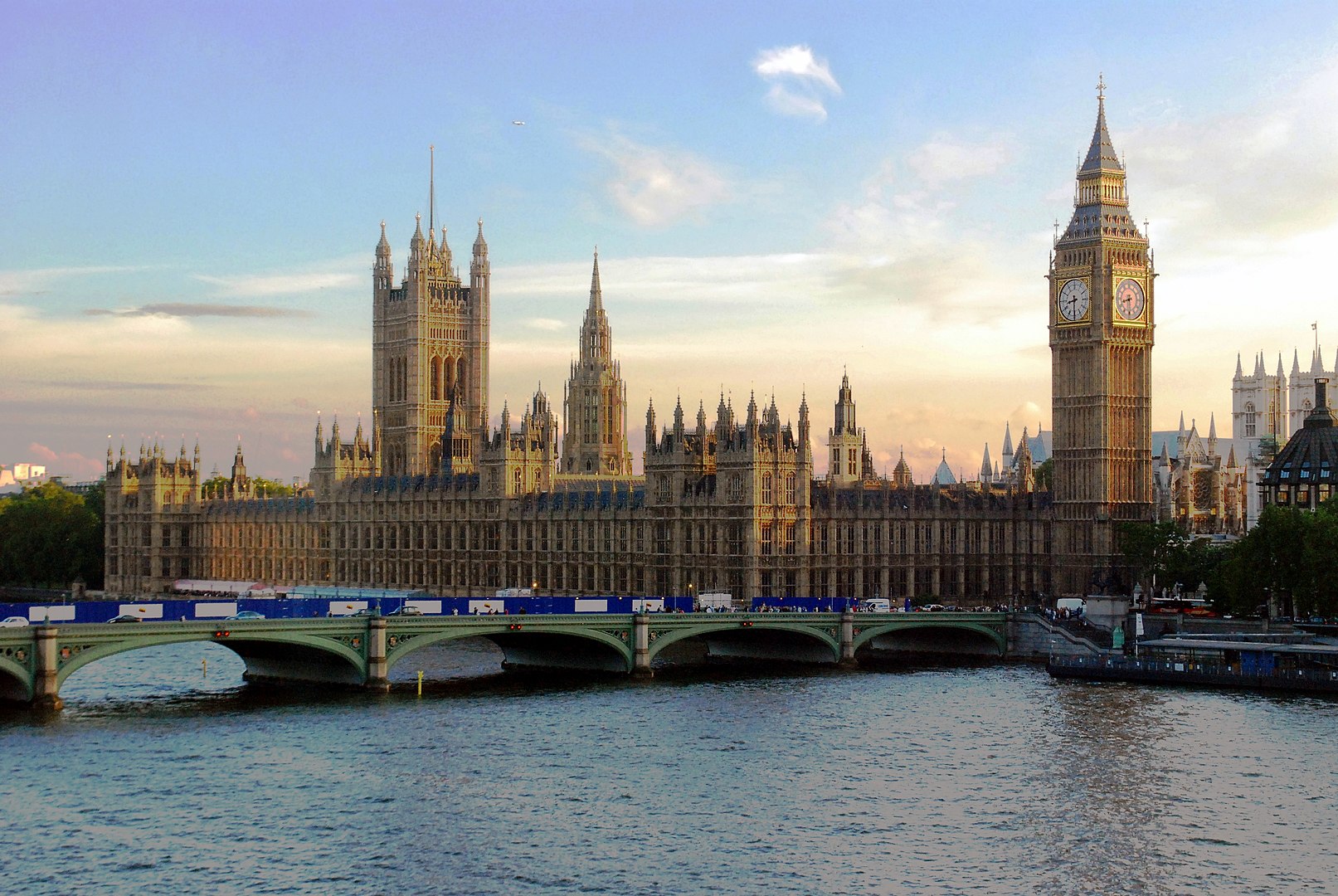
You may be reading this and thinking: “It’s been passed by parliament, of course it’s a law!” (Photo By Mайкл Гиммельфарб (Mike Gimelfarb)/Wikimedia Commons, Public Domain)
After months of deadlock, the House of Lords withdrew its opposition to the safety of Rwanda (asylum and immigration) bill, meaning that it will become law upon receiving royal assent. This legislation declares in UK law that Rwanda is a safe country for the UK to send asylum seekers.
Much has been written about the Rwanda plan’s practical (un)workability, high cost and its perceived cruelty. But one thing we have overlooked is a conceptual question: are there problems with this law that mean it’s not a real law at all?
You may be reading this and thinking: “It’s been passed by parliament, of course it’s a law!” If so, then you’re adopting what is known in legal theory as legal positivism. This is the belief that if a rule has been properly passed (or “posited”, hence the name) by a lawmaking authority, then it’s a valid law.
It’s fair to say that this is probably the dominant position in Anglo-American legal theory – so much so that many people adopt it without even realising they’re doing so. But though it might be dominant, it’s not the only approach we could take.
An alternative was offered by influential American legal theorist Lon Fuller who thought that law was more than this and, like all good teachers, he used a story to explain why.
In his 1964 book The Morality of Law, Fuller invited his readers to imagine a lawmaker, King Rex, who set about to reform the legal system in his kingdom. Rex failed, but in the process, he came to realise that laws must possess eight desirable features:
- they must be generalisable
- they must be publicly available
- they shouldn’t be retroactive
- they should be written in language people can understand
- they cannot contradict other laws
- they cannot require you to do the impossible
- they must be stable through time, and
- when it is applied, the law must be reflect what was passed by the legislator.
Fuller tells us that this is because the whole point of law is to provide a reason for us to behave in a certain way, or to do (or refrain from doing) a certain thing. Because of this, a law that is impossible to follow cannot be a law. Fuller says that each of these qualities are, to a greater or lesser extent, necessary for us to be able to follow the law.
You could make a similar observation about cars. The purpose of a car is to get us from A to B, so is a car without wheels really a car? It might look like a car. It might smell like a car. If you ask someone, they may even begrudgingly tell you that it’s a car, but a really defective one.
Well, Fuller believed the same was true of law. If a rule can’t be complied with, then at best it’s defective and not a good example of what a law should look like – and at worst, it might not be law at all.
Does the safety of Rwanda bill pass the test?
The Safety of Rwanda bill’s purpose is clear: to direct the home secretary, immigration officers, courts and tribunals to hold that Rwanda is a safe country for the purposes of fulfilling the UK’s domestic and international asylum obligations. This is a direct response to the UK Supreme Court’s decision in November 2023 which held that the facts on the ground in Rwanda meant that they could not declare it a safe country.
When it becomes law, this bill would direct courts to ignore this evidence in future cases and declare Rwanda safe regardless. This purpose falls foul of several of Fuller’s criteria. There are issues here around both retroactivity and stability through time – would asylum seekers whose cases are already in the system be affected by this new law, even though it was not in force when they initially sought asylum?
There is an issue around contradicting other legal rules, as Lord Reed held in November that his decision to declare the policy unlawful was grounded in principles of domestic law. Simply ignoring these, as the bill requires decision makers to do, does not make them go away.
Perhaps most worryingly, there is an issue around requiring the impossible in that Rwanda has been found not to be a safe country for asylum seekers. You might reply (as the government has done) that parliament is sovereign and can declare otherwise if wants to.
But parliamentary sovereignty does not empower parliament to alter reality to suit its ends, and that is what this bill does. Like asking us to believe that 2+2=5 (something I hope we would raise an eyebrow at if parliament pursued), it requires all decision makers to ignore documented fact and give legal priority to a fiction.
According to Fuller’s account then, this legislation is like a car with no wheels. It might superficially resemble a law in that it was passed by parliament, but if you look closely you can see there are significant issues around how it is supposed to guide our conduct. At best, it is a highly defective law and one that needs serious rethinking in order to give us good reason to accept its requirements.
Joshua Jowitt, Senior Lecturer in Law, Newcastle University
This article is republished from The Conversation under a Creative Commons license. Read the original article.




















