News
Israel is accused of using white phosphorous. Would this be against international law?

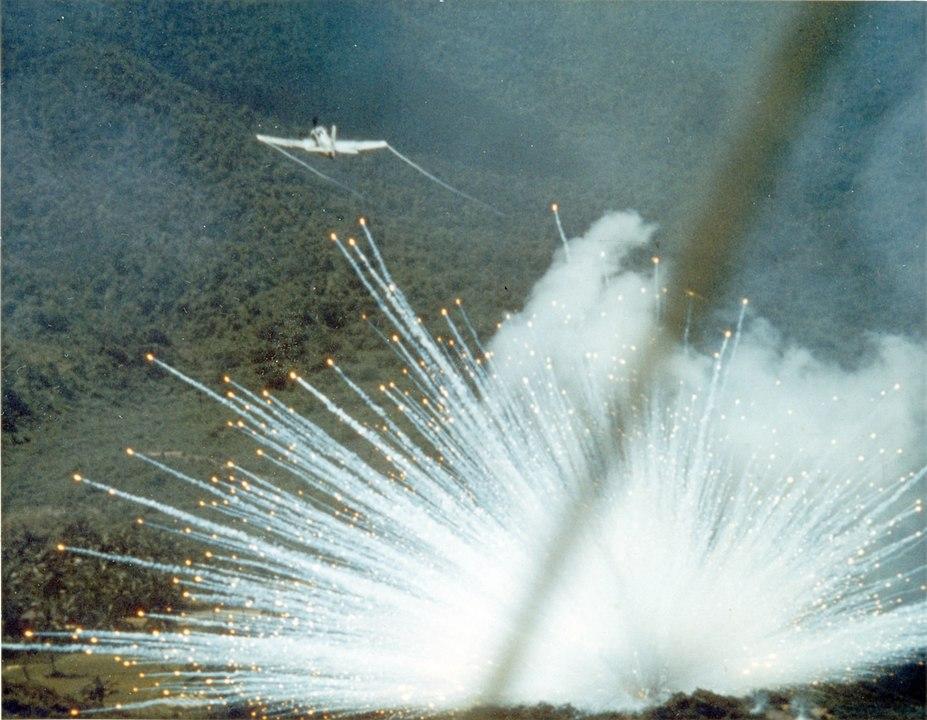
FILE: US Air Force Douglas A-1E Skyraider dropping a 100-pound (45 kg) M47 white phosphorus bomb on a Viet Cong position in South Vietnam in 1966. (Photo By United States Air Force – National Museum of the U.S. Air Force photo/Wikimedia Commons, Public Domain)
Israel’s military is accused of using white phosphorous in an October attack on the Hezbollah militant group in Lebanon, which allegedly injured at least nine civilians.
US National Security Council spokesperson John Kirby said this week the Biden administration was “concerned” about the possible use of white phosphorus munitions and that it would be “asking questions to try to learn a bit more.”
Israel has rejected any allegations of the unlawful use of white phosphorus in Lebanon.
But what are the legal uses of this chemical under international humanitarian law? And can its use be considered a war crime?
How white phosphorous has been used before
White phosphorous is a chemical component that ignites on contact with air and burns at around 1,500 degree Fahrenheit (815 Celsius). It can lead to serious injury and or even death if it comes into contact with humans.
Human Rights Watch regards incendiary weapons, such as white phosphorous and napalm, as “among the cruellest weapons used in contemporary armed conflict” due their impact on the human body. Says one Human Rights Watch researcher:
Incendiary weapons are weapons that set fire or burn people.
White phosphorus can be used defensively, though, as a smokescreen to mask troop movements on the ground, to illuminate the battlefield, or as a signalling device. It can also interfere with an enemy’s infrared optics and weapons tracking systems.
But these incendiary weapons can also be used offensively in mortar bombs, rockets and artillery ammunition.
White phosphorous was used by many adversaries in both the first and second world wars, targeting enemy soldiers and civilians alike.
The US also used white phosphorus, alongside napalm, in the Vietnam War and more recently in Iraq during the battle of Fallujah in 2004 and against Islamic state in both Syria and Iraq.
Russia is also accused of using white phosphorus indiscriminately against civilians and combatants in both Ukraine and Syria.
Human Rights Watch criticised Israel’s use of white phosphorous against Hamas targets in Gaza in 2008–09 and said it was evidence of a potential war crime.
Aware of the negative publicity from these reports, the Israeli Defence Forces pledged in 2013 to stop using white phosphorus on the battlefield, saying it would transition to gas-based smoke shells instead.
What international law says about it
Incendiary weapons fall under the 1980 Convention on Certain Conventional Weapons. This treaty aims to protect civilians by limiting the use of certain weapons deemed particularly dangerous. A protocol specifically focused on incendiary weapons defines them as:
any weapon or munition which is primarily designed to set fire to objects or to cause burn injury to persons through the action of flame, heat, or combination thereof, produced by a chemical reaction of a substance delivered on the target.
White phosphorus is not illegal under international law and the law of armed conflict, as long as long it is being used defensively as a smokescreen or as battlefield illumination.
The targeted use of incendiary weapons directly against civilians, however, is illegal and could be considered a war crime. The use of “air-delivered” incendiary weapons (such as white phosphorus dropped from a plane) against a military target that is in a civilian area is also prohibited.
There is an exception, though, if the military target is “clearly separated” from civilians and all “feasible precautions” are taken to limit incidental loss of civilian life or injuries to civilians.
So, this means the targeting of either Hamas or Hezbollah is permissible as long as the white phosphorus is not air delivered and steps are taken to minimise the harm to civilians.
What Israel is accused of doing
Amnesty International has compiled evidence that indicates white phosphorus was likely used in a civilian setting (the Lebanese town of Dheira) in October. Residents also told The Washington Post that Israeli forces had shelled the town with “white phosphorus munitions for hours”.
These reports need thorough investigation to examine what exactly happened and if there was an illegal use of white phosphorous by Israeli forces or whether it was permitted under the guidelines above.
Investigators will need to determine, for instance, if white phosphorous was indeed used and, if it was, whether it was delivered via an airburst or a groundburst.
Investigators would also need to determine if the forces took steps to minimise civilian harm. This a very difficult proposition in the current conflict, as both Hamas and Hezbollah are known to embed their fighters within the civilian population.
Any direct targeting of civilians or indiscriminate use of air-delivered incendiary weapons would potentially qualify as a war crime under the Geneva Conventions of 1949.
In the fog of war, it is more important than ever to have independent verification of the actions of combatants on both sides and a thorough investigation by the International Criminal Court (ICC).
However, prosecution of any alleged war crimes in the current conflict remains extremely difficult. This is due, in part, to the fact Israel is not a member of the ICC and rejects the court’s jurisdiction over its territory and both Hamas and Hezbollah are non-state entities.
Sascha-Dominik (Dov) Bachmann, Professor in Law and Co-Convener National Security Hub (University of Canberra) and Research Fellow (adjunct) – The Security Institute for Governance and Leadership in Africa, Faculty of Military Science, Stellenbosch University- NATO Fellow Asia-Pacific, University of Canberra
This article is republished from The Conversation under a Creative Commons license. Read the original article.