Headline
What Joe Biden’s meeting with Xi Jinping means for geopolitical tensions

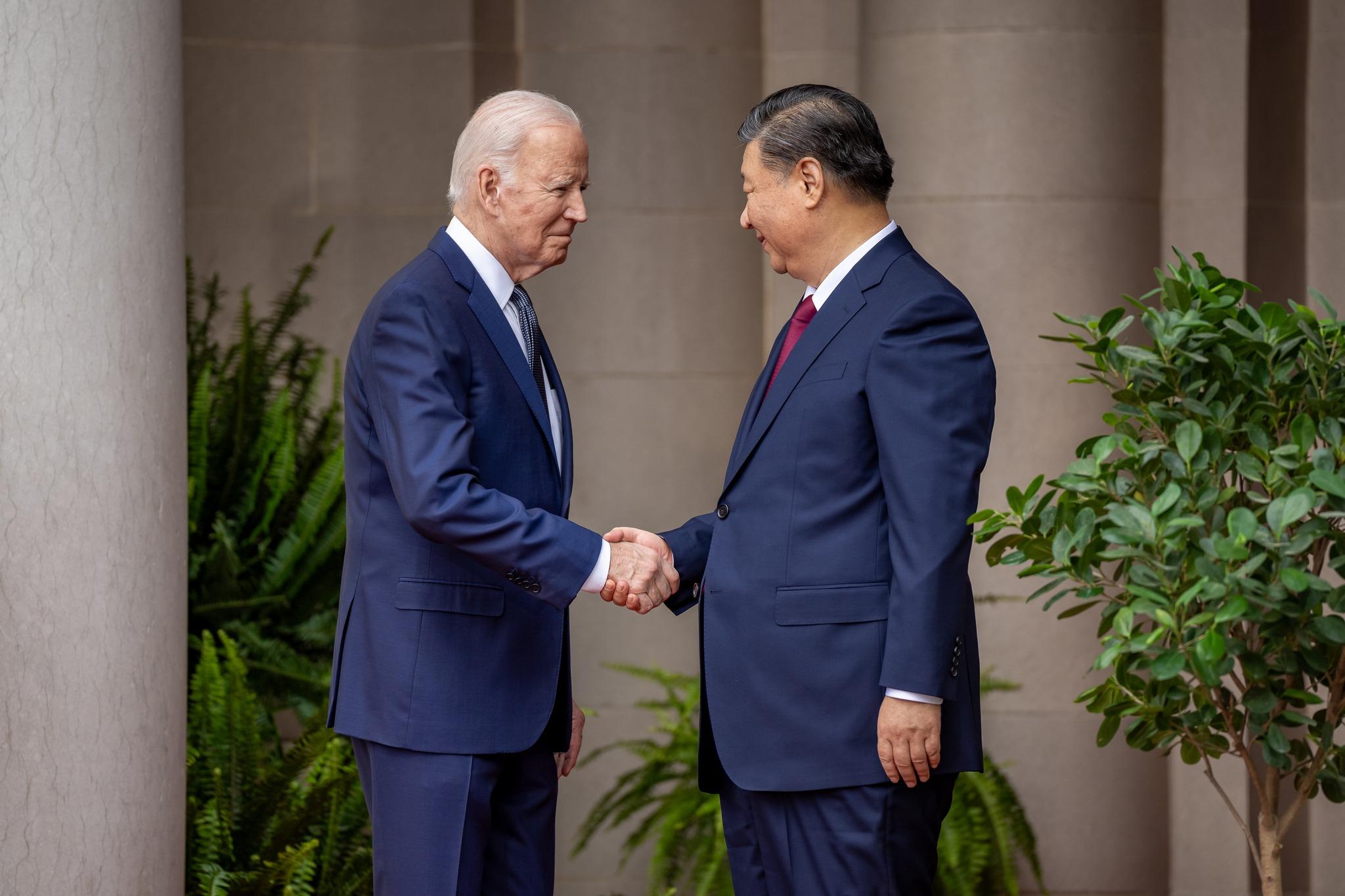
President Joe Biden greets President of the People’s Republic of China Xi Jinping, Wednesday, November 15, 2023, at the Filoli Estate in Woodside, California. (Official White House Photo by Carlos Fyfe via President Joe Biden/Facebook)
U.S. President Joe Biden has engaged in a crucial face-to-face meeting with Chinese President Xi Jinping at the Asia-Pacific Economic Cooperation (APEC) summit in San Francisco.
This high-stakes diplomatic encounter was aimed at alleviating tensions between the world’s two superpowers. The meeting carried immense significance as leaders of the world’s largest economies seek to establish a sense of stability following a challenging year in U.S.-China relations.
Even though both leaders have said they want to stabilize their relationship, the meeting is unlikely to bring about transformative changes between the two countries that are inherently antagonistic due to deeper structural reasons.
New Cold War?
The U.S. and China are enmeshed in a grand power competition in which China aspires to supplant the United States as a superpower while the U.S. aims to maintain its position.
This rivalry spans various facets of global politics, encompassing military, economic and technological domains. However, the contours of this new Cold War differ markedly from the previous one, with three key distinctions:
- In contrast to the Soviet Union, China is intricately woven into the American-built economic order. Beijing’s integration into the global economic framework has been instrumental in its substantial economic development. Unlike the Soviet Union, which existed outside this economic order, China’s active participation has transformed the dynamics of the current geopolitical landscape.
- The economic interdependence between the U.S. and China sets this rivalry apart. Unlike the relatively self-contained economies of the U.S. and the Soviet Union during the Cold War, China relies on the American market for its product sales, while the U.S. depends on China for financial transactions.
- People-to-people contact between the U.S. and China surpasses the ties between the U.S. and the Soviet Union during the Cold War. With a 5.4 million-strong Chinese diaspora in the U.S. and 300,000 Chinese students studying in American universities, the connections between both countries make outright hostilities less likely.
Stabilizing relations
In this context, the term coined by American political scientist Joseph Nye — “co-operative rivalry” — aptly characterizes Chinese-American relations.
The challenges of our globalized world — including climate change, pandemics, artificial intelligence, economic volatility and human security — necessitate active Chinese participation. These challenges make it particularly important that the U.S. and China stabilize relations.
The current emphasis on competition over co-operation needs to be shelved. Both nations should seek equilibrium by fostering co-operation in areas of mutual interest while navigating competition in areas of divergence.
Already complex relations between the U.S. and China have been tense in recent years. China was miffed when former U.S. House Speaker Nancy Pelosi visited Taiwan in August 2022.
Because China asserts territorial claims over Taiwan, a stopover in the U.S. by Taiwanese President Tsai Ing-wen added to the list of contentious issues.
Beijing also expressed displeasure over new U.S. exports restrictions on advanced technology, and Biden’s directive to shoot down a Chinese spy balloon in February 2023.
Spats intensified
Tensions escalated to the point that China severed military-to-military communications with the U.S. after Pelosi’s Taiwan visit, despite repeated American appeals for China to reopen these lines of communication to prevent any misconceptions or accidental escalations of conflict in the South China region and Taiwan.
When the U.S. downed the Chinese spy balloon, China’s foreign ministry contended that it was conducting meteorological research. American authorities, however, insisted it carried surveillance equipment inconsistent with a weather balloon.
In response to the balloon incident, Secretary of State Antony Blinken cancelled his planned visit to Beijing in protest.
Subsequently, China declined to reschedule the visit for several months. This communications void at both military and political levels between China and the U.S. posed a significant risk of potentially dangerous consequences. One of the outcomes of the Biden-Xi meeting is that military-to-military discussions will resume.
The Xi-Biden meeting
Prior to the meeting, U.S. National Security Adviser Jake Sullivan emphasized the importance of addressing fundamental aspects of the U.S.-China relationship, highlighting the need to strengthen open lines of communication and responsibly manage competition to prevent it from escalating into conflict.
Sullivan acknowledged the necessity of “intense diplomacy” to clarify misconceptions and avert surprises.
China’s economy is currently experiencing a slowdown, marked by falling prices due to subdued demand from both consumers and businesses.
With a projected economic growth of five per cent this year and an expected dip to 4.5 per cent in 2024, these economic challenges have adversely affected Xi’s domestic political standing. That may be behind any motivation to improve relations with the U.S. to address these domestic issues.
Biden, too, is keen on stabilizing relations with China. Confronted with escalating conflicts in the Middle East and the ongoing war in Ukraine, Biden is eager to avert the emergence of another global crisis during his tenure.
Restoring a semblance of stability to the Washington-Beijing relationship has been among the top priorities in his foreign policy agenda.
What the meeting might accomplish
One summit alone cannot resolve the extensive list of grievances between the two superpowers. Those challenges include issues like espionage, intellectual property theft, human rights abuses, foreign interference and trade penalties, as well as the sensitive matter of Taiwan.
The meeting addressed another point of contention between the two countries: fentanyl shipments. The leaders announced an agreement intended to stop China’s illicit exports of chemicals that can be used to make the drug that has led to the overdose deaths of hundreds of thousands of Americans.
The agreement on re-opening communication channels at both military and civilian levels could be a crucial step in improving China-U.S. relations. It might serve as a foundation to prevent relations from spiralling out of control, and lay the groundwork for addressing broader challenges in the future.
Saira Bano, Assistant Professor in Political Science, Thompson Rivers University
This article is republished from The Conversation under a Creative Commons license. Read the original article.