Food
Cranberries can bounce, float and pollinate themselves: The saucy science of a Thanksgiving classic

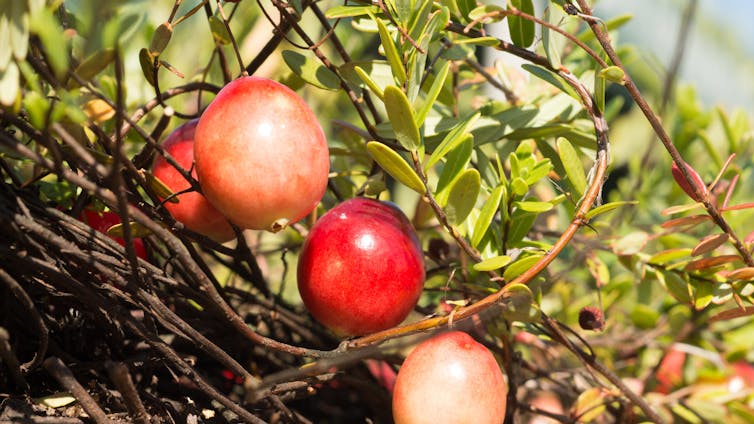
Cranberries grow on vines in sandy bogs and marshes. Lance Cheung, USDA/Flickr
Cranberries are a staple in U.S. households at Thanksgiving – but how did this bog dweller end up on holiday tables?
Compared to many valuable plant species that were domesticated over thousands of years, cultivated cranberry (Vaccinium macrocarpon) is a young agricultural crop, just as the U.S. is a young country and Thanksgiving is a relatively new holiday. But as a plant scientist, I’ve learned much about cranberries’ ancestry from their botany and genomics.
New on the plant breeding scene
Humans have cultivated sorghum for some 5,500 years, corn for around 8,700 years and cotton for about 5,000 years. In contrast, cranberries were domesticated around 200 years ago – but people were eating the berries before that.
Wild cranberries are native to North America. They were an important food source for Native Americans, who used them in puddings, sauces, breads and a high-protein portable food called pemmican – a carnivore’s version of an energy bar, made from a mixture of dried meat and rendered animal fat and sometimes studded with dried fruits. Some tribes still make pemmican today, and even market a commercial version.
Cranberry cultivation began in 1816 in Massachusetts, where Revolutionary War veteran Henry Hall found that covering cranberry bogs with sand fertilized the vines and retained water around their roots. From there, the fruit spread throughout the U.S. Northeast and Upper Midwest.
Today, Wisconsin produces roughly 60% of the U.S. cranberry harvest, followed by Massachusetts, Oregon and New Jersey. Cranberries also are grown in Canada, where they are a major fruit crop.
A flexible and adaptable plant
Cranberries have many interesting botanical features. Like roses, lilies and daffodils, cranberry flowers are hermaphroditic, which means they contain both male and female parts. This allows them to self-pollinate instead of relying on birds, insects or other pollinators.
A cranberry blossom has four petals that peel back when the flower blooms. This exposes the anthers, which contain the plant’s pollen. The flower’s resemblance to the beak of a bird earned the cranberry its original name, the “craneberry.”
When cranberries don’t self-pollinate, they rely on bumblebees and honeybees to transport their pollen from flower to flower. They can also be propagated sexually, by planting seeds, or asexually, through rooting vine cuttings. This is important for growers because seed-based propagation allows for higher genetic diversity, which can translate to things like increased disease resistance or more pest tolerance.
Asexual reproduction is equally important, however. This method allows growers to create clones of varieties that perform very well in their bogs and grow even more of those high-performing types.
Every cranberry contains four air pockets, which is why they float when farmers flood bogs to harvest them. The air pockets also make raw cranberries bounce when they are dropped on a hard surface – a good indicator of whether they are fresh.
These pockets serve a biological role: They enable the berries to float down rivers and streams to disperse their seeds. Many other plants disperse their seeds via animals and birds that eat their fruits and excrete the seeds as they move around. But as anyone who has tasted them raw knows, cranberries are ultra-tart, so they have limited appeal for wildlife.
Reading cranberry DNA
For cranberries being such a young crop, scientists already know a lot about their genetics. The cranberry is a diploid, which means that each cell contains one set of chromosomes from the maternal parent and one set from the paternal parent. It has 24 chromosomes, and its genome size is less than one-tenth that of the human genome.
Insights like these help scientists better understand where potentially valuable genes might be located in the cranberry genome. And diploid crops tend to have fewer genes associated with a single trait, which makes breeding them to emphasize that trait much simpler.
Researchers have also described the genetics of the cultivated cranberry’s wild relative, which is known as the “small cranberry” (Vaccinium oxycoccos). Comparing the two can help scientists determine where the cultivated cranberry’s agronomically valuable traits reside in its genome, and where some of the small cranberry’s cold hardiness might come from.
Researchers are developing molecular markers – tools to determine where certain genes or sequences of interest reside within a genome – to help determine the best combinations of genes from different varieties of cranberry that can enhance desired traits. For example, a breeder might want to make the fruits larger, more firm or redder in color.
While cranberries have only been grown by humans for a short period of time, they have been evolving for much longer. They entered agriculture with a long genetic history, including things like whole genome duplication events and genetic bottlenecks, which collectively change which genes are gained or lost over time in a population.
Whole genome duplication events occur when two species’ genomes collide to form a new, larger genome, encompassing all the traits of the two parental species. Genetic bottlenecks occur when a population is greatly reduced in size, which limits the amount of genetic diversity in that species. These events are extremely common in the plant world and can lead to both gains and losses of different genes.
Analyzing the cranberry’s genome can indicate when it diverged evolutionarily from some of its relatives, such as the blueberry, lingonberry and huckleberry. Understanding how modern species evolved can teach plant scientists about how different traits are inherited, and how to effectively breed for them in the future.
Ripe at the right time
Cranberries’ close association with Thanksgiving was simply a practical matter at first. Fresh cranberries are ready to harvest from mid-September through mid-November, so Thanksgiving falls within that perfect window for eating them.
Cranberry sauce was first loosely described in accounts from the American colonies in the 1600s, and appeared in a cookbook for the first time in 1796. The berries’ tart flavor, which comes from high levels of several types of acids, makes them more than twice as acidic as most other edible fruits, so they add a welcome zing to a meal full of blander foods like turkey and potatoes.
In recent decades, the cranberry industry has branched out into juices, snacks and other products in pursuit of year-round markets. But for many people, Thanksgiving is still the time when they’re most likely to see cranberries in some form on the menu.
Serina DeSalvio, Ph.D. Candidate in Genetics and Genomics, Texas A&M University
This article is republished from The Conversation under a Creative Commons license. Read the original article.