Canada News
Interest rates: Monetary policy is always political as central banks opt to back the financial sector

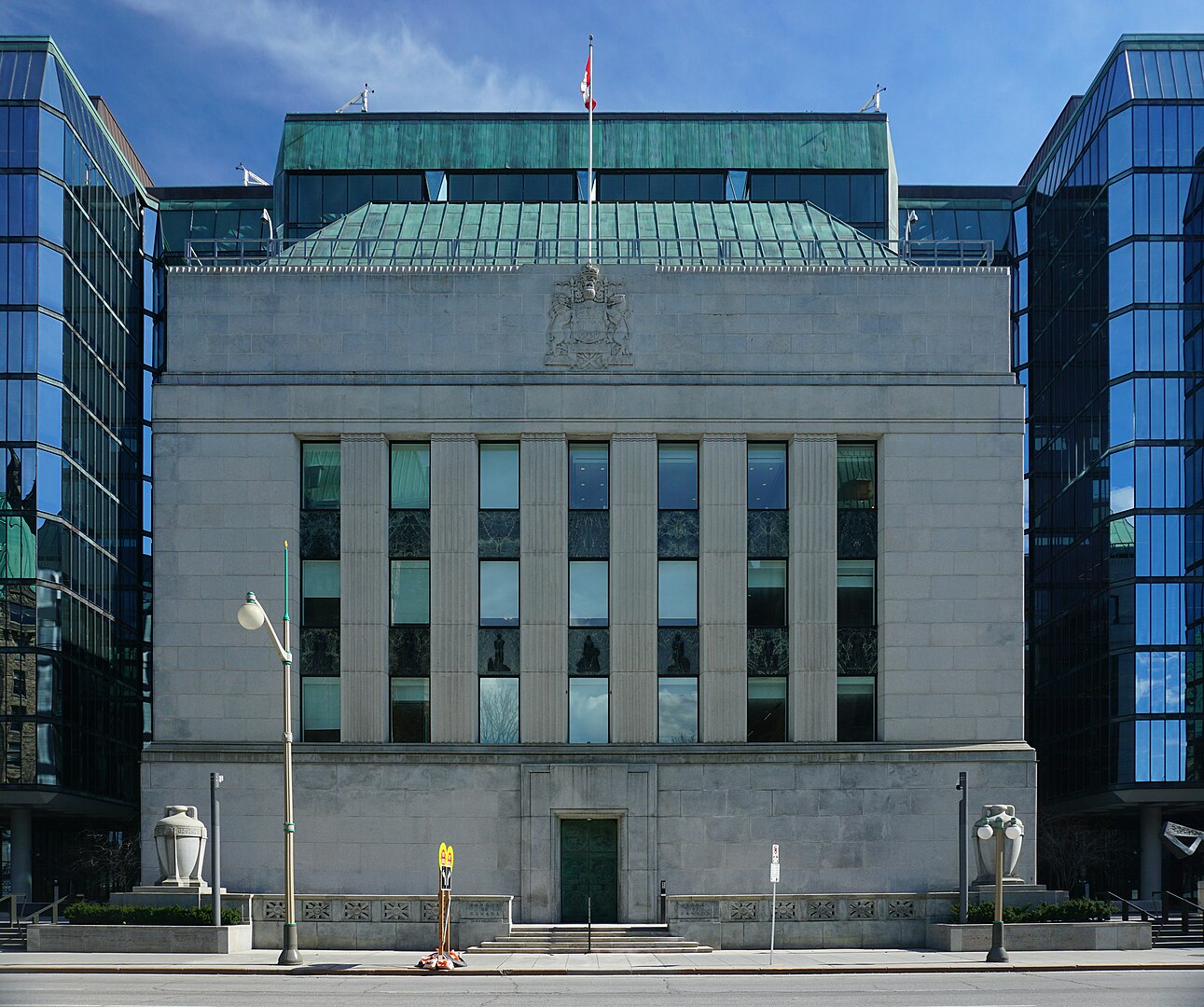
The view that central banks should be independent of politics has shifted many times over the history of central banks. (File Photo By 方畢可/Wikimedia Commons, CC0)
As the Bank of Canada prepared to announce its decision on interest rates in early September, Tiff Macklem, the bank’s governor, received imploring letters from premiers spanning both the country and the political spectrum.
New Democrat David Eby of British Columbia wrote to the Bank of Canada, followed by Ontario’s Doug Ford, a Conservative, and by Liberal Andrew Furey of Newfoundland and Labrador.
In their letters, the premiers urged the bank against raising rates again and to think of the “human impact of rate increases” on Canadians already burdened by rising mortgage payments and financial pain.
When Macklem announced he was holding the rate at five per cent, Finance Minister Chrystia Freeland called the decision “a welcome relief for Canadians.”
Facing subsequent accusations from economists and journalists that she was meddling, Freeland made clear a few hours later that she respected the independence of the Bank of Canada.
Social impact of monetary policy
But the criticism raises important questions. Is monetary policy really outside the realm of politics? What are the social ramifications of our current monetary policy system?
The view that central banks should be independent of politics has shifted many times over the history of central banks.
While central bank decision-making is independent from government, the banks follow mandates set by governments. These mandates vary in different countries.
The United States Federal Reserve (the Fed), for example, has a dual mandate: to manage inflation and pursue maximum stable employment. The Bank of Canada’s mandate, by contrast, is focused entirely on managing inflation, with an arbitrary target of two per cent.
In theory, central banks pursue these goals without interference from government.
But we don’t believe political debates over monetary policy should be off limits.
Ties between politics and monetary policy
In the 1970s, Fed chairman Paul Volcker famously used monetary policy — specifically a campaign of rapid interest rate increases — to erode the bargaining power of labour as a means of taming inflation.
That decision had wide-ranging effects — including a reduction in union membership — that continue to have an impact on American society and placed the burden of fighting inflation onto the working class.
This logic continues, crudely captured in a recent viral video when Australian real estate developer Tim Gurner argued:
“We need to see unemployment rise, we need to see pain in the economy … to remind people that they work for the employer, not the other way around.”
In more polite language, Phillip Lowe, outgoing governor of Australia’s central bank, recently acknowledged that the effects of monetary policy are “felt unevenly across the community.”
The scene in Canada
According to our research, monetary policy likewise has an impact on wealth inequality in Canada by supporting the financial sector over other parts of the economy.
Indeed, the overt goal of monetary policy is to stabilize the financial system, a priority that disproportionately benefits those in the financial sector.
This has become clear in recent decades, beginning with the 2008 global financial crisis and continuing to the COVID-19 pandemic, when central banks around the world began to use “quantitative easing” to stimulate the economy.
While monetary policy had previously centred on setting the rates at which regulated banks could borrow, central banks expanded their role by undertaking massive asset purchasing campaigns via quantitative easing.
Central banks began supporting not just regulated banks but investment funds, hedge funds and other “non-bank financial intermediaries” — also known as shadow banks — that are largely unregulated.
This involved tactics like purchasing corporate bonds to stabilize the corporate debt market.
Investors benefit
These new Bank of Canada policies grant “infrastructural power” over how monetary policy is implemented to the financial sector, buttressing the profits of investors with public dollars. This allows investors to determine how the capital provided by the bank will be invested — with little regulation or public oversight.
Acknowledging this shift, Bank of Canada deputy governor Toni Gravelle said the bank has moved from its traditional role as “lender of last resort” to “liquidity provider of last resort,” promising to “resolve market-wide stresses when the financial system cannot find its footing.”
When the working class cannot “find its footing,” however, the Bank of Canada doesn’t extend a helping hand. In 2022, for example, Macklem told employers not to increase wages despite rampant inflation, and told unionized workers not to ask for a raise.
The central bank’s decision to support the financial sector is, in fact, political. It benefits some — financial sector executives and investors — at the expense of others, and tilts economic decision-making in their favour.
When a public institution buys hundreds of billions in assets as the Bank of Canada did in March 2020, Canadians are right to ask questions about its impact, and politicians should respond.
Enriching the already rich
The premiers’ letters to the Bank of Canada, while described as unprecedented, expose how monetary policy involves fundamentally political questions about the distribution of wealth in our society.
As we demonstrated in our research, the Bank of Canada’s quantitative easing tactics during the pandemic had a vastly uneven impact, driving up house prices and enriching already wealthier homeowners, while lower-income households and renters faced higher rents and precarity.
It also helped investors who took advantage of cheap capital and rising asset values to scoop up multi-family apartments and houses in Canada.
The impact doesn’t stop at housing. As inflation rose, central banks hiked interest rates, assuming that would boost unemployment, reduce labour costs and slow the economy so that inflation would fall.
But at a time when the causes of inflation are highly contested (there are ongoing debates around supply chain disruptions and “sellers inflation,” for example) choosing to focus on wages is political.
What should central banks do?
Where does this leave us in terms of the politics of monetary policy and central bank independence?
While central bank decisions may need to be independent of government influence, the factors banks consider are determined by our political systems.
Central banks could consider factors that benefit workers and people who don’t own assets — from maximizing employment to promoting housing affordability and addressing climate change risks.
European Central Bank president Christine Lagarde, for example, has said climate change should factor into central bank decision-making.
Others argue monetary policy can be used to fund the green transition, building on the European Central Bank’s practice of using targeted loans to influence the financial sector rather than leaving decision-making in the hands of financial institutions.
Given the connection between monetary policy and inequality, it’s time for a serious debate on why central banks use public institutions to support private finance — and what they should be doing differently.
The authors would like to acknowledge and thank research assistant Yun Liu for her work on this article.
Dan Cohen, Assistant Professor, Queen’s University, Ontario; Emily Rosenman, Assistant Professor of Geography, Penn State, and Martine August, Associate Professor, School of Planning, University of Waterloo
This article is republished from The Conversation under a Creative Commons license. Read the original article.