
Lifestyle
Curious Kids: why are our tears salty?


So our tears are much less salty than sea turtles’ tears, although still a little bit salty. (File Photo: Nathan Dumlao/Unsplash)
Why are tears salty? — Aarna, aged 6

Hi Aarna, thanks for your great question! I’m going to start off by telling you a little bit of a story about sea turtles. That might seem strange, but don’t worry, it will all make sense soon.
When mother sea turtles sneak onto the beach at night to lay their eggs, if you look really carefully you might see them shedding a few tears. Ancient legend believes mother turtles are crying because they will never get to meet their babies.
But scientists have discovered sea turtles aren’t really crying. Instead, they’re getting rid of salt from their bodies, through weeping some very salty tears.
Read more:
Curious Kids: Why do tears come out of our eyes when we cry?
As sea turtles live in salty seawater, and their favourite food is jellyfish, (which are made mostly of seawater!) they build up too much salt in their bodies, which can be poisonous. So they need to “cry” this salt out of their bodies to survive.
If we eat too much salt or it builds up in our bodies, our kidneys help to flush it out when we go to the toilet. But sea turtle kidneys aren’t as clever as human kidneys, and they can’t get rid of enough salt in their wee.
So, sea turtles have a special salt gland in each eye, which is twice the size of their brains, that pumps this extra salt into their tears.
These turtle tears are so salty, some animals such as butterflies have been spotted licking these turtle tears.
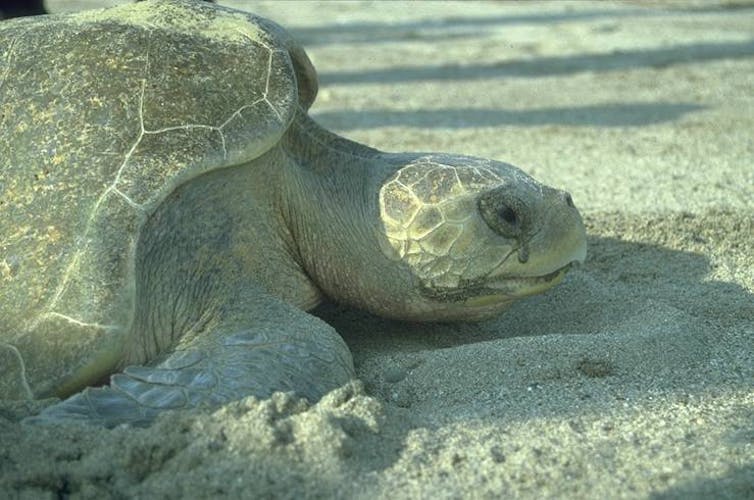
Wikimedia commons, CC BY
But what about us humans?
If you’ve ever licked a tear coming down your cheek, it probably tasted a little bit salty. But if our kidneys work better than turtles’, and we don’t eat jellyfish for breakfast, then why are our tears still salty?
Well, all fluids in our bodies have a little bit of salt in them. This salt is made into electricity to help our muscles contract and our brains to think. The amount of salt in our body fluids (like tears, sweat, and saliva) is about the same as the amount of salt in our blood — just under 1%, or about two teaspoons of salt per litre.
So our tears are much less salty than sea turtles’ tears, although still a little bit salty.
Read more:
Curious Kids: how do sea creatures drink sea water and not get sick?
3 types of tears
The saltiness of your tears can actually vary depending on what kind of tears your eyes are making.
That’s right, your eyes — or a part of your eyes called the lacrimal gland, to be precise — make three different types of tears. These are called basal tears, reflex tears and emotional tears.
- basal tears keep your eyes wet and stop nasty germs infecting your eyes
- reflex tears are made when your eyes need to wash away something harmful that gets in, such as smoke or a grain of sand
- emotional tears are the kind you cry when you’re feeling very happy or sad.
Basal tears and reflex tears have more salt in them than emotional tears, which is important for keeping your eyes healthy. Emotional tears contain more of other things, including a hormone (a special type of chemical in your body) that works like a natural painkiller. This might help to explain why we sometimes feel better after having a good cry.
Read more:
Curious Kids: why do we cry?
Next time you shed a slightly salty tear, take a minute to think how lucky you are to have kidneys that control the salt levels in your body, and you don’t have to cry salty tears to stay alive, like those mother turtles.
Hello, curious kids! Do you have a question you’d like an expert to answer? Ask an adult to send your question to [email protected]
Matthew Barton, Senior lecturer, School of Nursing and Midwifery, Griffith University
This article is republished from The Conversation under a Creative Commons license. Read the original article.




















