
News
Russia: Biden brings a new US challenge to Putin’s backyard

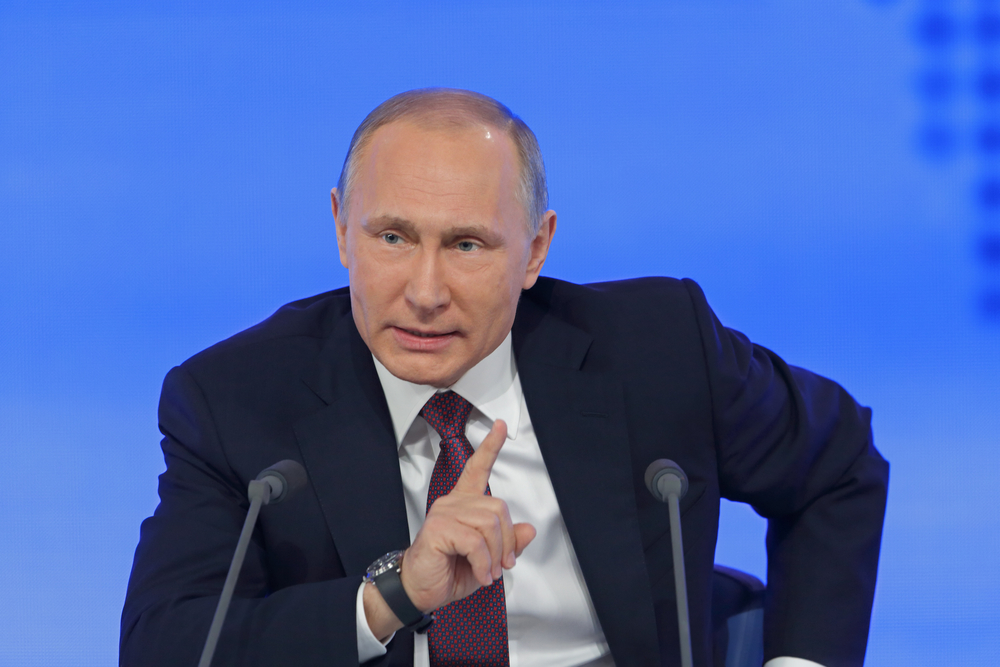
FILE: MOSCOW, RUSSIA – DEC 23, 2016: The President of the Russian Federation Vladimir Vladimirovich Putin at the annual press conference in Center of international trade (ID1974 / Shutterstock.com)
Russia’s reaction to the announcement of Joe Biden’s victory in the US elections has been very muted. Russian president, Vladimir Putin, has yet to officially congratulate the president-elect. Putin’s political opponent Alexei Navalny, on the other hand, was quick to tweet his congratulations, wryly observing that the free and fair election was a “privilege not available to all countries”.
Russia’s silence stands in stark contrast to the visible enthusiasm that greeted Trump’s victory in 2016. Trump’s face decorated boxes of sugar, while the Army of Russia store offered a 10% discount for US citizens on the day of Trump’s inauguration. Vladimir Zhirinovsky, the leader of the Liberal Democratic Party of Russia, a far-right party, was pictured drinking champagne with members of his party in celebration of Trump’s election victory.
Putin’s silence is unsurprising. During the election campaign, Biden described Russia as the “biggest threat” to US security and alliances. He promised to convene a summit of democracies to join forces against the rise in authoritarianism around the world.
The Kremlin may not welcome the intended direction of travel of the Biden administration’s policies, but the predictability and clarity of intent is likely to be a welcome change after four years of Trump’s capriciousness.
There are two issues that stand out for Russia from the forthcoming change in the White House: Biden’s commitment to returning democracy to the centre of US foreign policy, and his desire to repair America’s relationship with Nato, strengthening the Euro-Atlantic alliance. The Kremlin views both of these as potential challenges to its national security.
Unrest on the doorstep
Biden’s promise to return to a foreign policy grounded in western democratic values will have prompted disquiet in the Kremlin. It has been deeply suspicious of Washington’s efforts since the 1990s to promote democracy and support democratisation efforts around the world.
My own research has looked at how Russia perceives anti-government protests and popular uprisings that seek to overthrow incumbent regimes to be part of a wider strategy of US-sponsored regime change, deliberately designed to undermine rival states. Such events, such as the so-called “coloured revolutions”, popular uprisings that occurred across the post-Soviet space in the early to mid-2000s in countries such as Ukraine and Georgia, are seen as a fundamental threat to Russia’s national security and regime stability. The Kremlin believes that Russia is vulnerable to foreign interference in its internal affairs via western efforts to promote democratic forms of government.
In recent months, the post-Soviet space has been rocked by pro-democracy protests and popular uprisings in Belarus, Kyrgyzstan and, most recently, Georgia, as well as fighting between Armenia and Azerbaijan over the contested territory of Nagorno-Karabakh and protracted conflict in eastern Ukraine.
Belarus could become a flashpoint for confrontation between Washington and Moscow. The country has experienced almost daily protests and violent police crackdowns since presidential elections in August in which the incumbent, Alexander Lukashenko, claimed victory amid widespread allegations of vote-rigging. Biden has criticised Trump’s silence about the violence committed by Lukashenko’s regime against pro-democracy activists. He promised to stand with the people of Belarus and support their democratic aspirations and to significantly expand sanctions against the Lukashenko regime.
Belarus is a key Russian ally and Putin’s pledge of financial and military support for Lukashenko places Russia at odds with the US. The Kremlin is unlikely to remain inactive if the Biden administration increases its support for opposition groups. Minsk and Moscow may well work together in an attempt to bring a swift halt to the protests before Biden’s inauguration in January 2021 to forestall any US assistance to the pro-democracy movement.
Ukraine is another potential flashpoint. Biden has pledged to increase US support for the country, including the supply of lethal weapons, while also calling on Russia to end its “aggression” and “occupation” of Ukraine.
Read more:
The foreign policy legacy that Donald Trump leaves Joe Biden
A boost to Nato
The second core challenge for Russian foreign policy involves Nato. Moscow has consistently voiced its opposition to Nato’s global reach and enlargement. It argues that the alliance is a relic of the Cold War, which threatens Russian national interests.
Nato’s enhanced capabilities, global scope and enlargement were identified as the principal risk to Russian national security in the Kremlin’s 2014 Military Doctrine. Its 2015 National Security Strategy also makes several references to Nato, including the advance of its military infrastructure towards Russia’s borders.
Throughout his political career, Biden has been vocal in his support for Nato enlargement, including membership for Ukraine. During the presidential election campaign he was also very clear about his wish to repair America’s relationship with Nato. It’s thought that he intends to renew multilateralism and strengthen the alliance, which has been damaged by public spats during the Trump era.
I congratulate @JoeBiden on his election as the next U.S. President & @KamalaHarris as Vice President. I know Joe Biden as a strong supporter of our Alliance & look forward to working closely with him. A strong #NATO is good for both North America & Europe https://t.co/Ij3rWtNH5c
— Jens Stoltenberg (@jensstoltenberg) November 7, 2020
Visible internal divisions over enlargement and funding have undermined Nato’s security and cohesion. Adversaries such as Russia are aware that cohesion – or a lack of it – is the alliance’s critical vulnerability. A reinvigorated, unified Euro-Atlantic alliance poses a significant challenge to Moscow, which will counter any attempts to kick-start the enlargement process in states such as Georgia or Ukraine.
Russia and its post-Soviet neighbours are unlikely to constitute foreign policy priorities for the incoming Biden administration. But several of the incoming administration’s priorities, such as bolstering Nato and promoting democracy, represent challenges for Moscow. The inaction of the Trump regime across the post-Soviet region, which could be interpreted by Moscow as either disinterest or tacit acquiescence, is likely to be replaced by a much more active approach.
This suggests that relations between Moscow and Washington are likely to become more antagonistic and confrontational, as the US intensifies its engagement in Russia’s backyard.
Tracey German, Reader in Conflict and Security, King’s College London
This article is republished from The Conversation under a Creative Commons license. Read the original article.




















