News
No agreement among EU leaders on launching membership talks

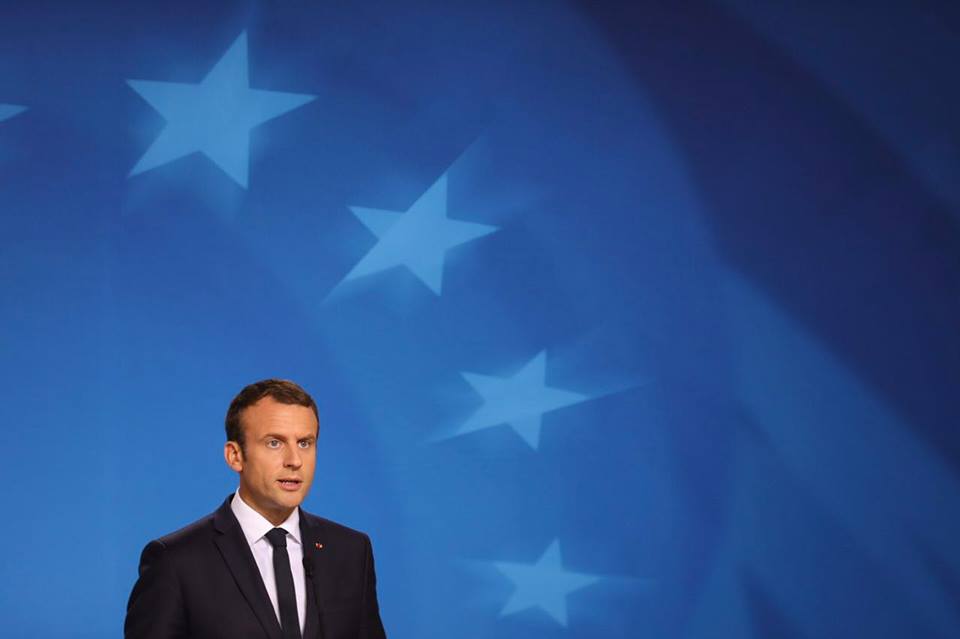
French President Emmanuel Macron is refusing to allow any new countries into the 28-nation bloc until its enlargement procedures have been improved, while the Netherlands opposes Albania’s candidacy and disputes the commission’s assessment. (File photo: Emmanuel Macron/Facebook)
BRUSSELS — European Union leaders broke off off talks without agreement early Friday on whether to launch membership negotiations with Albania and North Macedonia, despite warnings that turning them away would tarnish the EU’s reputation and risks inflaming the volatile Balkans region.
The two countries were expecting to receive a green light to begin negotiations on joining Europe’s rich club, a process which could take several years. The European Commission, which supervises entry talks, insists that both have met all the criteria. The leaders had promised a decision on their futures by the end of October.
French President Emmanuel Macron is refusing to allow any new countries into the 28-nation bloc until its enlargement procedures have been improved, while the Netherlands opposes Albania’s candidacy and disputes the commission’s assessment.
“There’s no conclusion today but tomorrow we will still discuss about this,” said Finnish Prime Minister Antti Rinne, whose country currently holds the EU’s rotating presidency. Asked about the chances of finding a compromise, he said: “I am not sure that it is possible but I hope that it is possible to reach an agreement.”
Visiting on the eve of the summit, North Macedonian Prime Minister Zoran Zaev recalled the leaders’ promise to issue their verdict this month.
“October is here. We came here to Brussels and we’re expecting the well-deserved news on the decision to open negotiations,” Zaev said, adding that if no news comes, “then the credibility of the EU and the trust that our citizens have in the Union might be brought into question.”
“This will most certainly incite regressive forces in the country and will strengthen the interest of third parties in the region,” he said, in what appeared to be a veiled reference to Russia’s influence in the Balkans.
The prospect of EU membership has been a powerful driving force for reforms in the Balkans since Yugoslavia disintegrated into war in the early 1990s. Croatia and Slovenia have joined; others are waiting, more or less patiently.
The EU has always said that membership is based on a candidate’s merits, but in the case of Albania and North Macedonia the merits acknowledged by the commission do not appear to be receiving their just reward.
EU foreign policy chief Federica Mogherini warned in May that any “failure to recognize and respond to objective progress would damage the European Union’s credibility.” She said it could also “undermine stability and seriously discourage further reforms.”
Her warning came just after Serbia put its troops on full alert after heavily armed Kosovo police fired tear gas and arrested about two dozen people in Serb-dominated northern Kosovo in what they called an anti-organized crime operation.
EU-backed talks between the two on normalizing relations are bogged down.
But the constant expansion of the EU over the years has complicated decision-making in the world’s biggest trade bloc, and a kind of “enlargement fatigue” had set in. Turkey’s membership talks, for example, are virtually frozen.
On taking up his post as commission president in 2014, Jean-Claude Juncker vowed that no countries would join during his term, which is set to end in a few weeks.
On Tuesday, European affairs ministers failed again to reach any consensus on the cases of Albania and North Macedonia. There seemed little appetite even for separating their cases and allowing one country to start talks.
“It was not a moment of glory for Europe,” Enlargement Commissioner Johannes Hahn said. He apologized to the citizens of the two Balkans hopefuls, and said that “the overwhelming majority” of EU member countries supported them.
Hahn had hoped that EU leaders would break the deadlock at the summit “in order to restore our credibility.”
But the chances appear slim. A top French diplomat said Thursday that not enough progress has been made to fix the EU’s enlargement shortcomings. She said Paris could change its mind over the next six months if North Macedonia passes more reforms and if Albania does more to stop its citizens from seeking asylum in France.
———
Samuel Petrequin contributed to this report