News
Pope in Madagascar insists: ‘Poverty is not inevitable’

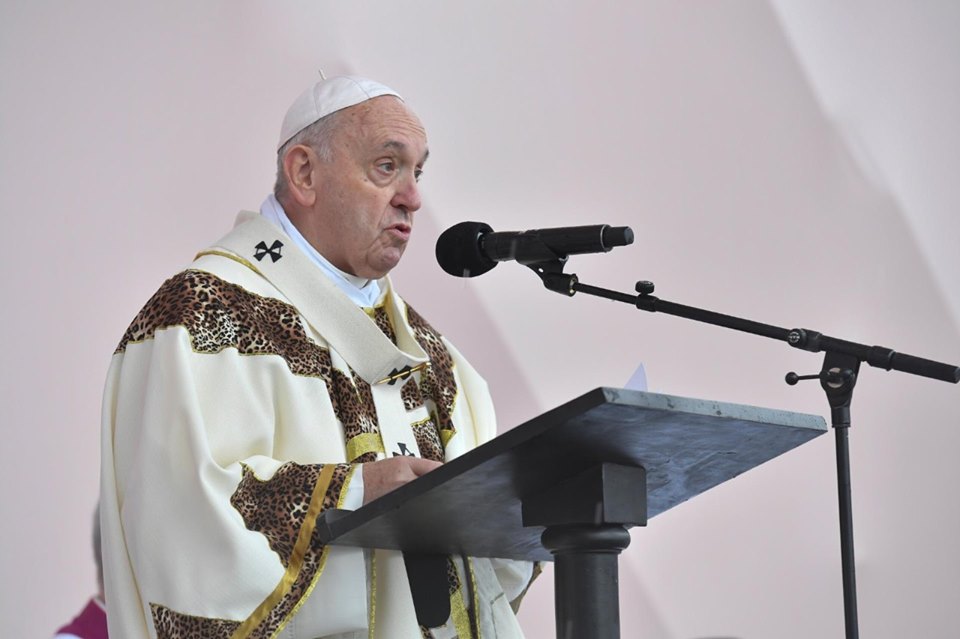
Francis appealed for new development strategies to fight global poverty as he visited the Akamasoa project, or “City of Friendship,” which soars on a hillside above the dump in Antananarivo. (File Photo: Vatican News/Facebook)
ANTANANARIVO, Madagascar — Pope Francis insisted Sunday that poverty isn’t inevitable and that the poor deserve the dignity of work as he visited a rock quarry in Madagascar where hundreds of people toil rather than scavenge in the capital’s biggest dump.
Francis appealed for new development strategies to fight global poverty as he visited the Akamasoa project, or “City of Friendship,” which soars on a hillside above the dump in Antananarivo. The project is the brainchild of an Argentine priest who was so overwhelmed by the abject poverty of Madagascar that he set about creating ways for the poor to earn a living.
Over 30 years, the Akamasoa quarry has produced the stones that built the homes, roads, schools and health clinics that now dot the pine-covered hillside.
Villagers, students and quarry workers lined the neat streets and pastel-painted doorways to greet the pope as he arrived, and thousands of children sang their hearts out for him in the village auditorium. The pope was clearly overwhelmed by their enthusiasm, particularly when a girl named Fanny told him in French that his visit would encourage the students to work and pray harder.
Speaking off the cuff in French, Francis told them that Akamasoa’s founder, the Rev. Pedro Opeka, had been a student of his in 1967-1968 at a Buenos Aires seminary, but that he remembered that Opeka didn’t much care for studying.
“He had a love for work,” Francis said to giggles.
Returning to his prepared remarks and with Madagascar’s president listening behind him, Francis told the villagers that the existence of Akamasoa meant that God had “heard the cry of the poor.”
“Your plea for help – which arose from being homeless, from seeing your children grow up malnourished, from being without work and often regarded with indifference if not disdain – has turned into a song of hope for you and for all those who see you,” Francis told them. “Every corner of these neighbourhoods, every school or dispensary, is a song of hope that refutes and silences any suggestion that some things are ‘inevitable.”’
“Let us say it forcefully: Poverty is not inevitable!”
Francis, the first pope from the global south, has long preached about the dignity of work, and the need for all able-bodied adults to be able to earn enough to provide for their families. He has frequently met with workers and the unemployed and used his moral authority to demand political leaders provide job opportunities, especially for young people.
Opeka, a charismatic, bearded figure who is beloved by many in this city, was working as a Lazarist missionary in Madagascar when he was inspired to create Akamasoa after witnessing the degrading life led by the parents and children who lived off the dump.
The Akamasoa project, which is funded by donors around the world and recognized by the Madagascar government, says it has built some 4,000 homes in more than 20 villages serving some 25,000 people since its foundation in 1989. About 700 people work in the rock quarry, using simple mallets to chop chunks of granite into cobblestones or pebbles, while others work as carpenters or attend training classes. It says 14,000 children have passed through its schools.
Opeka said the low salaries he can pay the quarry workers are an injustice. But he said they are at least better than what scavengers earn in the dump, and are enough to enable parents to send their children to school.
“Akamasoa is a revolt against poverty, it is a revolt against inevitability,” Opeka told The Associated Press ahead of the pope’s visit. “When we started here it was an inferno, people who were excluded from the society.”
Despite Madagascar’s vast and unique natural resources, it is one of the poorest countries in the world. The World Bank says 75% of its 24 million people live on less than $2 a day; only 13% of the population has access to electricity.
In his greeting to the pope, Opeka said much of Madagascar’s poverty is due to indifference, by society at large and its leaders.
“In Akamasoa, we have shown that poverty isn’t inevitable, but was created by the absence of a social sensibility on the part of political leaders who abandoned and turned their back on the people who elected them,” Opeka said. “This place of exclusion today has become a place of communion of brothers and sisters of the whole world.”
Francis said Akamasoa, built up the hill from the dump, was a concrete example of a faith capable of “moving mountains.” He said that faith “made it possible to see opportunity in place of insecurity; to see hope in place of inevitability; to see life in a place that spoke only of death and destruction.”
“Let us pray that throughout Madagascar and everywhere in the world this ray of light will spread, so that we can enact models of development that support the fight against poverty and social exclusion, on the basis of trust, education, hard work and commitment,” Francis said before heading to the rock quarry itself to deliver a prayer for workers.
Susane Razanamahasoa, 65, has worked in the quarry for 20 years, 9.5 hours a day, to provide for her six children. She said the pope’s visit recalled the dedication to the poor of St. Francis of Assisi, his namesake.
“He is an extraordinary man and the fact that he has taken the name Francis after St. Francis of Assisi means he is thirsty to live like St. Francis,” she said during a break in her work. “I am so full of joy that he is coming.”
Ravo Razafindrabe, a midwife who volunteered at Akamasoa during her medical training, said the project was a model for Madagascar since it fights inequality by empowering the poor themselves.
“Father Pedro takes people from the streets and gives them work to have a house,” she said of Opeka as she waited for Francis to arrive along the main road in Akamasoa. “It’s important because it’s an example for the president of doing something: giving things to people to help improve their lives. It means people in the streets today can have a house tomorrow.”
“It shows Christ’s love in a perfect way,” she said.