
News
Health-care wastes big factor in Manila Bay pollution

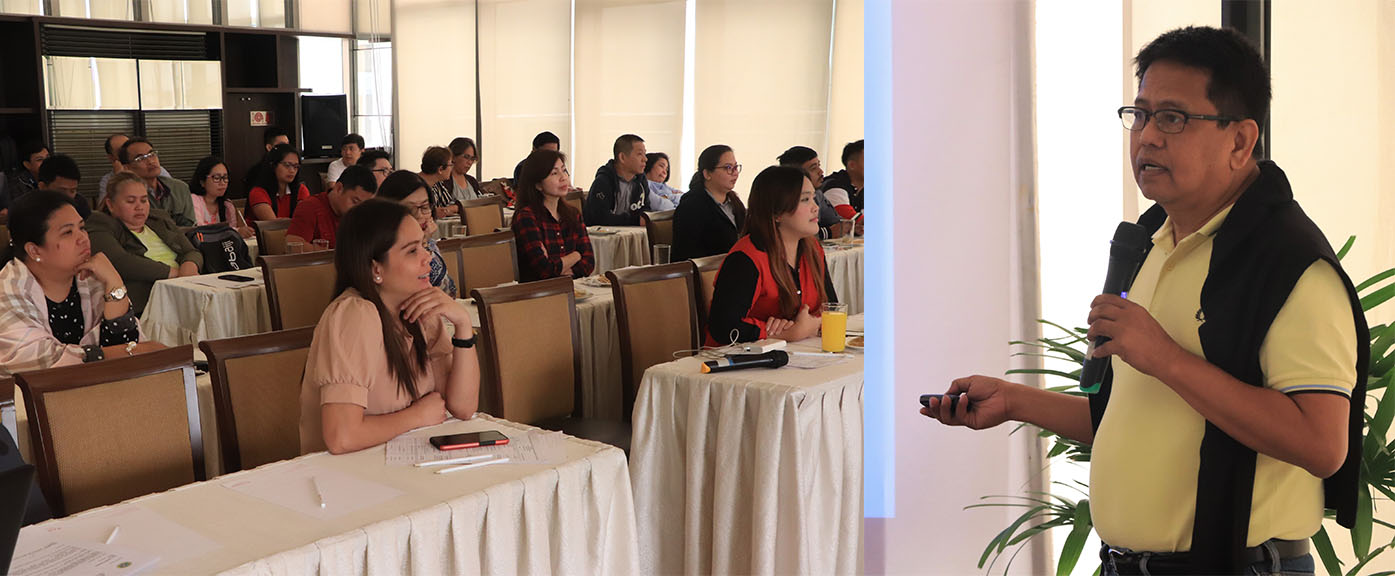
WASTE MANAGEMENT. Department of Health Environmental and Occupational Health Cluster head Engr.
Gerardo S. Mongol discusses issues on health care waste management to sanitation engineers and inspectors and hospital administrators Cavite, Laguna, and Rizal during a three-day training on DOH’s new key performance indications in Manila Bay Rehabilitation.
The training was held in Manila on August 27-29, 2019. (Photo: Glenn Ramos/PNA)
MANILA — Proper health-care waste management plays a vital role in the rehabilitation of the Manila Bay, an expert said Thursday.
In an interview with the Philippine News Agency, Department of Health (DOH) Environmental and Occupational Health Cluster head engineer Gerardo Mongol said health care facilities like clinics and hospitals contribute to the destruction of the bay and all the living organisms depending on it.
“Hindi lang (not just) households ang source of waste, pati rin ang (but also) health care facilities especially their liquid waste. And the major contributors are the Region 4-A provinces near the bay. In terms of population, it is big, because Cavite alone has a lot of informal settlers and they don’t have sanitation facilities, and there are a number of hospitals in the region,” Mogol said.
Cavite, Rizal, and Laguna were identified as the biggest contributors to health-care waste in Manila Bay.
Citing that the Supreme Court, through Department of Environment and Natural Resources- DOH Administrative Order 2005-2, has instructed DOH 4-A to report which hospitals comply with proper waste management, Mogol said it is deemed that many hospitals are unable to dispose of their health-care wastes properly.
“Hospitals in the region must be able to satisfy all the elements like waste generation, waste segregation and storage, collection and transport, treatment disposal and liquid waste management,” he said.
In line with this, Mogol explained that secondary and tertiary health care facilities are expected to have their own sewerage treatment facilities that would handle their liquid wastes which can be chemicals, biological fluids, or a combination of both.
“Organic materials and other contaminants must be treated because the ecosystem has a carrying capacity, wherein it can no longer handle or treat heavy pollution load. The living creatures in the bay will be affected like the fish they can be contaminated with coliform and heavy metals and also people who are using the bay who are taking a bath there or doing some recreational activities there,” he said.
To address this issue, the DOH 4-A conducted three-day training for the local government units and hospitals in the region on liquid waste management, solid waste management, informal settler families and illegal structures, habitat and resources management, and institutional arrangement and governance.
“Ang maganda dito maliliwanagan kung ang mga hospital kasi may protocol naman po kung paano madi-dispose ang waste kaya lang (The good thing about this is that the hospitals will be enlightened since there’s a protocol on how to dispose waste but) it’s not clear with some as to how it is going to be from the patient to the nurses’ station to storage and to where exactly the waste must be disposed. I think the lapses happen there,” Non-Communicable Disease cluster head Dr. Marilou Espiritu said.
“Through this training and the technical, spread of infectious diseases especially if the ones disposed are infectious wastes like syringes, placenta, human waste,” Espiritu added.
The training, which started on Tuesday until Thursday, also provided the participants updates on the Manila Bay monitoring tool.




















