
News
US Homeland Security discusses asylum agreement in Guatemala

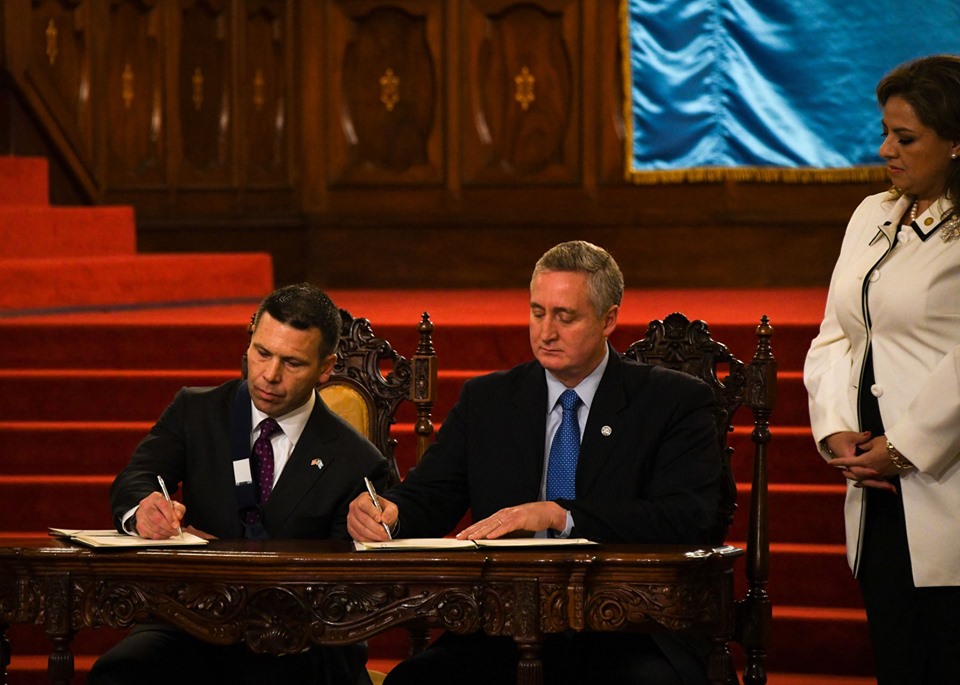
FILE: In recent months, DHS has entered into several agreements with our Guatemalan counterparts to help stem the flow irregular migration and ensure the safety and protection of vulnerable populations, especially children. (Photo: Department of Homeland Security/Facebook)
Details on acting Secretary Kevin McAleenan’s agenda and activities were scant, and there was no immediate access for journalists. But the Guatemalan government said it included a meeting with Interior Minster Enrique Degenhart, who signed the deal in Washington last week.
“Looking forward to working to expand the partnership between Guatemala and the U.S. to stem the flow of illegal migration and disrupt human smuggling and transnational criminal organizations,” McAleenan tweeted.
Presidential candidate Sandra Torres’ political party also said McAleenan would meet with her, a week and a half before her runoff election against Alejandro Giammattei, who was also due to talk with the acting secretary.
Torres has said President Jimmy Morales’ administration should not have signed the agreement since he is due to leave office in January. She says the matter should have been left to whomever wins the Aug. 11 vote.
Torres has also said Guatemala doesn’t have enough resources to take care of its own people, “much less to have foreigners here and attend to them.”
Giammattei, meanwhile, said previously that he was “angry” about and opposed the signing of the deal. He said lawmakers should be consulted and called it a difficult agreement to fulfil.
Washington is apparently seeking to win local approval for the pact, which could significantly ease the wave of mostly Central Americans arriving at the U.S. border. It would mean Hondurans and Salvadorans who travel by land through Guatemala must apply for asylum here rather than on U.S. soil.
Critics of the deal point out that Guatemala, which is both a sending and transit country for irregular migration, has the same problems that are driving Hondurans and Salvadorans to flee their homes: violence, poverty, joblessness and a prolonged drought that has severely hurt farmers.
Economic analyst Hugo Maul, who attended one of the meetings with McAleenan, said the agreement’s scope was discussed.
“In general terms, Guatemala’s institutional weakness was recognized, as well as the problems we already have with corruption, drug trafficking and economic stagnation,” Maul said, adding that therefore it is crucial to know “what is being negotiated, committed, and what will be obtained in exchange.”
Guatemala is ill-prepared financially or in infrastructure terms to provide safety, housing, education and other support for potentially tens of thousands of Central Americans.
Former Vice-President Eduardo Stein, who was also invited, said, “Due to the lack of economic, institutional and technical capacity that Guatemala has, an operational effort of this size could bring us to a much more dangerous situation than the one that is trying to be solved.”
The agreement has been challenged in Guatemala’s constitutional Court. Human rights prosecutor Jordan Rodas asked the tribunal to overturn it, arguing that U.S. President Donald Trump’s threats of tariffs or other consequences made the agreement null.
The constitutional Court also issued injunctions before the signing telling Morales’ government not to enter into a deal without approval from the country’s Congress, but the rulings were ignored.
In a statement Wednesday, U.S. Ambassador Luis E. Arreaga called the agreement “a bold new approach to reduce irregular immigration.”
“The status quo is not sustainable. Guatemalan children and families have fallen victim to a dangerous cycle of human smuggling that puts the most vulnerable populations at risk. This, in turn, is tearing at the fabric of local Guatemalan communities,” Arreaga said.
The ambassador added that under the deal, subject to Trump’s approval, Guatemala could see economic support through “increased overseas private investment, U.S. development assistance and additional U.S. investment” in Guatemala’s private sector and to create jobs in the Western Highlands, a region with high emigration numbers.
According to the U.N. Development Program, Guatemala is one of the most unequal nations in the world and 60% of its people live in poverty.
The president of the American Chamber of Commerce in Guatemala also said McAleenan would present a plan of action to implement the deal.




















