
Canada News
Greenhouse gases causing Canadian Arctic seas to acidify quicker: report

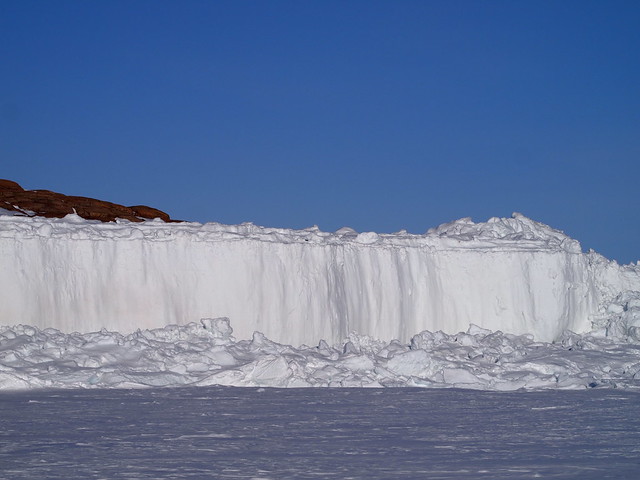
Ocean acidification happens as seawater absorbs carbon from the air. Arctic seas are more vulnerable than others, because higher runoff from rivers increases carbon flows into those oceans. Declining ice cover lengthens their exposure. (File Photo: Fiona Paton/Flickr, CC BY-NC-ND 2.0)
Greenhouse gases are acidifying Canada’s Arctic waters at a faster rate than anywhere else in the North, says a report presented earlier this week at a meeting of the eight countries that ring the Arctic Circle.
The summary tabled for policy-makers at the Arctic Council meeting is based on research that predicts the Beaufort Sea off Canada’s northwest coast will be corrosive enough within a decade to make it hard for animals such as clams or crabs to create shells.
That’s expected to spread east, with similar impacts in Baffin Bay, by mid-century.
While much remains unknown about how the northern ecosystem will react, scientists fear the changes are likely to make it tough for the fish that seals, beluga whales and Arctic char depend on for food.
“Some of the fastest rates of ocean acidification currently observed are in the Arctic Ocean, with important physiological and geochemical thresholds already surpassed,” the report says.
Ocean acidification happens as seawater absorbs carbon from the air. Arctic seas are more vulnerable than others, because higher runoff from rivers increases carbon flows into those oceans. Declining ice cover lengthens their exposure.
Ocean water is not yet below neutral on the pH scale used to measure acidity, but it has been declining for decades. That has resulted in lower saturations of dissolved calcium-bearing minerals marine animals need to build shells and bones.
The average decline in those minerals across all Arctic waters has been about 15 per cent since 1980. In Canada, those declines have averaged about twice that.
“Marine species form calcium carbonate skeletons or shells,” said Nadja Steiner, a Department of Fisheries and Oceans scientist who helped write the report. “There is a point where the saturation state would start to dissolve those shells.
“If the species lives in that undersaturated condition, then the species becomes more fragile or it needs a lot more energy because it continuously has to reproduce the calcium carbonate that dissolves.”
This week’s report is an update of previous research done in 2013.
Since then, pools of acidified water have grown both deeper and larger. The Western Arctic has become the first ocean area on Earth to have large and expanding pools of such water near the surface.
Acidification is happening at the same time that water temperature is increasing. Little is known about the combined impact on marine ecosystems, which provide about 10 per cent of the world’s fish catch.
“What you’re seeing now in the Arctic is that you have extreme changes in temperature that already stress the species,” Steiner said. “In addition to that, we have acidification, where we’re not sure how bad it is.”
Some of the tiny creatures at the base of the food web appear resilient. But molluscs grow smaller and weaker shells, coral grows slower and fewer crabs survive.
Some fish species seem to thrive in the new environment. But Arctic cod, the main food of beluga whales, seals and Arctic char, seem to grow more slowly.
More research is needed, said Steiner, especially amid suggestions that climate change could open the Arctic to commercial fishers chasing migrating stocks.
“Caution,” she said. “A lot of caution.
“People are looking at it but there are so many uncertainties.”




















