
Canada News
American researcher offers theory on Trudeau’s ‘bad’ French: It’s not

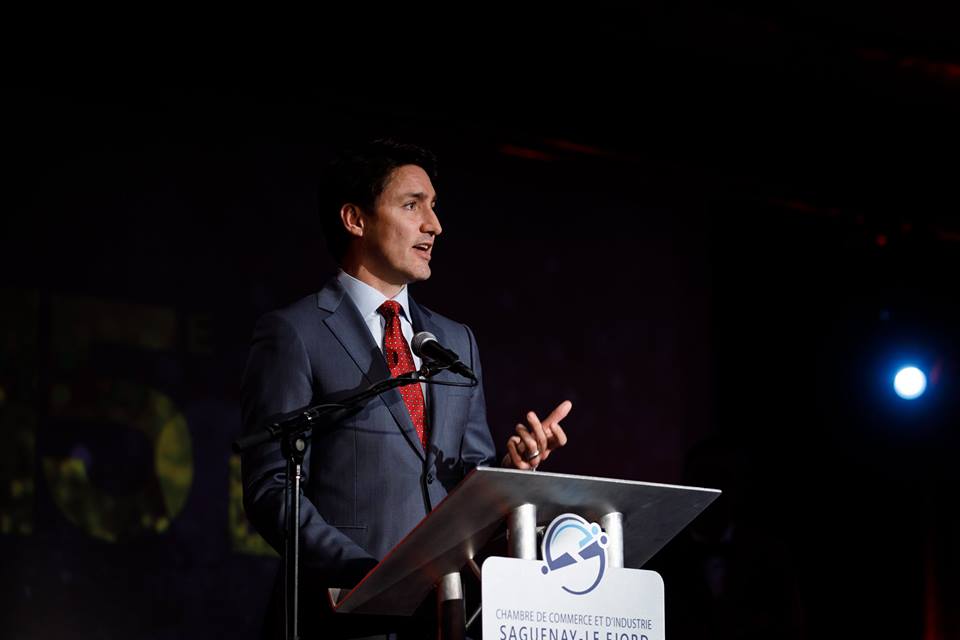
On an linguistic level, the claim that Trudeau doesn’t speak French well is simply untrue, Bosworth said in an interview Wednesday. (File Photo: Justin Trudeau/Facebook)
MONTREAL — Quebec’s media elites are unfairly criticizing Prime Minister Justin Trudeau’s spoken French because they see him as an outsider pretending to be a real Quebecois, an American academic argues in new research.
Journalists will forgive Conservative Leader Andrew Scheer’s mangled pronunciations or former NDP leader Thomas Mulcair’s use of Anglicisms but Trudeau is held to an unrealistic standard, according to Prof. Yulia Bosworth of Binghamton University in New York.
Her article, “The ‘Bad’ French of Justin Trudeau: When Language, Ideology, and Politics Collide,” was published in the most recent issue of the American Review of Canadian Studies. The author analyzed 53 online news items, mostly between April 2013 and January 2017, that discussed Trudeau’s linguistic abilities or those of other federal politicians.
Bosworth, a self-professed “lover” of Quebec, discovered a near-unanimous chorus of criticism by journalists regarding the quality of Trudeau’s French, which she says suggests they are using language as a way of attacking his identity.
She chose to focus on prominent Quebec journalists — mostly francophone — because they have historically been “agenda-setters” in Quebec society and who have an established role of positioning themselves at the centre of the conversation on what is the correct use of the French language.
“A lot of the things he is being blamed for are the things francophone Quebecers are themselves doing on a regular basis,” said the professor, who teaches French linguistics, specializes in North American French and studies how language and society intersect.
On an linguistic level, the claim that Trudeau doesn’t speak French well is simply untrue, Bosworth said in an interview Wednesday.
Moreover, Trudeau speaks French with virtually no accent, she said, and sounds like a regular Quebecer. That’s unlike his father, former prime minister Pierre Elliott Trudeau, who she says consciously chose to speak French that was more closely aligned with France.
Bosworth studied hours of the younger Trudeau speaking French in public appearances across Canada and in France. She said he doesn’t suppress his regional dialect. “In France he seems perfectly comfortable speaking the way he does at home and that should be recognized and credited but it’s not.”
Instead, the media elite in Quebec describe his French as “incomprehensible,” “limp,” “snobbish,” and “jarring to the native ear.”
“Some of the things being pointed out are OK in the mouths of just about any other Quebecer but not him,” Bosworth said.
One of the main reasons she believes Quebec’s media elite have chosen to zero-in on Trudeau’s French is because he identifies as one of them — a francophone — but also as bilingual, a cultural intersection she says is construed in the province as necessarily clashing.
“In his autobiography and in some interviews he states that he considers himself a proud Montrealer, a francophone,” she said. But he was born in Ottawa and lived there until the age of 13, when he moved to Montreal with his father. He continued his education entirely in French until university.
This “ideological misalignment,” Bosworth argues, “plays a crucial role in fostering a collective denial of Quebecois identity to Justin Trudeau.”
Another reason journalists deny Trudeau a Quebecois identity is because his name evokes memories of his father, whose vision of a bilingual, united and multicultural Canada is rejected by many in the province’s media elite.
Trudeau, she says, can do no right. “It doesn’t matter what he says and how he says it in French it will be viewed negatively.”




















