
Headline
House passes bill lowering age of ‘social responsibility’ to 12

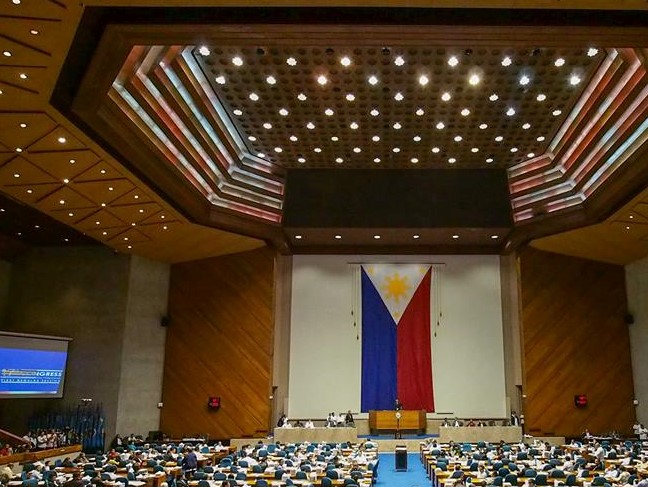
The approved bill, House Bill 8858, was actually an amended version of the original proposal submitted by the House committee on justice which initially pegged the minimum age of criminal responsibility (MACR) to nine years old. (File photo: Speaker Pantaleon Alvarez/Facebook)
MANILA — The House of Representatives on Wednesday approved a bill lowering the age of “social” responsibility from 15 to 12 years old, amending for the purpose Republic Act 9344 or the Juvenile Justice and Welfare Act of 2006.
The approved bill, House Bill 8858, was actually an amended version of the original proposal submitted by the House committee on justice which initially pegged the minimum age of criminal responsibility (MACR) to nine years old.
The word “criminal” was also struck out from MARC and replaced with the word “social.”
Oriental Mindoro Rep. Salvador “Doy” Leachon, the chair of the House justice panel, said the age of 12 was the consensus of majority of the members of House members.
He said majority of congressmen agree that 15 years old is already too high, while many expressed reservations on pegging the MASR at nine.
“We have to compromise so that at least we can have this bill passed. After all it would be for the protection of children, and one of the top priorities of the justice panel and this Congress to be passed this year,” he said in an interview after the bill’s approval.
“When we got more than majority of members, we decided to have it uniform 12 years old instead of the original proposal of nine,” Leachon said.
He thanked the House leadership led by Speaker Gloria Macapagal-Arroyo for their help in coming out with the compromise bill.
Leachon said they will try to pass the bill on third reading by next week before Congress adjourns on February 7.
Bill not passed in haste
Meanwhile, Leachon belied allegations that the passage of the bill was done in haste, noting that the House internal rules were followed when the proposed bill was passed on second reading even if there were still many congressmen lined up to interpellate the measure.
HB 8858 was approved at the committee level only on Monday, with plenary debates immediately started Tuesday.
Leachon said the period of interpellation and debates could be terminated anytime as long as there were already more than two interpellators finished on both sides of the issue.
“What happened was in accordance with internal rules. Those who hadn’t had the chance to debate would certainly object but what is important is that we decided based on what is stated under the rules,” he said.
He also reminded his colleagues that the measure was being deliberated upon since 2016, with the Justice panel having conducted 11 public hearings on the matter, not counting the four hearings conducted by the panel’s technical working group.
“It could not be said that it was done in haste. What we are trying is to speed things up right now because Congress is about to adjourn,” he said.
“We need to speed things up because all our efforts in the past two years would all be for naught if we go back to square one,” Leachon added.
Under the proposed measure, a child in conflict with the law would not spend jail time, but in youth care facilities called “Bahay Pag-asa” to correct their ways and bring them back to the community.
Bahay Pag-Asa refers to the a 24-hour child-care institution established, funded and managed by the Department of Social Welfare and Development (DSWD) providing short-term care for children in conflict with the law who are 12 years and above but below 18 years old who are committed for rehabilitation or awaiting court disposition of their cases or transfer to other agencies or disposition.
Part of the features of a Bahay Pag-asa is an Intensive Juvenile Intervention and Support Center (IJISC) which will cater to children who committed serious offenses.
Children 12 years old but below 18 years who commit petty offenses would not be confined in a Bahay Pag-asa.
The exception is when the child has no family or deemed as “neglected.”
“Mandatory confinement to a Bahay Pag-asa would be carried out on only three instances: when the crime committed are serious offenses; when the child is deemed neglected; and the child in conflict with the law is a recidivist,” Leachon said.
Children 12 years old and above but below 18 years of age who commit serious crimes like parricide, infanticide, murder, kidnapping, rape, destructive arson and offenses under the Comprehensive Dangerous Act punishable by more than 12 years imprisonment among others shall be mandatorily be placed in the IJISC.




















