News
Experts air new concerns about UN response to Myanmar crisis

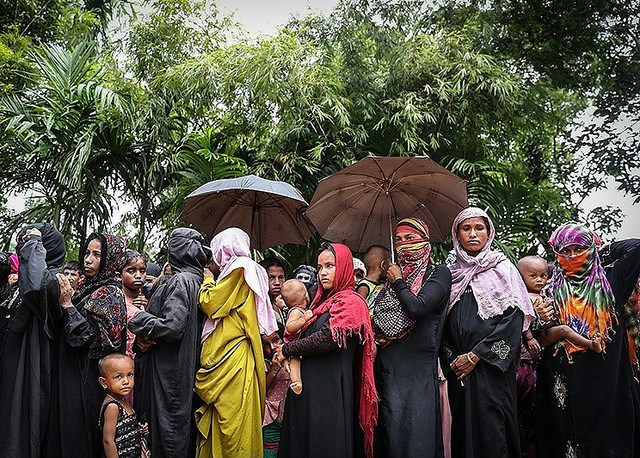
U.N.-backed investigators who examined a crackdown by Myanmar security forces that caused hundreds of thousands of Rohingya Muslims to flee to neighbouring Bangladesh issued a searing critique Tuesday of the United Nations’ own response to the human rights crisis. (File Photo: Prachata/Flickr, CC BY-NC-ND 2.0)
GENEVA — U.N.-backed investigators who examined a crackdown by Myanmar security forces that caused hundreds of thousands of Rohingya Muslims to flee to neighbouring Bangladesh issued a searing critique Tuesday of the United Nations’ own response to the human rights crisis.
In a 432-page report, the members of a “fact-finding mission” on Myanmar fleshed out preliminary findings and recommendations released in a shorter version three weeks ago.
The investigators reiterated that senior Myanmar military leaders should be prosecuted for war crimes, crimes against humanity and genocide against the Rohingya during a deadly crackdown that erupted in August 2017 following militant attacks on security posts in Rakhine state.
The full report also provided new details about the investigators’ concerns about the how the United Nations reacted during that spasm of violence. The investigators pointed out the “only statement” from the U.N. resident co-ordinator’s office “was to condemn the ARSA (militant group) attacks and losses suffered by the Myanmar security forces.”
The fact-finding mission was created by the U.N.-backed Human Rights Council in March 2017 after years of abuses against ethnic minorities in Myanmar, with a focus on the period since 2011 when the country began opening up after decades of isolation under a long-ruling military junta.
Though the investigators looked at the treatment of minority groups across the Southeast Asian nation, their mandate came just six months before crackdown against the Rohingya in Rakhine, injecting the mission with far greater importance to help detail those abuses, crimes and human rights violations.
The full report provides a detailed analysis of violence in Kachin, Shan and Rakhine states, much of which has been documented and made public through collection of witness accounts, satellite imagery and other sources of information.
It pointed to allegations of crimes against humanity and war crimes on the part of the military and other security forces, including murder, torture, pillaging, execution without due process, rape, sexual slavery and taking hostages.
It said some acts by ethnic armed groups and the Rohingya militant organization ARSA could also constitute war crimes.
Crimes against humanity, war crimes and genocide can be considered by international tribunals such as the International Criminal Court, but Myanmar is not a party to the ICC and its government has snubbed a ruling by the court’s judges that said the ICC has jurisdiction to investigate alleged crimes against the Rohingya.
The investigators decried little or no response from the Myanmar government to their findings, which were provided to it in advance.
On Tuesday, Myanmar has a chance to respond directly to the allegations: its new ambassador in Geneva, Kyaw Moe Tun, was set to speak during an “interactive dialogue” at the Human Rights Council, after the fact-finding team shared some of its findings with the 47-member body.
The full report’s critique of the United Nations focused not only on its response to Rohingya crisis, but its efforts across the country.
For example, the investigators noted that the U.N. had rolled out a “Human Rights Up Front Action Plan” in Myanmar in 2013, but said its “human rights driven” approach was “rarely, if ever, pursued.”
“Rather, it was largely ‘business as usual’, with development goals and humanitarian access prioritized only,” the authors wrote.
They cited allegations that some U.N. personnel who tried to pursue a human rights agenda “were ignored, criticized, sidelined or blocked in these efforts.”
They alluded to criticism from Fieldview Solutions, an outside group that works to advance human rights, in July that cited some in U.N. and humanitarian circles for not doing enough to expand their “political space” in Myanmar, and alleging: “The Myanmar government has learned that it can count on U.N. and humanitarian self-censorship.”
The U.N. experts said they regretted that some U.N. entities and staffers showed “a lack of co-operation” with their work, and “appeared to view it as a threat, rather than a means to address the most deep rooted human rights challenges facing Myanmar.”
“This attitude and approach must change,” they added.
The investigators did acknowledge that some people in the country had faced “intimidation and reprisals” for their “engagement” with the United Nations.
The team reiterated their urgent call for “a comprehensive, independent inquiry into the United Nations’ involvement in Myanmar since 2011, with a view to establishing whether everything possible to prevent or mitigate the unfolding crises was done,” as well as drawing lessons and — “as appropriate” — making recommendations on accountability.
They also said a second fact-finding mission should be authorized to examine the continued threats to human rights of the Rohingya and others throughout Myanmar.
The investigators bemoaned that “there has been no review of what happened, of where the approach taken had some positive effect and where it did not, and of how the U.N’.s approach could be improved in future crises.”