
Lifestyle
Japan website offers anonymity for variety of grievances

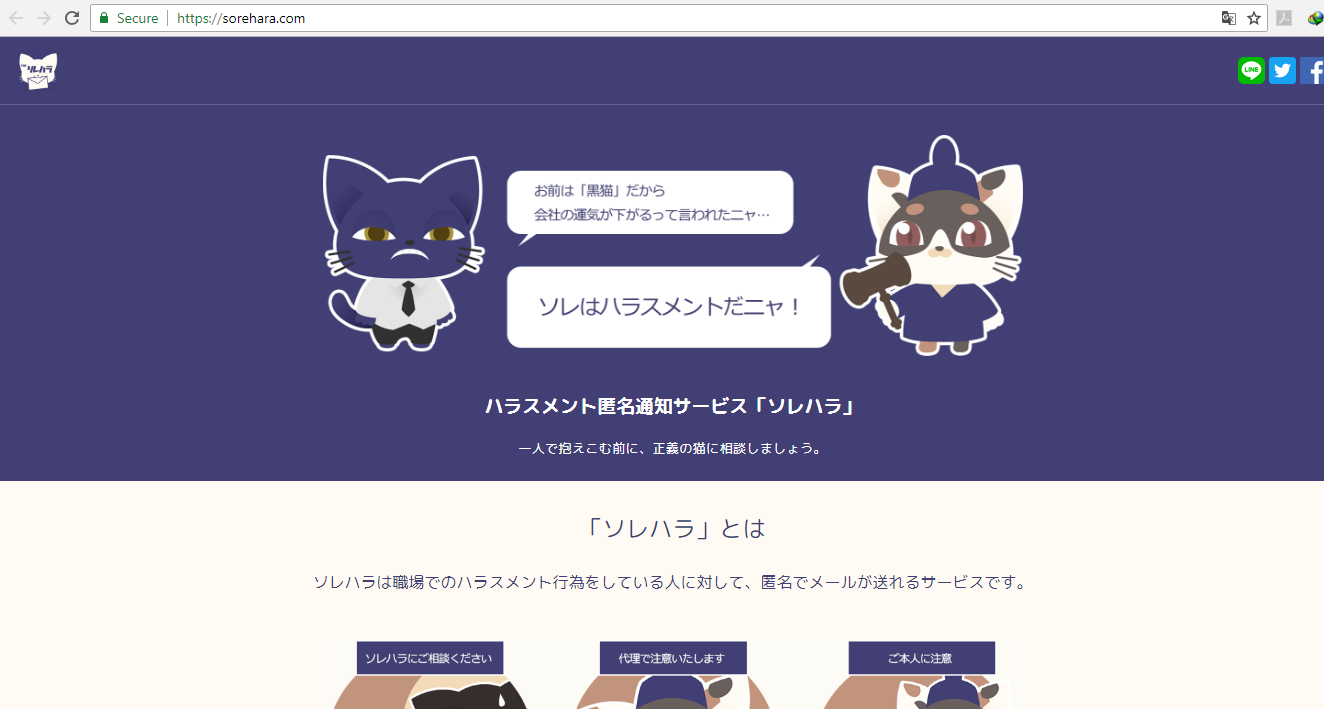
A college sophomore, he is taking time off from his studies to work on Sorehara. (Screengrab from Sorehara website)
TOKYO — A cartoon cat in a purple robe brandishes a tiny gavel as it comforts another cat yowling from abuse: The images welcoming visitors to Sorehara, a Japanese website for anonymous complaints about harassment and other grievances, are deceptively endearing.
“You don’t have to suffer alone. Get help from the cat who seeks justice,” it says.
Sorehara, an abbreviation of the Japanese for “That’s harassment,” was devised by a 21-year-old college student and, like many #MeToo apps and websites, is meant to help victims of abuse safely fight back against their tormentors.
It allows users to send anonymous complaints by email, without registering any personal information and is gaining popularity in Japan, despite some concerns over the potential for its misuse.
On-the-job harassment is gaining attention as the #MeToo movement slowly takes root here. Sexual harassment claims have brought on recent resignations of high-profile officials, pop stars and professors.
But the website doesn’t focus just on sexual misbehaviour. Sorehara goes to very Japanese extremes in allowing users to register their disapproval electronically to those who offend them in all sorts of ways, including indulging in garlic, wearing excessive perfume or smelling too strongly of cigarette smoke.
Victim blaming can be severe in highly conformist Japan so anonymity is essential for helping them feel safe, says Tatsuki Yoshida, 21, who developed Sorehara and founded his start-up Quaerere last year.
“In Japan, companies don’t like to deal with harassment issues. People who raise their voices about harassment usually just get moved to a different department or maybe given a raise. Or they get fired,” he told The Associated Press in a recent interview in Fujisawa, southwest of Tokyo.
A college sophomore, he is taking time off from his studies to work on Sorehara.
Inappropriate behaviour and unwanted sexual advances, repugnant and dangerous as they can be, are just part of a universe of gripes people might have about their co-workers.
So Sorehara offers users various options, including “power harassment,” bullying, alcohol harassment, sexual harassment and even “smell harassment.”
Next, they chose the level of severity, ranging from mere annoyance to threatening legal action. They fill in the email and a name or nickname of the person accused of the misbehaviour, but not their own email or name. The Japanese-language site gives an option to delay sending the message for up to two months, to reduce the possibility of the accuser being recognized.
Recipients get an email politely notifying them of the harassment claim, asking if they recognize it and giving a choice of responses such as: “I will reflect on my behaviour,” or “I have done nothing wrong.”
An English version was released recently, and a Korean-language version is in the works.
The #MeToo era has inspired companies, colleges and support groups to devise all sorts of apps and other online support for victims of sexual harassment and other abuses.
Some, like Protibadi in Bangladesh, HarassMap in Egypt and bSafe use mapping and GPS technology to help protect people by identifying potentially unsafe locations or notifying a user’s friends if the person seems to be in trouble. AI-powered chatbots like Spot, developed in California, automate harassment reporting. Others focus on support and counselling for victims. Few combine anonymity with direct online complaints the way Sorehara does.
Some worry that this anonymity could invite abuse because the claims can’t be verified, and because many Japanese tend to view simple annoyances like body odour as grievous social transgressions.
“There’s a possibility that the person you say is a harasser is not really harassing,” said Yoko Iwasaki of Cuore C Cube Co., a business management consulting company in Tokyo that focuses on harassment and diversity issues.
“That person who receives that email from Sorehara might feel very weird and attacked. Sending that kind of message can also be harassment,” she said.
But Hiroaki Morio, a professor at Kansai University, says he just believes the website is meant to be “light-hearted.”
“They’re trying to make harassment easier to deal with,” Morio said.
Despite the wider recognition of sexual harassment as a problem, Japanese thinking has not changed much and as most people still feel unable to speak up, so anonymous outlets like Sorehara can help, says Mayumi Haruno, who became the first Japanese woman to sue alleging on-the-job sexual harassment after she was forced out of her job in the 1980s. She won 1.65 million yen ($15,000) in damages in a lawsuit that she filed in 1989.
Social media that allow anonymity, like Line, Twitter and Mixi are popular in Japan and in neighbouring South Korea, where Blind, an anonymous message board app for employees, launched a #MeToo message board early this year.
“I think people are still afraid to make things public because they’re afraid of a backlash,” said Kyum Kim, co-founder of TeamBlind, which started the Blind app in 2013 and has offices in San Francisco, Seoul and Tokyo. “I think that’s the culture right now in Japan and Korea.”
Sorehara says it sends about 50 complaints a day. Most people who get them accept or at least acknowledge them, suggesting most claims are genuine, Yoshida said.
He says Sorehara is meant more to open lines of communication and raise awareness than to provide a formal way to report or solve harassment cases. Different people draw social lines in different places, Yoshida says, so he wants Sorehara to help people educate each other.
Several companies, including one with about 200 employees, are working with Sorehara to use the service internally, and Yoshida says he is also collaborating with counselling services.
“I don’t think companies are really changing internally,” Yoshida said. “But they are scared about their image, so at least they are paying more attention.”




















