Science
Dunes on Pluto made of tiny frozen grains of methane

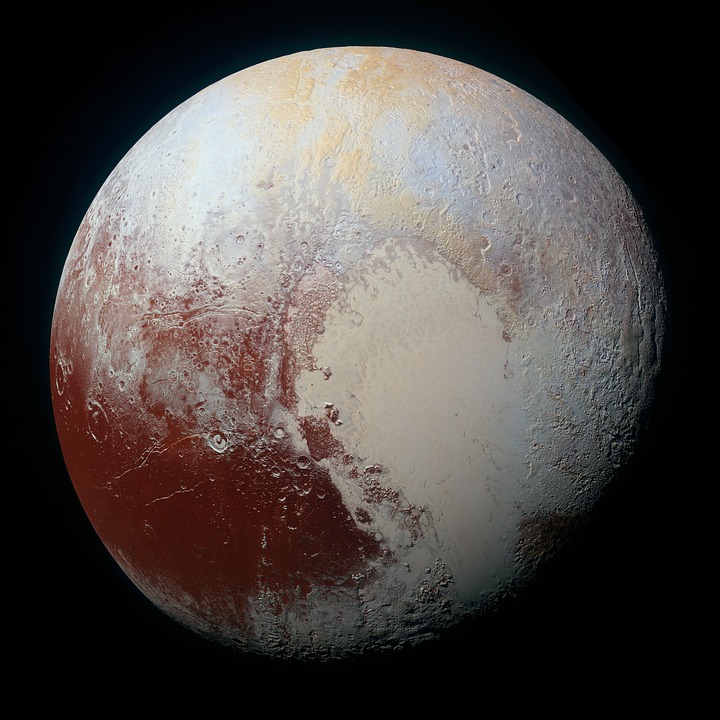
Thought to be relatively recent, the parallel rows of dunes are located in Pluto’s heart-shaped region at the base of mountains as tall as the Alps and formed from giant blocks of ice with frosty methane snowcaps. (Pixabay photo)
CAPE CANAVERAL, Fla. — Scientists have discovered dunes on Pluto made of tiny frozen grains of methane.
The pale grey and white ridges were revealed by NASA’s New Horizons spacecraft during its 2015 flyby. A British-led team announced the findings Thursday in the journal Science.
Researchers said the dunes appear to be made mostly of icy specks of methane the size of sand, with some frozen nitrogen likely mixed in. Thought to be relatively recent, the parallel rows of dunes are located in Pluto’s heart-shaped region at the base of mountains as tall as the Alps and formed from giant blocks of ice with frosty methane snowcaps. These plains in the left lobe of Pluto’s “heart” are known as Sputnik Planitia.
Scientists were surprised to find dunes given Pluto’s thin, weak atmosphere. They suggest nitrogen ice coating the surface of Sputnik Planitia transformed into gas that lifted methane particles into the air. Pluto’s gentle winds then carried and deposited the grains.
Dunes already have been found on Mars, Venus, Saturn’s moon, Titan, and even a comet. But Pluto’s are the only ones known to consist of methane.
“Pretty much nowhere else we know of is cold enough!” the study’s lead author, Matt Telfer of Plymouth University in England, said via email Thursday.
He noted there are dunes on the scorching surface of Venus under a dense atmosphere and out in the distant reaches of the solar system at minus 230 degrees Celsius (minus 400 degrees Fahrenheit) under a thin atmosphere.
“These are not just balls of ice far out in space,” he said, adding that frozen worlds on the fringes of our solar system, like the dwarf planet Pluto, might have been active early on.
Researchers liken the dunes to those at White Sands, New Mexico, or California’s Death Valley.
“It’s a little bit lower density than sand we’re used to holding on the Earth,” Brigham Young University’s Jani Radebaugh, a co-author, explained by phone. “So it would feel lighter in your hand, but it would still be granular and would kind of flow off of your hand, and your feet would kind of crunch them as you’re walking along. It would just kind of feel a lot like you’re on another sand dune on the Earth.”
The team has yet to determine the height of the dunes; Telfer guesses they’re at least tens of meters (yards) tall
“Much work is left to do to understand dunes on Pluto,” Cornell University’s Alexander Hayes wrote in a companion article. He was not involved in the study. “Most notably, it remains to be shown how high the dunes are, when they are most active, whether they change” and whether particles can be swept into dunes without rising into the air.
Nonetheless, he described the Telfer team’s argument for uplifted methane granules as convincing.
Launched in 2006, New Horizons was the first spacecraft ever to visit Pluto, passing within 7,770 miles (12,500 kilometres). The spacecraft is now headed toward an even more distant world in our solar system’s so-called Kuiper Belt, or Twilight Zone. It’s expected to zip past the Kuiper Belt object nicknamed Ultima Thule — orbiting 1 billion miles (1.6 billion kilometres) beyond Pluto — on Jan. 1.
Flight controllers at Johns Hopkins University’s Applied Physics Laboratory in Laurel, Maryland, will rouse New Horizons from a five-month electronic hibernation next week.