
Art and Culture
Native images in exhibit questions how America is defined

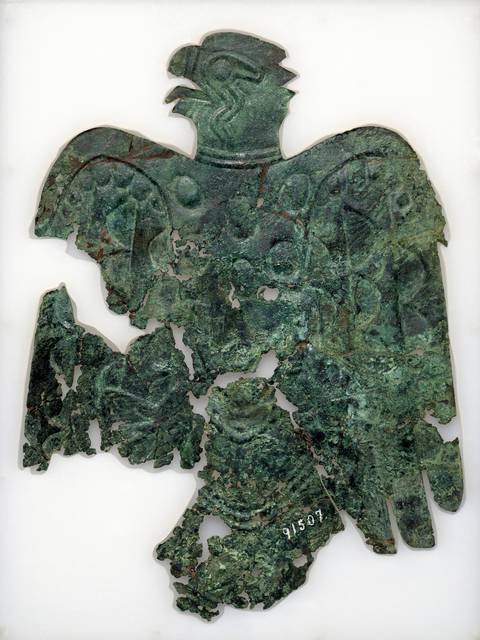
This embossed copper plate depicts a Peregrine Falcon, symbol of the heavens. Recovered from an earthen mound on the shore of the Illinois River in 1859, it would have been displayed during ceremonies by the Native American society that occupied the area around AD 1200. (Photo: Smithsonian’s National Museum of Natural History/Facebook)
Bold. Visionary. A spectacular success.
The words in an online promotion for a new museum exhibit in Washington, D.C., describe an 1830 U.S. law that forced thousands of American Indians from their lands in the South to areas west of the Mississippi River.
Provocative, yes, says the co-curator of the exhibit “Americans” that opened last month at the National Museum of the American Indian. Bold and visionary in imagining a country free of American Indians. A spectacular success in greatly expanding wealth from cotton fields where millions of blacks worked as slaves.
“When you’re in the show, you understand bold and visionary become tongue in cheek,” co-curator Cecile Ganteaume said.
The exhibit that runs through 2022 has opened to good reviews and pushes the national debate over American Indian imagery — including men in headdresses with bows, arrows and tomahawks—and sports teams named the Chiefs, Braves and Blackhawks. The NFL’s Washington Redskins logo on one wall prompts visitors to think about why it’s described both as a unifying force in D.C. and offensive.
The exhibit falls short, some say, with an accompanying website and its characterization of the Indian Removal Act.
The online text is a perplexing way to characterize an effort that spanned multiple presidencies and at one point, consumed one-fifth of the federal budget, said Ben Barnes, second chief of the Shawnee Tribe.
The law led to the deaths of thousands of people who were marched from their homes without full compensation for the value of the land they left behind. And it affected far more tribes than the five highlighted online, he said.
“It made it seem like it was a trivial matter that turned out best for everyone,” he said. “I cannot imagine an exhibit at the newly established African-American museum that talked about how economically wonderful slavery was for the South.”
Ganteaume said the website isn’t encyclopedic and neither it nor the exhibit is meant to dismiss the experiences of American Indians. Instead, it challenges the depths at which people recognize indigenous people are ingrained in America’s identity and learn how it happened, she said.
An opening gallery has hundreds of images of American Indians — often a stoic chief in a Plains-style headdress or a maiden — on alcohol bottles, a sugar bag, motor oil, a missile mounted on the wall and a 1948 Indian Chief motorcycle.
Dozens of clips expand on how the imagery has permeated American culture in television and film.
But when historic or cartoonish images are the only perception people have of what it means to be Native, they can’t imagine American Indians in the modern world, said Julie Reed, a history professor at the University of Tennessee.
“Even when I’m standing in front of students, identified as a Cherokee professor, making the point from Day 1 that I’m still here and other Cherokee people are still here, I still get midterm exams that talk about the complete annihilation of Indian peoples,” she said.
Ganteaume said that while Native people have deep histories in other countries, the United States is more often fixated on using images of them.
Side galleries expand on what’s familiar to most Americans: the Trail of Tears, Pocahontas and the Battle of Little Bighorn. An orientation film on the invention of Thanksgiving starts with a once widely used television screen test featuring an Indian head and then questions the hoopla of the national holiday when America already had Independence Day.
Eden Slone, a graduate student in museum studies in the Washington, D.C., area, said she was impressed by the exhibit’s design and interactive touch tables. She never realized that Tootsie Pop wrappers featured an image of an American Indian in a headdress, holding a bow and arrow.
“I think the exhibition was carried out well and it definitely makes you think of Native American imagery,” she said. “When I see images like that, I’ll think more about where it came from.”
Reed, University of Tennessee professor and Cherokee woman, fears people will get the wrong impression about the Indian Removal Act from the website. An essay puts a positive spin on what Reed calls ethnic cleansing.
Yet, she plans to visit.
“I think there is legitimacy to say, come look at this exhibit. That’s a fair response to criticism,” Reed said. “I want to go and give the exhibit a fair shake because it may be brilliant and could do everything the website does not.”




















