Breaking
Scientists find closest thing yet to Earth-Sun twin system

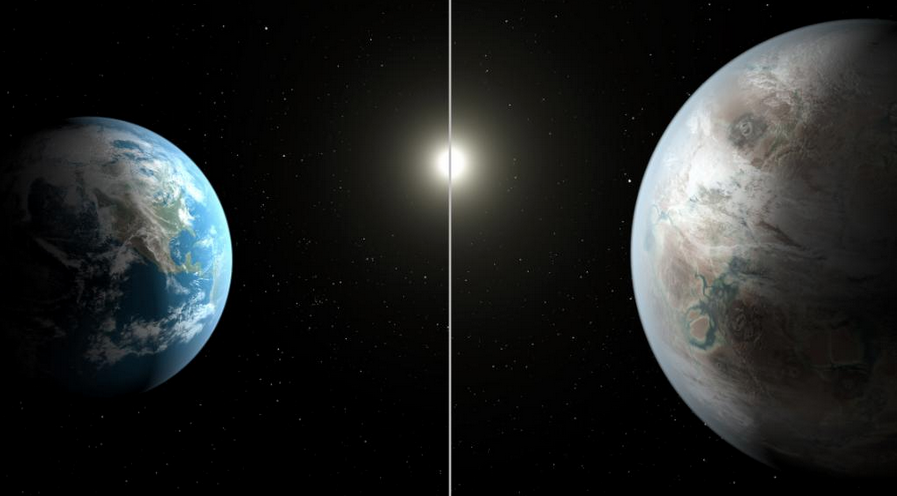
Earth and Kepler-452b side by side (Photo: NASA)
CAPE CANAVERAL, Florida — Scientists have identified a “close cousin” to Earth that’s orbiting a sun-like star and might harbor life.
“It is the closest thing that we have to another place that somebody else might call home,” said Jon Jenkins from NASA’s Ames Research Center in California.
The researchers announced their discovery Thursday based on observations from NASA’s Kepler space telescope.
This older, bigger cousin to Earth is called Kepler-452b. What makes this planet remarkable is that it orbits its star at about the same distance that Earth orbits the sun. What’s more, its home star looks to be similar to our sun. Based on what scientists know today, Jenkins noted it’s the nearest thing to another Earth-sun twin system.
“Today the Earth is a little less lonely because there’s a new kid on the block,” Jenkins said during a news conference. He led the team that discovered Kepler-452b.
The last Kepler discovery that had scientists gushing was just over a year ago. That close-to-Earth-size planet, Kepler-186f, also was in the habitable zone of its star. But that faint dwarf star was unlike our sun.
John Grunsfeld, NASA’s science mission chief, emphasized that the exoplanet system identified Thursday – “a pretty good close cousin to the Earth and our sun” – is the closest so far. “And I really emphasize the `so far.’ ”
The planet-hunting Kepler will keep churning out new discoveries, Grunsfeld noted, and possibly find even better matches for “Earth 2.0.”
Kepler was launched in 2009 and has nearly 5,000 potential exoplanets to its credit – worlds beyond our solar system. It is helping to address such fundamental questions as where do we come from and where are we headed, and arguably the biggest question of all: Are we alone in the universe?
Grunsfeld said thanks to Kepler’s latest finding, we’re taking “one small step in answering that question today.”
While scientists are uncertain whether Planet 452b is rocky like Earth, they believe there’s a better than even chance it is.
As for the age and size, it is about 6 billion years old, 1.5 billion years older than Earth, and 60 percent larger in diameter than our home planet. Its star, Kepler 452, is also older and bigger, as well as brighter than our sun.
If the planet is indeed rocky, geologists believe its mass would be five times that of Earth and its gravity would be twice Earth’s. (That’s right, you would weigh twice as much there.) Its atmosphere would be thicker and have more clouds, and any volcanoes would likely still be active.
Planet 452b takes 385 days to orbit its star, just a little more than Earth takes for a one-year lap. It’s just a bit farther from its star than Earth is from our sun. That’s important because it makes the planet ripe, potentially, for liquid water on the surface. And water could mean life.
The planet is in a solar system that is 1,400 light years from our own, located in the Constellation Cygnus, or swan.
“So pack your bags, it’s a long trip,” joked Jenkins.
Planet 452b is among more than 500 new entries listed in the Kepler team’s latest catalog of exoplanet candidates released Thursday. Kepler identifies potential planets by looking for periodic blips against the brightness of stars – some 150,000 stars to be exact.
Of those 500-plus new potential planets, 12 are less than twice Earth’s diameter and also orbiting in the so-called habitable zone of their star, also known as the just-right Goldilocks zone.
Kepler 452b is the first of those 12 to be confirmed as a true planet, thanks to ground observations.
Altogether, the catalog now includes 4,696 exoplanet candidates.
Slightly more than 1,000 of them – 1,030 – are confirmed to be planets.