Breaking
Local engineered bamboo industry can look forward to better days

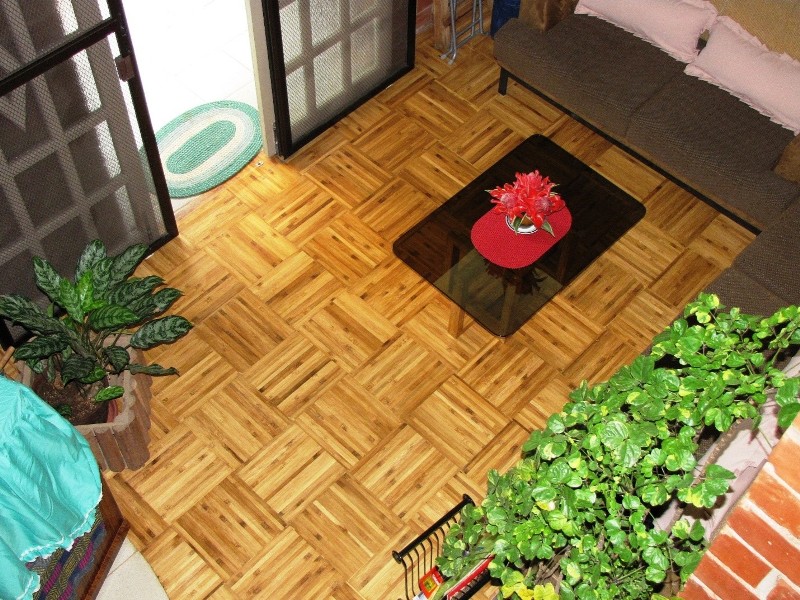
engineered bamboo
The humble bamboo has gone a long way. From being called “the poor man’s timber,” it now graces many high-end homes, hotels and offices around the world, as attractive engineered panels, floors, furniture and handicrafts.
The global market for bamboo products amounts to US$12 billion and much of this is for the engineered bamboo sector.
“We are happy to say that the Philippines now has its own engineered bamboo industry,” says Dr. Romulo T. Aggangan, director of the Department of Science and Technology-Forest Products Research and Development Institute (DOST-FPRDI). “Although still immature and bugged by various problems, it is also blessed with a lot of strengths, and given enough support from concerned groups, can be expected to grow strong, and in time be able to meet the needs of local clients or even capture a slice of the global market.”
According to Dr. Rico J. Cabangon, also of FPRDI, “Engineered bamboo includes a wide range of products made by binding together bamboo veneers, strands, fibers, strips or slats, woven mats or flattened bamboo with a suitable glue to form a composite material designed to meet specific needs. It is often stronger and less prone to warping than equivalent solid woods.”
In the Philippines, there are about 10 companies making engineered bamboo products. Most of them are small-scale enterprises producing items on a per order basis. The most common species they use are kawayan tinik (Bambusa blumeana), giant bamboo (Dendrocalamus asper), bolo (Gigantochloa levis), botong (D. latiforus) and bayog (B. merrilliana).
These are not easy days for the young industry. It does not have enough supply of bamboo poles, the quality of poles is low, and the price high. Plus, glues are expensive and producers do not have the means to buy high-capacity machines.
“Fortunately,” discloses Dr. Cabangon, “these weaknesses are offset by a lot of plus points. For instance, there is at present a huge national demand for engineered bamboo. Since 2010, it has been mandated by law that 25% of all school desks and furniture in the country’s public schools should be made of engineered bamboo.”
To meet the projected annual demand of 312,000 school desks and other saleable products such as panels, flooring, decors and high-end furniture, about 10,000 hectares of plantations must be established using the right bamboo species.
“Good thing there are government projects that push for the development of plantations,” reports Dr. Cabangon. “These include those of the DENR and the National Greening Program which lists bamboo as a priority reforestation species.
“Likewise, we also have R&D agencies which are studying advanced methods of mass producing bamboo planting materials and checking if some lesser-used species may also be fit as raw materials.”
Dr. Cabangon lists the other strengths of the local engineered bamboo industry: availability of cheaper yet effective glues in the market, availability of labor force, as well as several groups, both private and public, which are ready to help the industry in various ways – from standardizing product quality, manpower training, machine design and fabrication, R&D, and financing.
In machine design and fabrication, for instance, FPRDI has developed the bamboo flattening machine and the bamboo veneer lathe specifically for the engineered bamboo producers. “It is important that all the industry’s strengths are tapped,” he adds, “considering that the world market for engineered bamboo can reach US$20 billion by 2020.”
One of the biggest boosts to the sector was the creation in 2010 of the Philippine Bamboo Industry Development Council thru Executive Order 879. Tasked to provide policy and program directions, it is expected to push for robust and sustainable bamboo enterprises nationwide, with the help of both government and private groups.
“In the end,” concludes Aggangan, “the strength of the country’s engineered bamboo sector is in people. The policy-makers, researchers, foresters, trainers, machine engineers, product designers, artisans, plantation owners and farmers, and bamboo enthusiasts who see the industry’s potential and are willing to give it the necessary push.”
To know more about engineered bamboo and other FPRDI technologies, contact FPRDI at (+6349)536-2586/ 536-2360/536-2377. You may also visit FPRDI’s booth at the National Science and Technology Week celebration at the SMX Convention Center, Mall of Asia Complex, Pasay City on July 24-28, 2015 for other technologies. Admission is free. For more information, go to www.nstw.dost.gov.ph or like us on Facebook at nstw2015