
Business and Economy
Chinese stocks vs. reality: Shares are untethered to economy

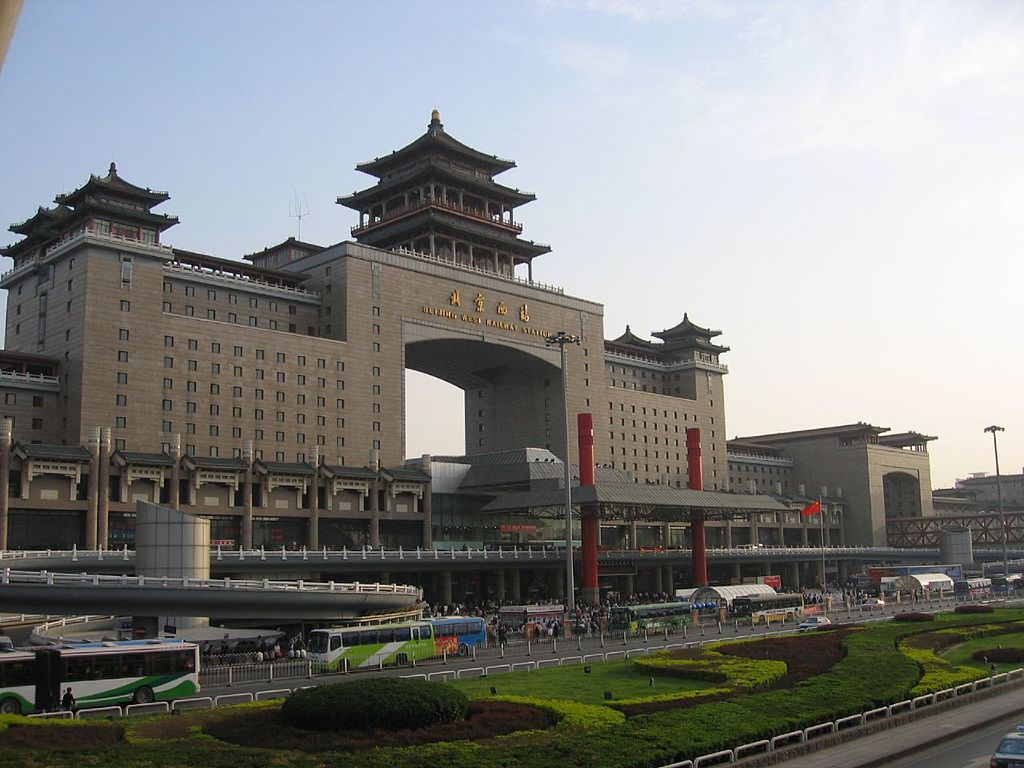
Beijing West Train Station China. Kim S / Wikipedia photo
WASHINGTON (AP) — There’s economic reality. Then there’s the Chinese stock market.
The two usually occupy parallel universes.
When China’s economy was roaring along at double digit rates in the 2000s, Chinese stocks floundered. But starting in the summer of 2014, as evidence of an economic slowdown gathered, the Shanghai Composite index climbed nearly 150 percent.
“The stock market has never been fully aligned with the fundamentals,” says Yukon Huang, senior associate at the Carnegie Asia Program in Washington.
Now the Chinese stock bubble has burst and Shanghai shares are in a free fall. They’ve lost about 30 percent since peaking last month. But economists don’t expect the market meltdown to do much damage to the real economy.
“We don’t see it as a major macroeconomic issue,” Olivier Blanchard, the International Monetary Fund’s research chief, told reporters Thursday.
The IMF expects the Chinese economy to grow 6.8 percent this year, unchanged from the forecast it made in April, before the market meltdown.
Prices in the stock market are supposed to reflect business realities: the health of the economy, the quality of the companies listed on stock exchanges, the comparative allure of alternative investments.
But in a communist country where the government plays an oversized role in the economy, investors pay more attention to signals coming from policymakers in Beijing than to earnings reports, management shake-ups and new product announcements.
During the booming 2000s, only politically connected firms were allowed to list on stock exchanges for the most part. Many of them were run by insiders of dubious managerial talent.
The markets were dominated by inefficient state-owned companies.
Investors were especially wary of investing in big government banks believed to be sinking under the weight of bad loans. Stocks went nowhere.
The Chinese government is now trying to manage an economic transition away from an overreliance on exports and over-investment in things like real estate and factories. The old way left the country with too many vacant houses, idle factories and corporate debt. The government wants to nudge the economy toward slower but steadier growth based on spending by Chinese consumers.
Talking up the stock market became part of the plan. As China’s real estate market cooled, Chinese with money to spare could invest in stocks instead. If their portfolios grew, they’d feel wealthier and more willing to spend. Chinese companies could issue shares of stock and use the proceeds to pay down debt.
So state media began encouraging Chinese to buy stock, even as the country’s economic outlook dimmed. The economy grew 7.4 percent last year, the slowest pace since 1990. It’s expected to decelerate further this year.
But authorities allowed investors to borrow to buy ever-more shares. Unsophisticated investors – more than a third left school at the junior high level – got the message and bought enthusiastically, taking Chinese stocks to dangerous heights.
Now it’s all crashing down.
Analysts say the economy is unlikely to take a big hit. The IMF’s Blanchard says most Chinese investors didn’t spend their paper gains as stocks rose, so they shouldn’t have to curb spending now. Carnegie’s Huang notes that most investors are still ahead: Despite the recent drop, Shanghai stocks are still up more than 80 percent over the past year. And the Chinese stock market is small compared to the overall economy, the world’s second biggest.
More damage has been done to the credibility of government policymakers who talked up stocks only to see them crumble. Now they are desperately trying to control the damage – suspending trading in hundreds of stocks, for instance, and barring major shareholders from selling their stakes.
“It’s pretty safe to say that Beijing’s appreciation of how hard it is to control equity prices is much greater today than it was a month ago,” says Daniel Rosen, partner at the Rhodium Group consultancy.




















