
Travel
Atlantic City betting big on non-gambling attractions

Wikipedia Photo
ATLANTIC CITY, N.J. (AP) — Atlantic City’s efforts to recapture some of the tourism dollars it has lost to casino competition in recent years finally appear to be working.
Nine years ago, the city’s casinos started realizing they needed to offer more than just gambling if they still wanted visitors. They doubled down on expensive investments like additional hotel towers, restaurants, swimming pools, spas, shopping, nightclubs and concert venues.
Now, cash sales at non-gambling outlets within casinos represent 28.5 percent of revenue, up from 22.3 percent two years ago, and bars have increased their payrolls by nearly 39 percent in the past two years, according to a recent study conducted by the consulting firm Tourism Economics and commissioned by the Atlantic City Alliance, which promotes the resort to other parts of the country. The study didn’t address profits, but many casinos have reported upturns in profits after adding extras.
“I’m not really a gambler,” said Brandon Ferguson, of Oaklyn, New Jersey. “I don’t like to give my money away; I like it to work for me. I like to chill on the beach, enjoy some good food, do some sightseeing and people-watching.”
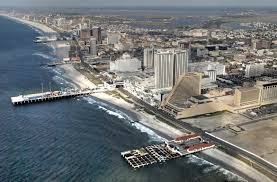
He was one of many who turned out in late June for the opening of The Playground, Philadelphia developer Bart Blatstein’s $52 million remake of the former Pier Shops complex into a music-themed entertainment facility. Blatstein said casinos alone have become boring.
“Would you go see the same movie over and over again?” Blatstein asked. “That’s what’s happening here. Atlantic City needs something else besides gambling.”
For nearly 30 years, Atlantic City’s casinos drove busloads of people to their doors, let them play the slot machines or table games for a few hours, and sent them home. It worked fine – until other casinos started popping up nearby, and suddenly people could drive 20 minutes to play the same slot machines and table games that otherwise would be a three- or four-hour round trip.
“All we really needed was gaming,” said Tony Rodio, president of the Tropicana casino and a longtime Atlantic City casino executive. “We were the convenience option for the entire Northeast. We had more demand than we had supply. We didn’t need conventions.”
Now, he said, his casino and the city are both staking a good portion of their futures on offering more than gambling. If revenue from third-party businesses that lease space at attractions like The Quarter, the Tropicana’s Latin-themed dining and shopping complex, are included, Rodio said, his casino’s gambling and non-gambling revenues would probably be close to even.
Atlantic City has plenty of company in banking on non-gambling attractions as a way to reinvent itself, among them Las Vegas and tribal casinos. But Atlantic City had far to fall and, some observers say, waited too long to shift its strategy.
Even with the extras, the city’s casino revenue continues to plunge, from its high of $5.2 billion in 2006 to $2.74 billion last year, as competition from casinos in neighboring states continued unabated. Four of the city’s 12 casinos closed last year. The remaining gambling halls – and the city itself – need to replace that money.
A poll released in June by Fairleigh Dickinson University found that non-gambling attractions are the most important factor for most New Jerseyans in choosing a casino to visit; 40 percent listed it as their main priority.
Also in June, the Borgata casino opened a $3.5 million outdoor concert center that can hold 5,000 fans with a show by The Hooters, Southside Johnny and The Asbury Jukes, and G. Love & Special Sauce. In April, Bass Pro Shops opened a $15 million superstore. In August, Caesars Entertainment will open its $126 million conference center to grab a bigger piece of the Northeast meetings trade.
Non-gambling attractions are not the only reason some casinos are doing better. The elimination of a third of Atlantic City’s casinos last year reduced competition and increased market share for the eight survivors. But casino executives say the extras are helping.
The Tropicana spent $50 million on renovations this year, including a huge outdoor video display, on top of $25 million in 2012. When billionaire investor Carl Icahn bought the casino out of bankruptcy in 2010, it posted an operating loss of nearly $4 million. In 2014, that had swung to a $59.8 million profit.
Resorts Casino Hotel spent $35 million on its Jimmy Buffett-themed Margaritaville dining and entertainment complex in 2013, a year in which it lost $12.2 million. But a year later, Resorts posted a $2.5 million profit, and it has since spent another $9.4 million to expand its meeting space.
When the Borgata opened its $400 million Water Club non-casino hotel in 2008 it had a profit of nearly $61 million. By 2014, with another $50 million room renovation completed, its profit had swelled to $158 million, although a favorable tax court ruling helped that figure.




















