News
DSWD opposes “anti-poor” provision under tax reform package

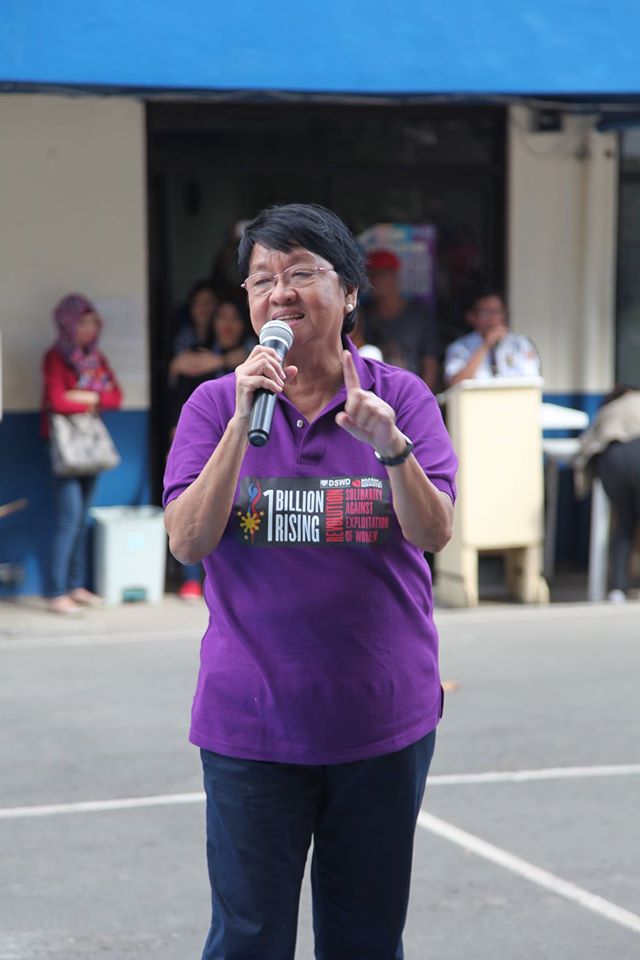
“While it is understood that the tax reform package aims to fund the President’s (Rodrigo R. Duterte) 10-point socioeconomic agenda and massive infrastructure plan, there are included proposals that are likely to be inimical to the poor,” said DSWD Secretary Judy Taguiwalo in a statement. (Photo: Department of Social Welfare and Development/ Facebook)
MANILA— The Department of Social Welfare and Development (DSWD) on Tuesday pointed out certain “anti-poor” proposals under the tax reform package of the Department of Finance (DOF) under House Bill No. 4774.
“While it is understood that the tax reform package aims to fund the President’s (Rodrigo R. Duterte) 10-point socioeconomic agenda and massive infrastructure plan, there are included proposals that are likely to be inimical to the poor,” said DSWD Secretary Judy Taguiwalo in a statement.
Taguiwalo said the DSWD has reservations concerning two major items in the tax reform package believing that such will likely result in the increase in prices of consumer goods, food, services, and transportation, among others.
These major items include:
1) the proposal to expand the VAT on the sale of services and use or lease of properties; and
2) the imposition of the higher excise tax on oil and gasoline products.
“We also register our disapproval of the planned one-year unconditional cash transfer as cushion to the commodity and public utility price increases brought about by the two general tax increases,” she said.
HBN 4774 proposes to expand coverage of the value-added tax (VAT) for sale or exchange of services particularly on sales by CDA-registered agricultural cooperatives, credit or multi-purpose cooperatives, and non-agricultural, non-electric, and non-credit cooperatives.
It also removed exemptions on the sale of real properties utilized for low-cost and socialized housing and lease of a residential unit with a monthly rental not exceeding Php10,000.
The bill included money remittance centers that should remit 12 percent VAT.
“On the money remittance centers’ VAT, we ask: What is the proponents’ definition of “money remittance centers”? Would it include our Pantawid Pamilyang Pilipino Program bank conduits? If so, who do they pass the tax burden to: the DSWD or the Pantawid beneficiaries?,” she asked.
Taguiwalo added that DSWD’s Sustainable Livelihood Program (SLP) and Kalahi-CIDSS seek to empower the poor and marginalized through community organizing.
She said the proposed tax package may discourage stakeholders from creating cooperatives that can actually empower the beneficiaries of the said programs.
“We also wish to point out that cooperatives play a large role in the social and economic lives of rural Filipinos. We hope that government would not remove whatever relief they have from existing VAT laws,” she said.
Based on Philippine Statistics Authority (PSA) data, one in five Filipinos were considered poor in 2015.
On the family level, 16.5 percent of Filipino families, or 3.8 million families, were poor.
This means that these families have an average monthly income below P9,100.
Sixty percent of their income goes to food expenditures. Twelve percent of income goes to utilities and transportation combined. In the end, they have very little, no savings, or even negative savings (for the first decile).
Taguiwalo explained that in analyzing and offering its comments to the tax reform package under HBN 4774, the DSWD used its decades of experience of working with the poor, marginalized, and the vulnerable sectors of society to identify why portion of the tax reform bill is not pro-poor at all.
She assured they welcomed the initiative of the House of Representatives to reform the current Philippine tax structure, saying it is an opportunity to review and revise the country’s outdated tax laws.
“It has to be said that our country has the second highest personal income tax in the whole ASEAN, and it constricts economic activity and growth. Our economic managers are well aware of this,” she said.
Upon implementation, the DOF expects its proposal to result in revenues that will enable the administration to fund the priority infrastructure, education, health and social protection programs of the government. Among many alternatives of revenue generation, through heightened household economic activity and consumption to efficient tax collection system, the DOF conveniently chose to propose an increase in excise tax of oil and gasoline products and expansion of the value-added tax base.